 Edwin Arthur Cade, was born, in Ipswich, on 26th July 1856, at the new residence at 7 Orwell Place in the parish of St Clements, Ipswich, the eighth, and last, child of Robert Cade II and Maria (Underwood). His father had been a watchmaker from as early as the date of his marriage in London in 1842, and he is so described in directories until 1857. But, in 1859, he is listed as a photographer, which business they both continued together until the new work became sufficiently strong for the old to be abandoned.
He married, on 20th November 1883, Sarah Elizabeth, the daughter John Smith II, a London merchant with West African interests; in 1892, his father in law brought him into partnership with him and the company was renamed Smith and Cade.
They had five children: Ethel Della (1884), Gladys Mary (1886), Arthur Gordon (Jim, 1891), Cecil Ewart (Bobbie, 1899) and Theo Daphne (1903)
But the Gold Coast venture which made his career, also ended his life. In May 1903, in the Offin river village of Dominassi, Edwin Arthur Cade died, at the age of forty-six, from dengue fever; his death occurred three weeks before the birth of his youngest daughter. He is buried in the European cemetery at Obuassi.
In May, 1903, a hundred years after his death, the hospital in Obuassi was renamed the Edwin Cade Memorial Hospital.
Manuscript Examples
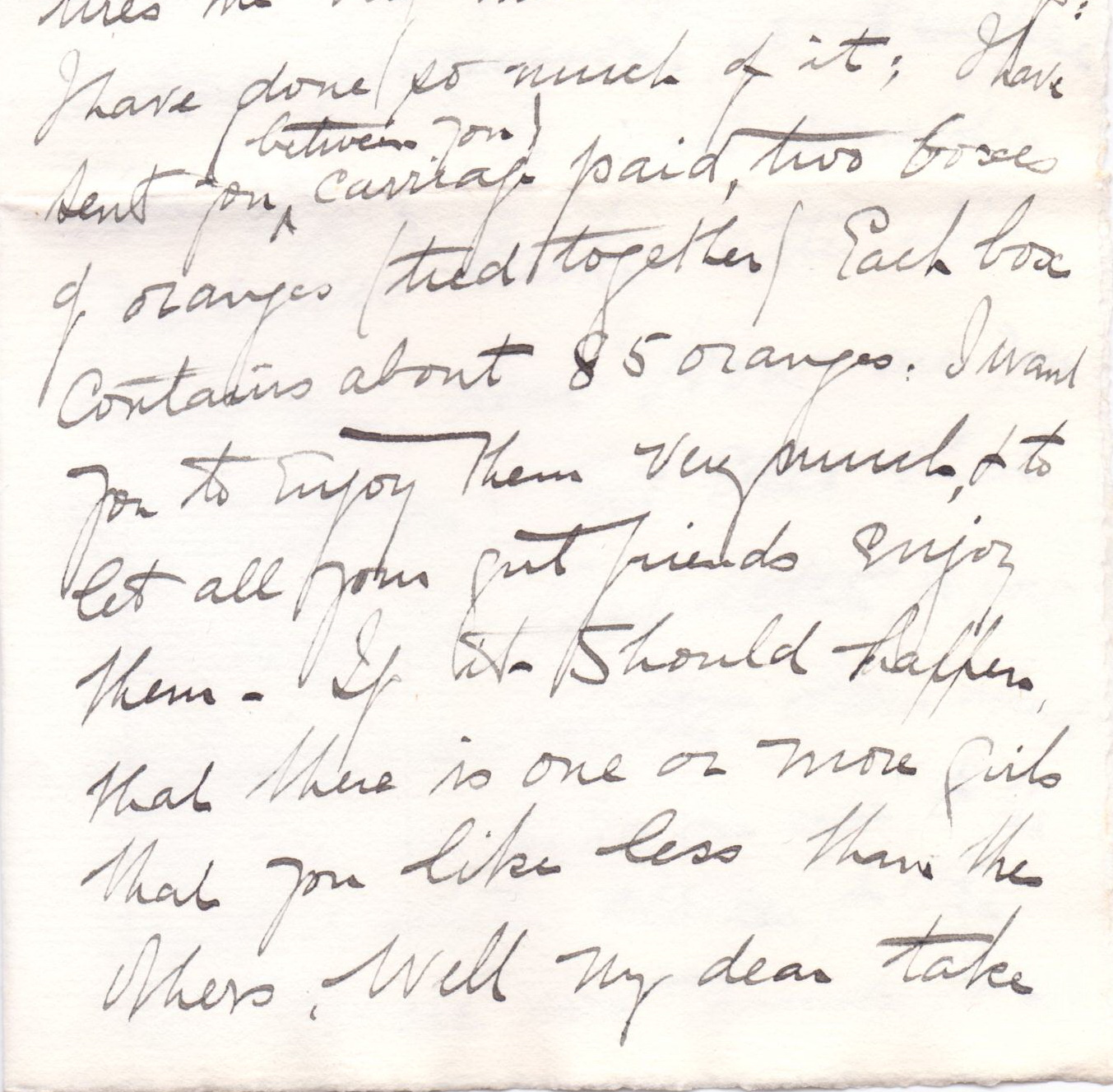
Handwriting May 29th 1902
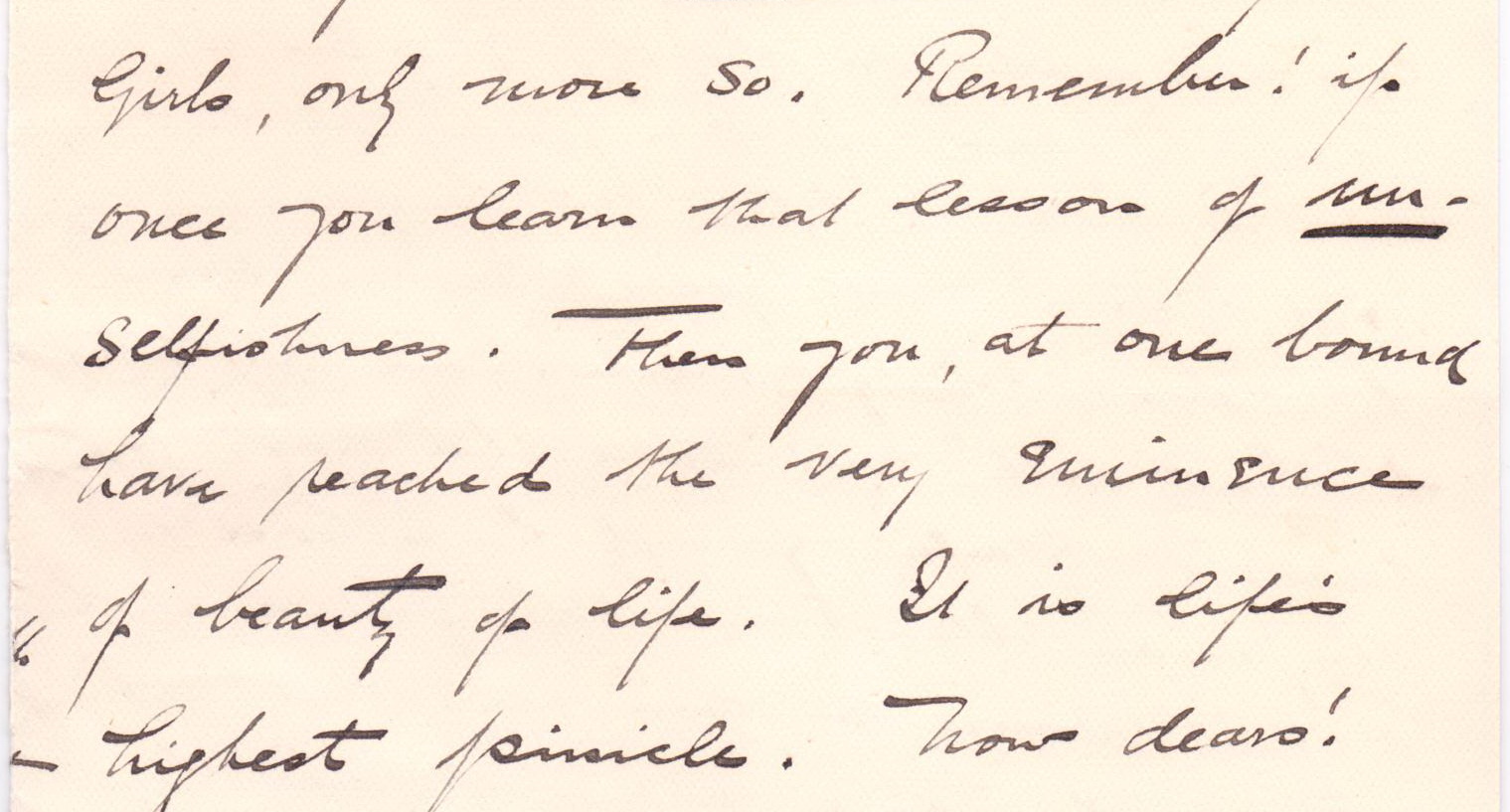
Handwriting Nov 13 1901
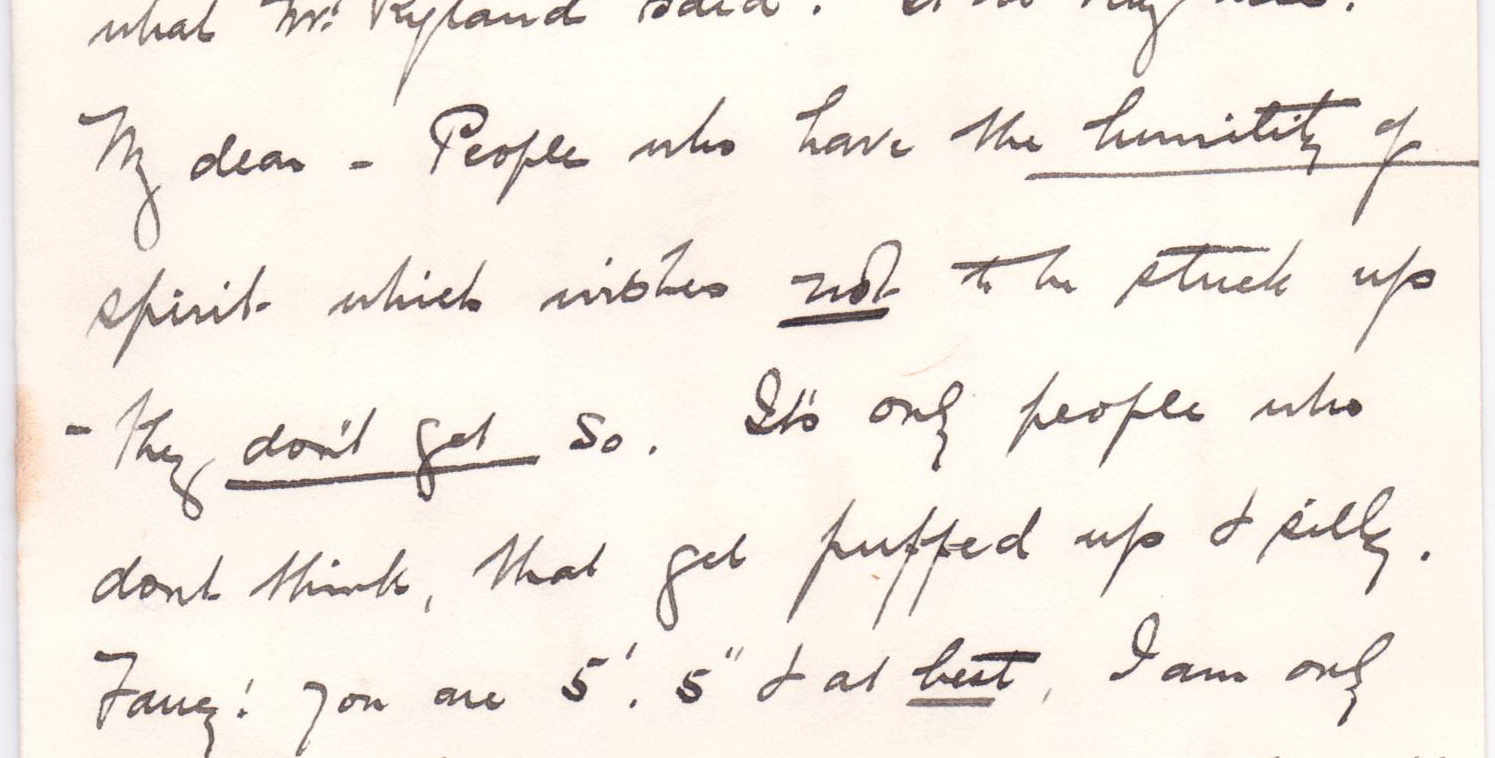
Handwriting Nov 24 1901
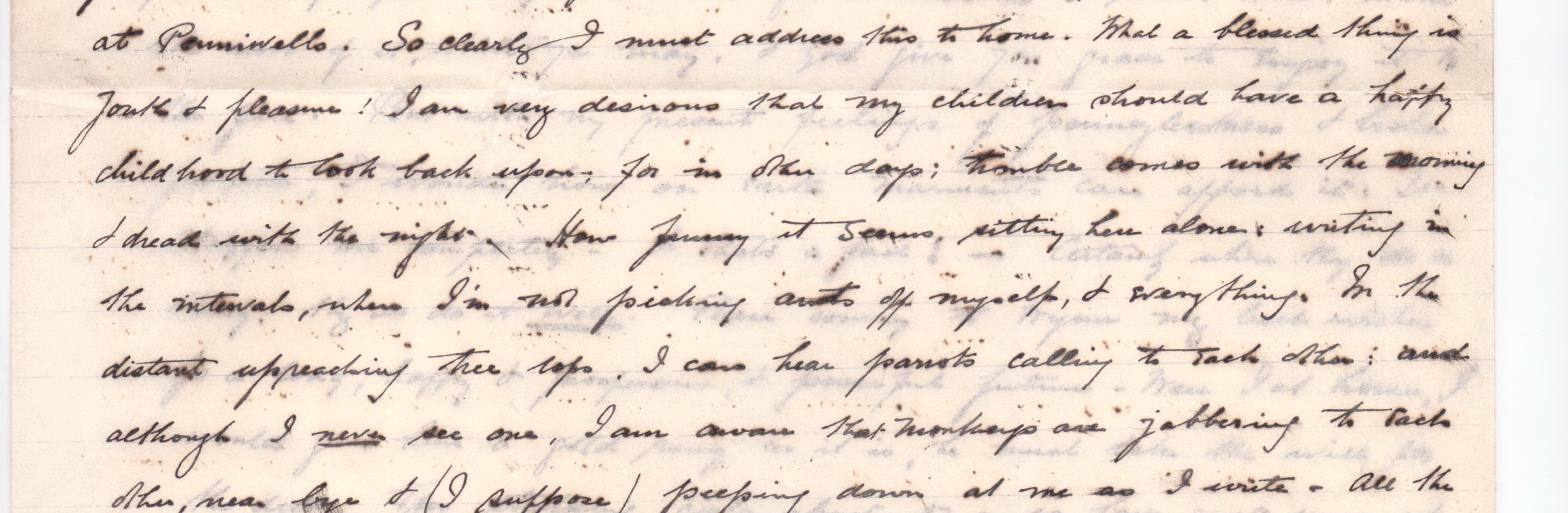
EAC March 15 1903
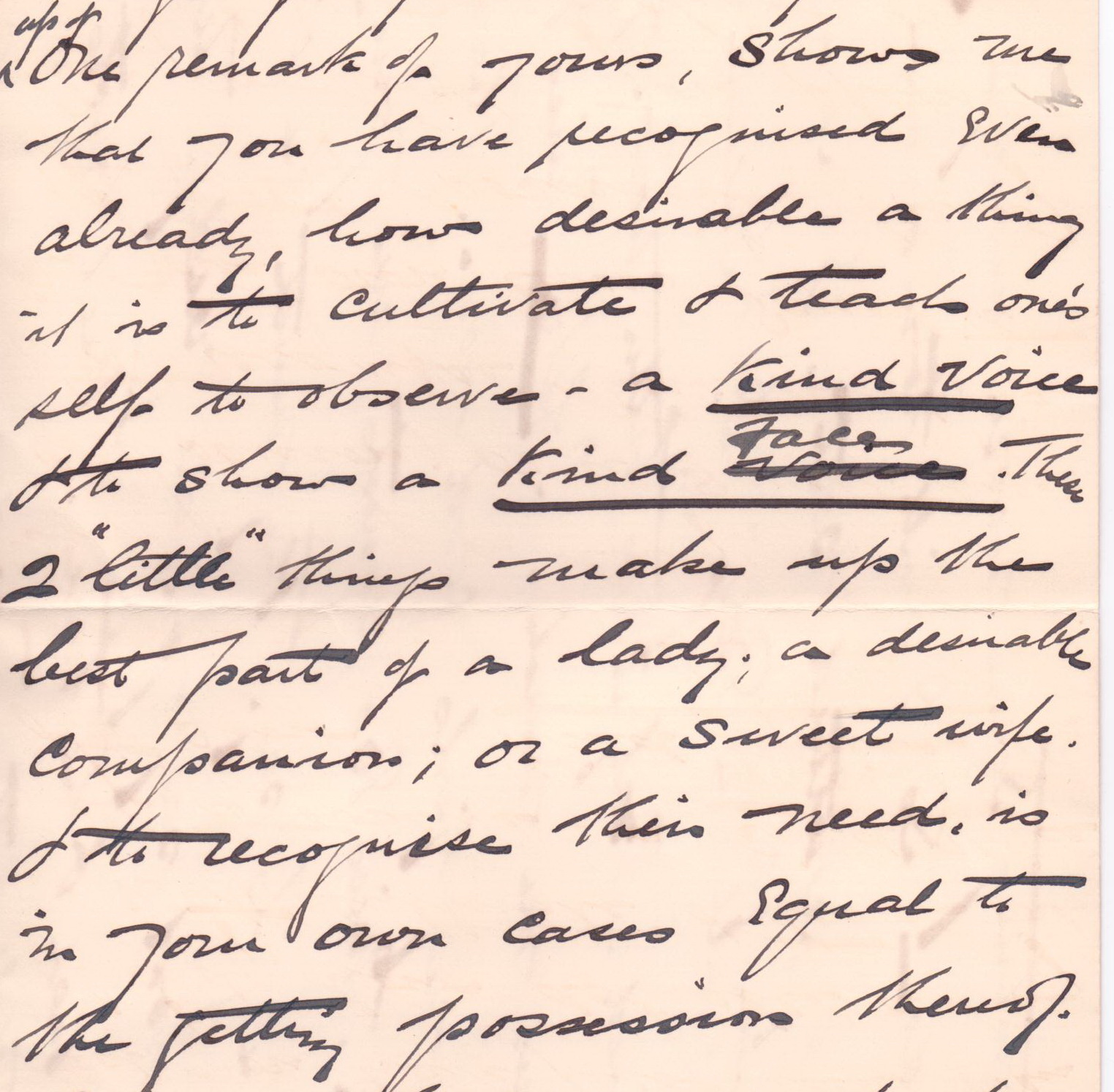
Handwriting 8 October 1901
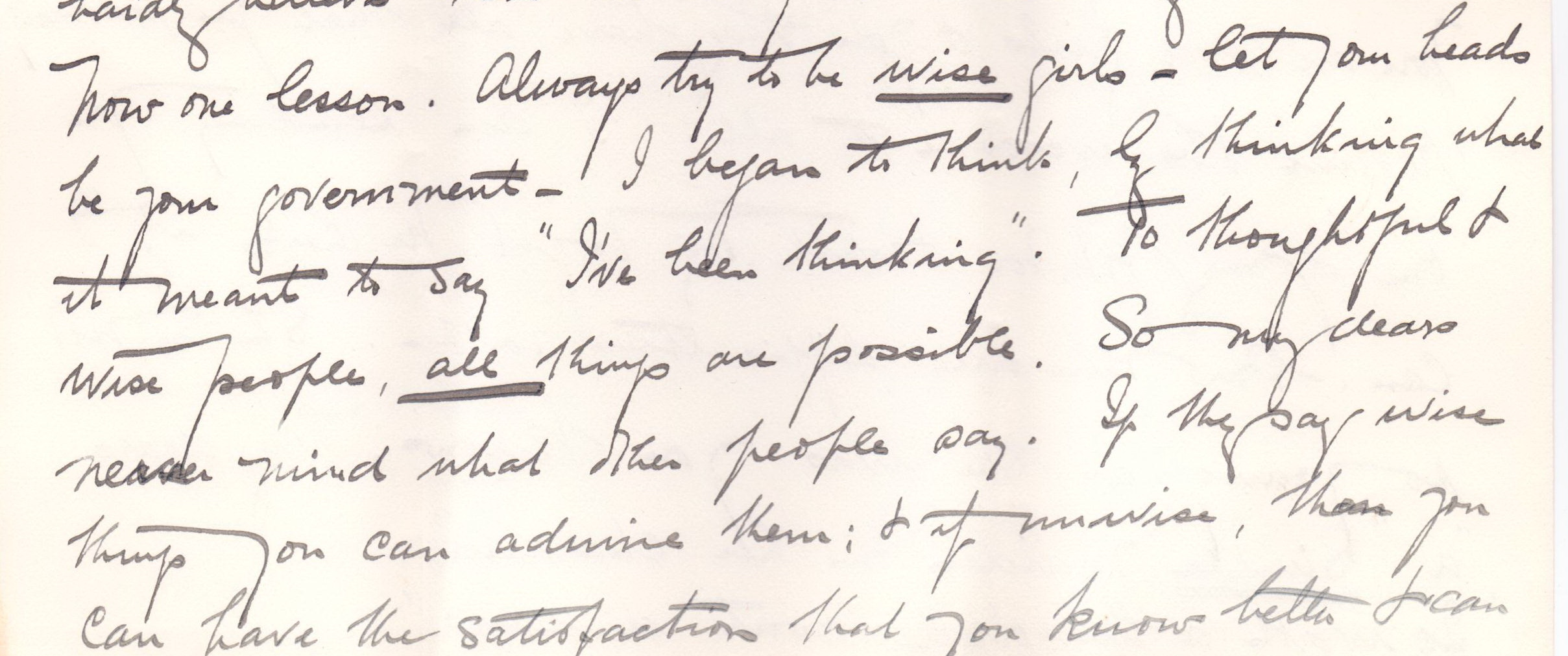
Handwriting 23 October 1901
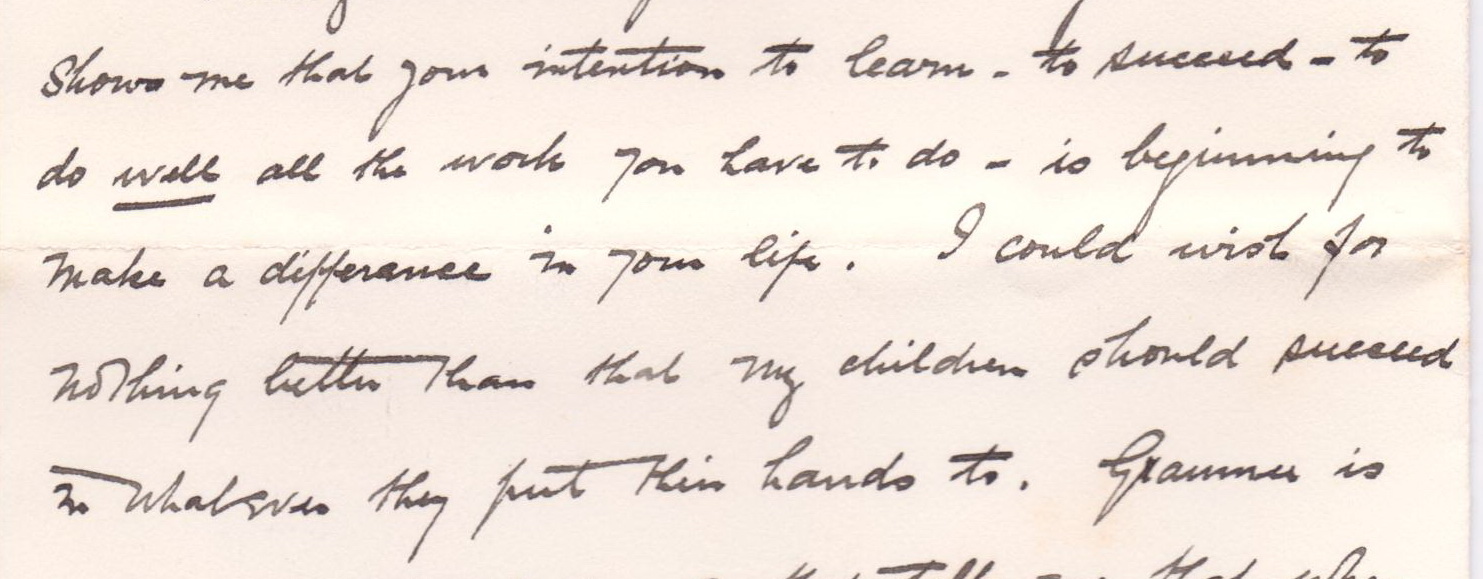
Handwriting 24 November 1901 Gladys
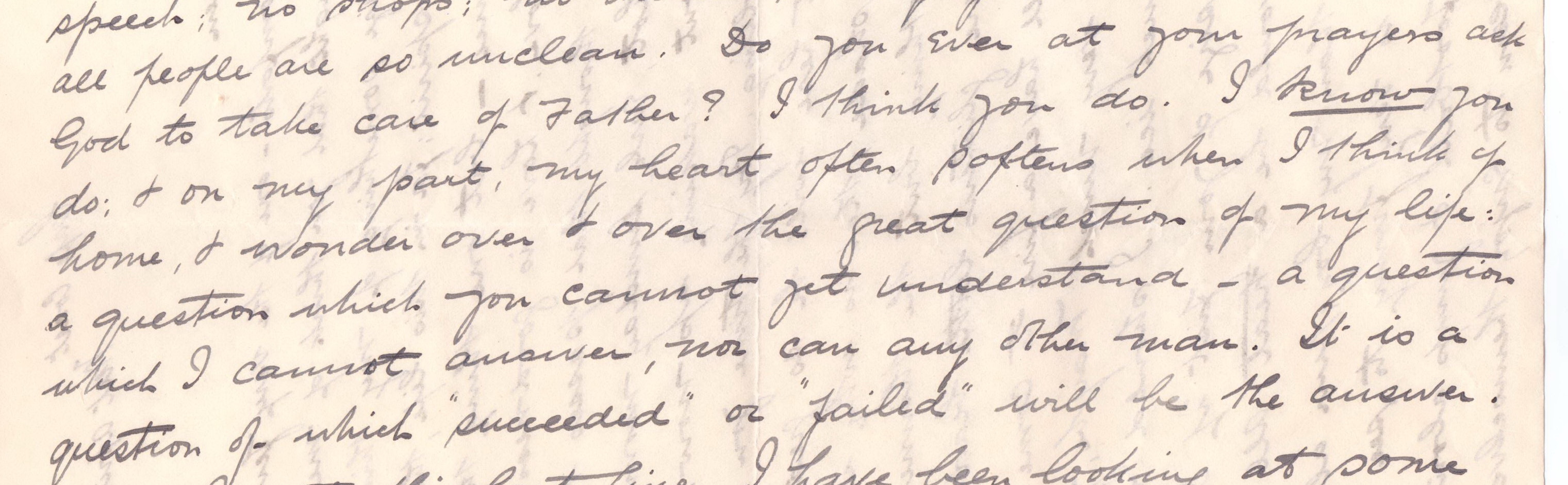
Handwriting EAC December 97
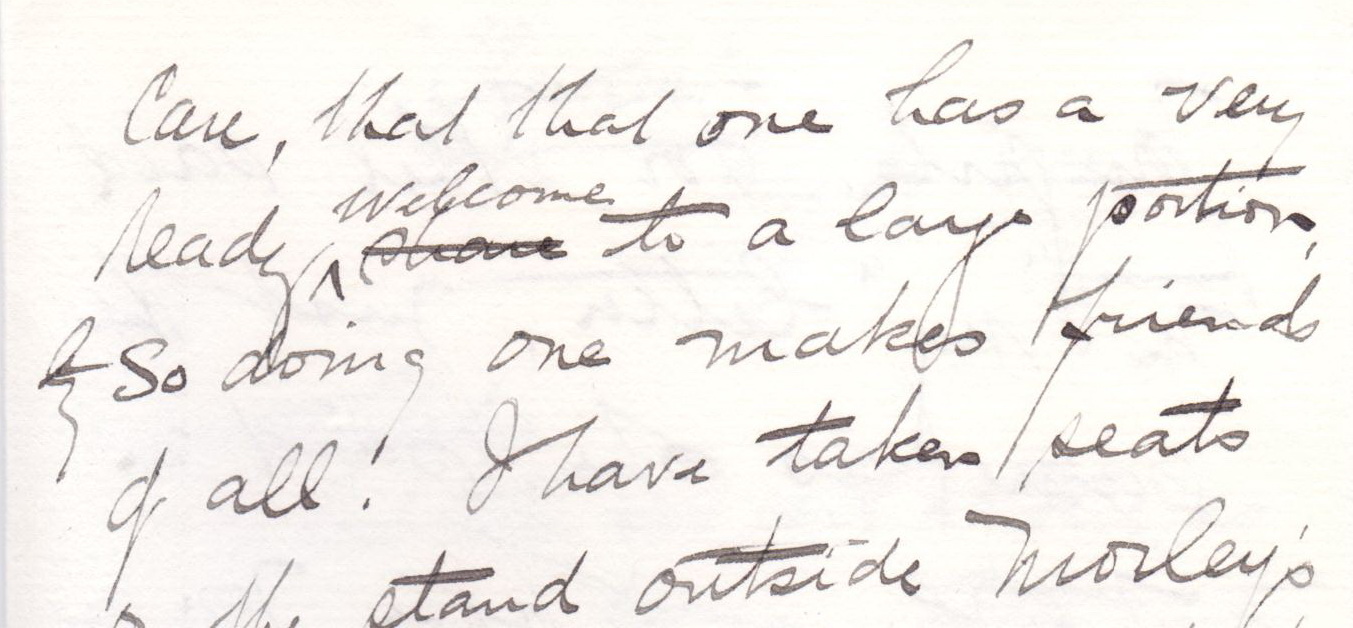
Handwriting May 29th 1902
Letters Home To Ethel & Gladys
SMITH & CADE
2 Aldermanbury Postern, EC
September 4 1894
My little ones.
I was very pleased to have Ethel’s nice letter and to hear that you have been to ‘Hog Island’. Did you see that old tree where the black bogies live? When I was a boy, we used to dare each other, to go inside and when we got in – the tree, I mean – the bogies just hummed a kind of burr-r-r, and we got out then and ran. When it was night, an old owl used to fly out of it like this Ooooooooooooo. I mean she used to fly round, and round and her wings never made a sound, and now and then she’d see a mouse and, in the dark, swoop on it and eat it.
Do you see the monsel? That red place is where the owl’s claws went in and let the juice out. The reason why the owl looks so much like a line, is because it was dark and one couldn’t see what way it waggled. The funniest thing about that place, however, was another tree; the one that was nearest to you. When that tree used to hear the last steamer from London blow its whistle, because it was stuck fast in the river mud (and they do, now and again), then that ole tree would dance and caper about, as though it was ever so glad and gone mad with glee. The last time I shan’t forget – after it had been running all over the field, it stood on its head. It was funny to climb up a tree but getting down. But there! Wonders never cease.
Good night, my dears! Papa
CAPE COAST, WEST AFRICA, 12/12/97
My very dear Children
One of the comforts – one of the very few comforts of my present life – is the thought that you think of me with love. I hope your minds can realize something of my thinking of you; in that same blessed spirit, for in this life, there is but one thing of supreme importance – but one thing that never dies, or can die; and that is Love, and Love is goodness and God is Love.
This is the kind of thought that passes through my head this wonderfully hot, early Sunday morning. You folk at home are just about waking up now; but I can hear the church bell tolling. By the time you go to chapel this morning, the heat here will be so great that no one can be out of the shade, that is why we are so early. As I sit, I have nothing but the thinnest of clothing and yet all over me there glistens little beads of perspiration, and you – why you will have a fire to come down to, and will perhaps need it very much.
Maybe, you have ice, a great deal too much ice. I should like just a little piece, about the size of your fist, if I couldn’t get any more. It would be a treat. All the boys and girls – who are no older than my boy, run about naked here, quite naked, and it is very funny to see these naked boys play cricket and football and jump about on the parallel bars, but they seem to enjoy themselves about as much as any boys can.
I am afraid they are very cruel little people, and don’t care what pain they give to live things; as long as they themselves do not suffer. One little boy was bathing here last week, and a lot of people were near him. But a big wave – our waves are ten times as big as the biggest wave you ever saw – knocked him down, and the others actually let him drown under their very noses, rather than get wet. The cowardly people did not seem to mind a bit; and that little boy was only ten.
I am afraid I cannot write you much of a letter, everything here is so disturbing; no quiet place, no private place: it is all open to everybody, and the place actually rocks as anyone passes bye.
I have bought some ivory bracelets off the arms of a native of Liberia; and will hope to bring them home some day. I have also bought a native cloth – a big one – for Mother to use as a curtain if she likes. I have tried to buy something that you boys and girls would like, but there is nothing at all here that would have any interest for you. Except oranges ñ lovely, sweet, delicious, green oranges – but those I could not get home over the thousands of miles of sea that stretch away between you and me.
I cannot think of anything else that is nice here. I can hardly think of anything that is even passable. All the world seems so strange and comfortless. So lonely and, often, so difficult and hopeless. Fancy living in a town without a single chimney to be seen. Where one drinks rain water – where horrid vultures live and are a necessity. Where all the people are black and talk a strange and unmusical speech; no shops; no drains; very few windows and where all the people are so unclean.
Do you ever, at your prayers, ask God to take care of Father? I think you do. I know you do; and on my part, my heart often softens when I think of home and wonder over and over the great question of my life: a question which you cannot yet understand – a question which I cannot answer, nor can any other man. It is a question of which ‘succeeded’ or ‘failed’ will be the answer.
Since I wrote this last line, I have been looking at some gold dust, which is very find indeed; so fine indeed that it seems to have scattered over everything. I don’t know whether you will find it there, but those words which I have underlined look quite yellow with gold dust under my glass.
There is just one thing which is nice here which I had overlooked – pineapples. They are just delicious, and if only I could get you some for home, I would gladly do so, but I cannot. Long before this, they would all be spoiled. While you have been at chapel, I have been having my breakfast and thinking of you. Mother tells me you have been good, and that comforts me. So Gordon has been hanging his Turks – what a boy he is to be sure. I hope he won’t ever try it on himself, for that would never do.
I suppose you are all thinking about Xmas. I wonder where you will go; and what you will get: I shall think much about you all, as you will think of me. I’ve got my plum pudding safe, and shall eat it with rare relish I think – on our mines. And now, my dears, goodbye once more – what big, little folk you will seem to me by the time that I get home once more.
With all my heart goodbye and never let us forget that one word, Love
Your affectionate Father
SMITH & CADE
151-153 Dashwood House
New Broad St
23 March 1899
My dearest Ethel
I suppose it is good business always to look after the ‘needful’, and you had better take your week’s money out of the cash which I gave you on Monday.
Glad to hear Auntie sent you the book by Dean Farrar – if you look on the title page, I think you will find his name does not end with a ‘w’ as you spelt it.
Put up with the want of bread and butter my dear, it is only for a little while longer.
I have been sending Holmes all over the place lately, to try and find up that donkey. I want to get a good one while we are about it, and perhaps you will see it sometime next week, but I’m not sure.
My love dearest Ethel, Father
THE GREEN, Southgate
My dearest Girls
Tomorrow is your examinations – be calm – be confidant. We are assured that you both have done, and will do, your best; and whatever the result is, we shall be satisfied. Gladysí letter is a great improvement.
Your loving Father
6 SOUTHAMPTON STREET, HOLBORN
Sept 19 1901
My dear Girls
Your letters, my dears, were welcome. So they will always be, let us never forget that. I could not help smiling at poor Mother as she read them. Her lips went out, her face reddened, and when she spoke, ‘it was such hard lines to loose ones sweets’, but I knew my girls didn’t really mind. They meant to be loyal to the rules of the school, and that, as soon as the rough edges of strangeness wore off a bit, that all would be well and satisfactory. Of course, we all of us know how horrid it is to give up our old ways, and our old pleasures, and have to grind away at work; but where Duty calls – or danger, we are never wanting.
Isn’t that so girls? So, I am sure will it with you. Grandpa is bringing his carriage to Bexhill on Tuesday or Wednesday. Ethel’s photos are splendid – beautiful – Mother will bring them. We’ll have Gladys taken the very first chance. Now good bye my dears, don’t forget your letters will always be welcome
Yours affectionately
Father
ASHANTI GOLDFIELDS CORPORATION
October 1st 1901
My dearest Ethel
Your poor old Father, knows so well what it is to be lonely. It’s always sad, and sad to everybody. But dear, don’t let it overcome us. Doubtless you sometimes think how wretched it is for us at home – with all the children gone – why, bless my heart, I could cry. But then love, I must not. Duty and work, and self government and self reliance; and self support, are the bread of our souls, and of our moral natures, and they have to be striven for, and won, in the same way as the bread we eat has to be (by someone).
So my love, let us be brave, and dare to be a Daniel, and dare to stand alone. You will have gathered from my letter why I did not come. Today has been a great rush and I’m staying very late in order to write this to you, my sweet seventeen. Bless me! How I’ve longed to have a daughter just about 17. To get a hold of my arm, and to go about a shopping. I wanted such a girl to be all my very own.
I guess I’d overlooked the fact of being old and staggery. But that can’t be helped either, so we must put up with it. Ninnie looked like an angel! Exactly, just out of the blue. Poor girl! That is hard to bear. Fancy! Not one taste of food all this time. She is almost transparent. Cheer up my dear girl. Cheer up! Make the others enjoy their school, and, as sure as ever you try to cheer others, your own heart shall be lifted up by the love of God himself.
Your affectionate Father
Edwin A Cade
Oct 4
My darling Girls
I am obliged to go back today – I am so sorry to disappoint you, but have left the tickets with Auntie, and my birthday presents to you both. Accept them with very much love. Your birthday cake will arrive on Saturday, and you can take it to school with you. Father says he ‘has been left to his own resources all this dreadful summer and is now without children, home, wife or anyone to care what becomes of him here or hereafter’ – you know whether this is true – but of course I must go.
The Southgate house is dismantled, things are to be stored but where we are going I don’t know. Auntie will call for you tomorrow – and try and be happy, to please.
Your loving Mother
Oct 4/01
My dearest Girls
Many happy returns of your day, my loves. I am asking your acceptance of a little brooch. They are fine gold and, although so neat. I fear it will be impossible for me to see you tomorrow, but I will soon.
With all my love
Your every affectionate
Father
I leave the choice to yourselves. Either Ethel choose first, or toss for choice.
THE FREDERICK HOTELS
8/10/01
My dear girls
I am very much encouraged, and pleased, to hear such good accounts of your endeavours, so strictly keep the rules of your school. Also of the estimate which has everywhere in the school (so it seems) been formed both of your general intelligence, and applications to work, and also (it is no small matter) of your general correctness of conduct, order and tidiness. Bravo. ‘That is good’.
Your letters are most acceptable to me. Never hesitate, my dears, to write to either Mother or myself on any little matter. We may often be able to help you, and it is of the little things of life, that life is made up. One remark of yours, shows me that you have recognized, even already how desirable a thing it is to cultivate and teach one’s self to observe a kind voice, and to show a kind face. These two ‘little’ things make up the best part of a lady, a desirable companion, or a sweet wife, and to recognise this need is, in your own cases, equal to the getting possession thereof. Am so glad, you speak so nicely of your school, your girls, food and mistresses, and also the violin master.
You are evidently wanting some more money – say so when you do. So I will tomorrow send you some by registered post. I have given your love to all the ‘boys’, Dr J Du Cane, etc, etc, etc, as you desired, Baby A is better now. Glady’s letter pleases me much. I like Miss B to remark on my girls good work. That’s fine. No! My dear, Miss B’s requests are your law, and whatever the girls say, they must be obeyed. But they won’t say you are greedy. No one could say that, and be true. That photo is AI.
(Answering Ethel’s letter). Yes dear! I was very glad to see Mother. We do exchange letters, so I hear all you write (see I mean). Don’t hesitate on that account, to say anything to Mother in private if you want to. Yes! Shakespeare is a glowing library in itself and a treasure. I am better thanks, my dear. Mr Young is away in Tangiers I fancy. Weíll be home shortly I suppose.
Yes, my dears, I quite understand, of course you miss home. Home would not be home if you did not do so. But how nice for me to think that you swallow down your feelings of loneliness, and mean to work, and to win. I shall see you very soon now, all well at home. I cannot write much my dears, I am so pressed with work and with leters but adieu
My dearest love to you both
Father
THE FREDERICK HOTELS
Oct 16 1901
My dearest Girls
Just one line to say that Mother enjoyed that Pine Apple very much. She is, unfortunately, in possession of a dreadful cold and is keeping to her bed for a few days at Southgate. But do not worry about it, all care is being given, and she will soon be well again, I hope. Mr Daw is very unwell also, so you see how matters press me for a little while. Today has been black as night, and rain and thick fog, and soot, and mud everywhere. So there are places more uncomfortable than Bexhill.
I look back on my visit to you with great pleasure and delight. It was a great treat to find you both so well, so nice, so full of intention to get on, and so loyal, and in such form with everybody. Quite charming to me I do assure you. I am here tonight to prevent Mr and Mrs Young being disappointed. They address is:
J E Young
6 Luxborough House
Northumberland Street
London NW
Well my loves, good night, I must be off
Your affectionate father, Edwin A Cade
October 17 1901
My dear Gladys
It is most good of you to write me so long a letter. I will dear! I will do as you say – ‘Come as soon as I can’. But that is just the difficult part. There is such a dreadful lot of work to do. It is too hard. So Miss Atwood is your ‘nice’ riding mistress, don’t the girls think you just lucky to have your friends at the Sackville? I guess they do! So cheer up hearty, and never say die! With my tender love and all kind thoughts on your nearing birthday
Your affectionate, Father
6 Southampton Street, Holborn
23/10/01
My dearest Children
You would much rather that I wrote to each of you separately I am quite sure, but that seems impossible. Even now, although it is 6pm, I am in my office with an immense amount of work on hand before I can get home. So please excuse.
Mother (who is much better), was with me at dinner at the Fillings last night. Dr and Mrs A and Mr and Mrs Rickets were also there. Mr Pope, of the Sackville, has introduced himself to me and made himself ‘awfully agreeable’. Why? I wonder.
Your drawings, my dears, give me much pleasure and satisfaction. Very much satisfaction, but did you do them entirely alone? I could hardly believe them to be your work. They are so nice. Now, one lesson. Always try to be wise, girls – let your heads be your government. I began to think, by thinking what it meant to say ‘I’ve been thinking’. To thoughtful and wise people, all things are possible. So my dears never mind what other people say. If they say wise things, you can admire them; and if unwise, then you can have the satisfaction that you know better, and can very well afford to disregard them.
So the world wags on – my ‘row’ came off as I imagined. I had won before the battle commenced. That’s the way to win. Yes! I told Mrs Young, and very nicely did they talk about you girls. No dears, your place is not filled. We miss you very much, and long for the holidays. We, all of us, you know have our crosses to bear. All! Our home seems ‘non est’ (schoolgirls know what that means of course) and I am so glad to find Mr Rylands and Miss B are pleased. It is such pleasant reading to me. Wise, my dears! Wise, wise all along the line (or as far as God gives you strength to do).
You are good girls, and you may have all that you reasonably require, and be welcome to all. I am sending you one of my photos, and will try to get Mother’s, if I can. But there are difficulties rather. She is not so young as she was you know. My dears
‘A simple maiden in her charms
Is worth a hundred coat of arms’
You girls, both of you, are very good to write such nice letters – such long letters. It is an excellent training. Everybody in Southgate seems very well ñ the Marments are not back yet (aren’t they having a time of it?). We are going to spend an evening at the Ross’s shortly. That tale is in Dicken’s ëAmericaí. Note, I fancy, but as it is 20 years since I rather forget.
Mr Daw is better, I am glad to say. The weather here is always so foggy and damp and thick, I wish I was out of it. Poor little Gladys, don’t be frightened about saying hymns. Yes, dear! I hope you will say it well. You are both of you dear good girls, to try so hard with your lessons, and in your endeavours to please me. I am delighted thereat.
Your affectionate
Fatherhyumns
SMITH & CADE
6 Southampton Street, Holborn
Oct 28/01
My darling Ethel
Your letter was doubly welcome to me, in that it tells me more than the written words convey. I read what you say, but I also see, my dear, that your Soul is awakening to the all surrounding love of God. When that comes home to anyone, it is like the opening of the Gates of Heaven and, for your sake dear, I am glad that ‘He’ (The fairest among 10,000 and the altogether lovely) comes home to you. May it ever be so my girl! Then you will have yourself discovered the ‘Balm for all distances’, the crown of all crowns.
With the conversing, we forget, all toil of time and care,
Labour is Rest, and Pain is sweet
If Thou, my God, art near.
Fancy how sweet, how resigned, how devout must have been the mind that thought, and wrote, such wonderful words. It is the same with ‘Abide with me’. It is so ‘inner-life like’, so really true, so easily recognised by us all. This, it is, that makes it so Beautiful and Soul Lifting. Look up, look up my dear. ‘Sadness’ leads to sentimentality, ‘Gladness’ leads to life and strength.
To be strong is to be happy. Tread your road gladly, my girl. I’m charmed to find you on that road. Blessed indeed I am – come along – and fear not.
So, my dear, you have your own medicine, a brave heart to the call of duty. See dear! Are you not growing in mind? Are you not arising to the fullness of a womanhood? (God’s best and greatest creation). So don’t let tears, or thoughts, keep you back. But go on, lass from conquest to conquest. How lovely it will be for you to come home, bringing your rewards with you.
No! I cannot imagine what Mr P wants – No! Miss B never hinted such a think. Never! Yes, they are as ‘young’ as ever and very jolly, but, of course, I only see them once in a blue moon. Southgate House is all but empty. We do want somewhere to go, and that’s a fact. You’ll have plenty of chances to sleep there, if you want – (but I doubt that) all right, Mr Ryland! Will tell Nellie Daw, Mr D is only just getting better, poor man, he has been ill ñ the Marments are just home, but I have not seen them yet. It will be nice to have an artist daughter. The Childes are all down (not ill), but down with chicken pox. In the light my dear! Photo (one’s own photos) are (in my mind) sacred for tried friends – not for new ones.
Yes! I think Lady du Cane (one N) is a relation of our Mr du C. Have been rather poorly lately and am advised by Dr Armstrong to go to Bournemouth. I would like to come to Bexhill, but the other is more what I need. So dear, I fear I must go. We are only lending our animals out, so as to gather them in again later on. No my dear, I really must dry up. I ought to have been at work, but I wanted to have a chat with my dear old Ethel and try to comfort, and cheer her heart, so good night my dear, and God Bless You.
Your affectionate Father, Edwin A Cade
PS Iíll see if any Shakespeare play is likely to be on
Oct 29th 1901
My dearest Ethel
I hope you won’t be very disappointed to hear that we are going to Bournemouth today for a week. Dr Armstrong said Father ought to go – and he wants me to go. Mrs Parker is coming to stay with Jim and Baby. I should awfully like to see you both ñ but, as I cannot come, I am going to ask Uncle Parker to come down and spend Friday with you, if that is the half term holiday. If it is not on that day, send word to Auntie here at once. If it is on Friday, never mind. So think what you would like to do on that day, and, if there is anything on in the afternoon, tell him of it.
I am sending you some orchids out of the greenhouse. Aren’t they lovely. I will send you two more merino bodices. One of your little birds – Jack I expect – sings so prettily. Jumps up and down while he sings. I have asked Mr Bolton to send you some more of your inhaler. I hope you use it very hot and do it thoroughly.
I am sorry to hear you are not very well – keep on with Dr A’s pills. Your letter to Father made me very sad – I can’t bear to think of you being homesick – do try not to be. This isn’t a bit like it was – so you wouldn’t like it much if you saw it. The Pams are at the Burlington and Mr and Mrs Daw are going in a day or two. It was very interesting to meet with a friend of Jack Kirk. Tommy Lipton is coming home on Thursday, and they are going to decorate the village, take out the horses and pull the carriage from Greens to the Bakers, up the village, and have illuminations at night. Dr Armstrong said he would write to you – he always asked after you both. He is a good sort, isn’t he?
I went to see Jim’s school yesterday – at Bengeo, at Hertford. It is a nice place – Mr and Mrs Bowden Smith are delightful – he will enjoy himself there. Try and be jolly, and happy, like dear girls. I shall be awfully glad when you come home.
Always your loving
Mother
Hotel Burlington, Boscombe, Bournemouth
Nov 1st 1901
My darling Gladys
I quite forgot to tell you in my two last letters of the very sad news which was wired to Father last Tuesday morning. Mr Starley died very suddenly on Monday night, under an operation which had to be performed in a great hurry. I can’t explain to you what it was – but he was only ill a few hours. Isn’t it dreadfully sad for poor Flo and Gertie at school. How little we thought, at Bryn Eithyn, that within two months he would be taken. I hope you are enjoying your day with Uncle and Jim. Tell Ethel to keep on with the pills and inhaler.
Very much love to your both
From Mother
Nov 10th/01
My dearest Girls
Of course I don’t think it selfish of you to want to see us – if you didn’t, I should think you were horrid little wretches – but I expect Miss Browning didn’t exactly mean that. She meant you ought not to make yourselves miserable about it. Father has been quite ill and, yesterday, I sent for a Dr McGillicuddy to come and see him, and we telephoned to Dr Armstrong, and he said he would come down today, but this morning Father was so much better, having had the first night for a week without a raging head, that I telephoned him not to come.
Don’t say a word – but Father is trying to get a furnished house in Ipswich for a time – how do you like that? You can say when you write to me. You are good children, and write so often, and such long letters.
This morning, Father and I went down the garden and found a hedgehog. We brought it into the lounge, where it is now. Father talks of going home next Tuesday, so you had better write to Southgate after that. There is the sweetest toy Pomeranian – black – here you ever saw. Its body is about the length of this paper, open – has a huge tail and the sweetest face, even Father is quite gone on it. Fancy! Woodcock has a baby girl, came last Friday. I’ve been buying Baby Jalger and sleeping suits – I hear he does no like that style, ‘prefers the old fashioned night shirt’ – like the man at the Gaiety Theatre.
Am glad you got on so well at hockey – did you two play? I’ve worn my coat twice, and Father went out with it, and said nothing – it is most lovely. As soon as I get home, I shall be most awfully busy about the Bazaar and must get you a dress each somehow.
Heaps of love dears
From Mother
Nov 11/01
My dearest Ethel
Were you not surprised to hear about the new baby? Many thanks to you both for your long letters. Certainly if it is likely to do it good, Gladys may have her hair short. Not close to her head, you know, but about 4 or 5 inches long. Mrs Pam and Tiddy left this morning – Father and I walked with them to the Station, and then on, through Bournemouth, across the Square into the gardens – by that time Father was tired, so had a rest and came back on the hotel bus. He got up in the middle of lunch and went to lie down – where he has been ever since – it is now 5.30. I went up three times to see if he was all right, and last time got him a glass of hot milk. The Doctor here says he is to drink a quart a day – but when I asked him to drink it, he said he ‘couldn’t be disturbed’. So I lit the fire – but he said ‘Oh that beastly skirt’ meaning the silk lining – so I came down.
It is ghastly dull here – not a creature to speak to – even when Father is up, he won’t talk. How I do wish I had one or two of you four here. I’m positively dying to see some of you. It is all very well of Father to preach ‘Self Control’ to other people – (he says it is the one great lesson you two have to learn) – I just wish he would slightly control his irritability. For goodness sake, don’t you ever allow yourselves to get into the way of fidgeting about every little thing that is not quite to your liking.
I’m sure, all last week while his head was so bad, I crept about like a mouse and did everything I could think of to relieve him, but he was as irritable as he could be. I should be glad to go back to Southgate. I wonder how much your theatrical frocks are going to cost! I suddenly remembered your aprons the other day ñ but, as you have managed so far, I suppose it is all right. I am looking forward to the 19th. You will be in time for at least one day of the Bazaar. I hope you will come by the early train, otherwise I could not come to meet you – as I should have to be at Queen’s Hall.
Isn’t it good of Auntie Parker to stay at Southgate all this time? I expect it is not very convenient. Mrs Starley has asked me to let her girls spend a day or two with you in the holidays. They had intended asking you there – of course, though, we couldn’t have spared you)
Goodbye dears, keep well.
Lots of love, Mother
Nov 13/01
My darling Girls
I trust you are well ñ I would like to hear from Gladys as to whether she feels any result of any kind whatsoever, from her fall?
I also want to know of Ethel, if her cold is better, and about her cough and whether her room, and her bath, are warmer now?
Miss Browning sent me a really nice and wise letter. Mrs Pam and Tiddy had got to think Miss B a . . . ? but, when they read this letter, they agreed that it was both wise and good. She speaks of ‘our all having to learn the greatest lessons’: self control. To learn that we none of us can have all (or anything like nearly all) we want; to learn to say NO! and to receive NO! from others, and yet be serene, and contented, and happy. She adds from her own life, ‘as life goes on, one learns that one has to say NO! to what one wishes, much oftener than YES’. And so dears, so it is. Let us then, with gladness of heart, learn this greatest of all great lessons, as soon as we can. You remember that it was the greatest lesson even Jesus had to learn. For in the Garden, on that last evening of his life, he prayed; and while he prayed, his sweat was as great drops of blood falling down to the ground. And this is what he prayed. ‘Nevertheless, NOT as I will but as thou wilt. Thy will be done’.
It is just the same lesson, my dear girls, only more so. Remember, if once you learn that lesson of unselfishness, then you, at one bound, have reached the very eminence of beauty of life. It is life’s highest pinnacle. Now dears! This is really and truly the true meaning of school discipline. So! (I am sure) both my girls will try to understand, and learn that lesson. Try to love the lesson. Try to glorify the lessons in themselves; by becoming it’s master.
Do you know dear old Grandma is 80 on Saturday. You had better skip me, and write to her on Sunday. Her address is Mrs Cade, 127 St Helens, Ipswich.
Joseph is nearly well again after an operation he underwent about 3 week’s since. Your fur caps will reach you shortly – they are at Southgate now. What a funny Mother you have, to write the little nothingnesses of hotel life. I must pass these my dears, they weigh nothing in life. Let our letters be heart talk, not table chit chat. Yes! dears. Mr Starley’s family have had a very severe blow indeed. It will be a great reverse to them all. But I believe, with you, he was a man of good heart and, although I shall greatly miss him, it is the only wish that we can have for all those who pass to the other side
R I P
Rest in Peace and may God keep his memory green. At dinner time I was making out at sums. When you read this it will be Nov 15. One week will be 22nd, 2nd weeks 29th, 3rd week Dec 6; 4th week Dec 13 and then no more weeks. So buck up, and come home with all your lessons learned, and a really good report. Bless me, those weeks (fancy how few) will fly, you see if they don’t.
Am glad you enjoyed the play of Henry V so much. Thanks, my head is rather better. But don’t talk of our good times. It isn’t a little bit nice, being shut up here and knowing nobody. Not a bit. Other people are nothing to me. NOTHING. Nor am I to them. Mere strangers you see. The Pams have gone. I wish you could enjoy the wonderful wisdom of Mrs Pam. She is a splendid woman – wise and good. Poor old Gladys, dear. I am so full of love over your hymn. But stick to it, lass, and (I’m so glad) read the General Epistle of James, I Chap, 5 verse. It used to help me so when I was a boy. Indeed, this whole Epistle is most helpful, and easy to understand. Yes! it is strange there should be so many girls related in your school. It proves to me that it is a good school, and one family recommends it to the other branches of the family.
I am so glad you have that play in rehearsal, it will be so much fun. Don’t care what any one may, or may not think. Think only of your part, and do it as though you were living it, and as though you were living it while no one was looking. It’s rather trying, I confess, to have to fall in love with anyone.
Mr Daw is better now, but is not yet allowed out of his house. Am glad that ‘May’ thought of you so nicely. What a nice doctor you must have to be sure. My medicine here is horrid. I hardly even go out, so I don’t think much of Bournemouth. I hear that all are well at home. No! Cappy will not forget you dears. Not a bit. I’ll write to Woodcock about Countess as you desire. Tiddy is quite well; she is a very beautifully- hearted girl. I’m so glad you know her. She will see more of you later on, perhaps. What a lot of ‘awfully nice’ girls you seem to have. I suppose I shall see some of them some day.
Ethel my dear, you are writing very nice letters indeed. They please us all very much. But I must dry up, so with love to you both, my dears, and ever in my thoughts, and never forgotten
Your affectionate
Father
It is just 5 minutes past midnight so goodnight my dears, and God bless you all.
Hotel Burlington, Boscombe, Bournemouth
My dearest Gladys
We shall leave here in a few days and go home. I cannot go to business just yet, so after Sunday, please send letters home. Yes, dear, I think we ought to be (and we shall be quite satisfied) if you make one letter do for us both.
Let Miss B govern dear, while she holds the reins. Weather here is very bright, but very cold and I can’t go out much, so find it very dull. I agree with Lizzy – it is not very nice – but the changing is the awkward part, so you’d better decide after thinking about that.
No further news so with my very best love and in haste
Yours affectionately
Father
Hotel Burlington, Boscombe, Bournemouth
Sunday Nov 17/01
My darling Girls
Just one line, to bid you God speed on Monday morning. Mother went home yesterday, and got caught in one of those awful fogs – poor old girl. She left here at twenty to two, and never got home till ten past seven (5 hours and a half). She seems to have got over it all right, I’m glad to say, and found everybody all well at Southgate. You see, my dears, what dreadful weather they are having at home. Such are the advantages of the South Coast. I had a bad night, so am keeping to my bedroom all day. But there is glorious sunshine everywhere, I only wish I felt well enough to go out. Don’t trouble at all about me, it is only that the pain makes me feel so tired and unwell. So soon as I get rested, I shall get better. My dear love to you both,
Your affectionate
Father, Edwin A Cade
Afternoon This room is so sunny, warm and quiet that I feel most thankful for the restfulness and comfort that is mine.
Hotel Burlington, Boscombe, Bournemouth
My dearest Ethel & Gladys
All day long have I been thinking of you, and have much wondered how you were. I have been rather unwell, but am very much better, and shall get on now.
When I was queer, of course, I was nervous and so I suppose I was impolite to enquire as to your health from Miss Browning. I hope, dears, it has not given her any idea that you had, in any way, unduly complained for you had not. Miss B sent me such a nice and sensible sort of letter. Now my dears, I must not write much but keep your hearts in heaven, your life in gladness. Banish dull care, and all homesickness. Say, ëget thee behind me weaknessí! I am going to be strong, I am going to dare. I am strong to endure. With these thoughts in your sunshiny little heads, the days will quickly pass – the work will become attractive (while you are well), and great good will result. I long to see you become Girls who can say NO, and mean it. Strong to endure! How lovely!
The reason Firm
The Temperate will.
Endurance, foresight
Strength and skill
A perfect woman, nobly formed
To guide, to comfort and command
Now count your days with gladness, I now hope to spend Xmas with you once again
With all love
Your affectionate
Father
The Green, Southgate
Sunday, Nov 24/01
My dearest Ethel
You will get this on Monday – so the days will be few before we have the great pleasure of seeing you both. You ask ‘do we miss you?’ Why, of course, my love, it is equally horrid to be without one’s children as it is to be away from one’s home, and a great deal more so, because one cannot get accustomed to change so easily as one could as a child.
Barley was calling for you both today, and wondering if he could find you if he were to go out. Cappy would wriggle himself into a worm if he could see you, I believe. We hope you got your costly caps (awful) and that you like them. We shall be anxious to know.
Mr Young’s letter is very nice – all good people – people with any ‘grit’ in them, are serious sometimes. That is essential for a proper man, woman or child. Mr Daw is getting well again, I am most thankful to say. He still remains at home however. It’s awfully nice of you two girls to be getting that for Mother. I’ve not told her anything. I am delighted to hear what Mr Ryland said. It is very nice, my dear, people who have the humility of spirit which wishes not to be stuck up; they don’t get so. It’s only people who don’t think, that get puffed up and silly.
Fancy! You are 5’5″ and, at best, I am only 5’8 1/2″. I have just measured up and find that I am now 5’8″. Mother is 5′ 6º” so you’ll soon be able to ‘look down’ on us, I guess. I’m sorry Miss B has been so very unwell. I am better, but not well yet ñ I am going every day to a Swedish exercise doctor. After leaving the Burlington, I went to Coventry for 5 days to help with poor Starley’s affairs. Thousands and thousands of people attended his funeral and I hear that it is proposed to put up a statue to his memory in Coventry. You see what happens when you come home? That’s all. Gordon has his engine to work at last, poor lad. He has not had much pleasure out of that costly toy. I’m so glad that they warm your rooms a bit, I thought they would. I am so thankful that the other girls are nice – all things are well here. Birds and beasts, do not listen to silly (because perfectly untrue) ghost stories. They do no good. Beginning with Tuesday, I take it, that you come home on the 24th day. Cheer up my dear girls, Love and Heaven be with you always
Your ever affectionate
Father
THE GREEN, Southgate
Sunday, Not 24/01
My dearest Gladys
I was glad to have your last letter, my dear, as it shows me that your intention to learn – to succeed – to do well all the work you have to do – is beginning to make a difference in your life. I could wish for nothing better than that my children should succeed in what ever they put their hands to. Grammar is not a pleasant study – so that tells me that when Miss Woodward praises you for it, that you must have tried – must have.
Yes! dear God is so great – that nothing is too small, or trivial, or unimportant enough for him. Nothing! That’s why we may claim of him an interest in our prayers. I was glad also to notice that you have succeeded with your arithmetic so well. Mother and I think that it would not look nice for us to send those rugs, it might look as though you had been complaining, so we will leave them over till next term. Gordon has a small magic lantern, and will want to show you all when you come back. We are counting the days, and long to see you both. It won’t be long now. I hope you like your hair being cut short – for you can’t have it cut long you know.
Well dear, I have several letters to write. Am better, and at home for a while. Exchange news with Ethel.
With much affections and best love
Father
THE GREEN, Southgate
Nov 30th
My dearest Ethel
I’m afraid you have not had many letters from me lately, since I came home – for Father has been away from business, and you know what it is like when he is at home; either I must be with him, or going out somewhere with him. For a whole week, I think I went up to town every day, either to look at flats or houses, or go to the dressmakers, or something. And now we are not one bit forwarder – we have no house.
Last Friday morning, we drove to Hampstead Heath to see one, and Father was very much gone on it. I was not. There was no stable, and only a small garden, though the house was very convenient. This morning, we drove Mr and Mrs Ross over to look at it, and they don’t like it at all – so it’s off, and I’m glad. Then, on Friday afternoon, we drove down to a most charming little house called The Cottage at Kingsbury, near Hendon – a lovely place – very lonely, miles from everyone. Father is gone on that now. Where we shall finally go for Xmas, I can’t imagine.
You had better send your silk frocks, and white blouses, home to be cleaned at the end of this week or you won’t have them for Xmas. Yesterday, Father and I went to lunch and tea at Mr Ross’, and had a very pleasant time. Father seems a little better, on the whole, though he has a bad head just now. This afternoon, we drove to Mr Cranfield’s at Enfield – (you remember us going one Saturday with Mr and Mrs Rice). I took Baby, and Mr and Mrs Parker went. They made us stay to tea, and baby had a high time with the children. He is a little dear. You will think he has grown a lot when you see him.
Countess has been clipped, and does look swell. I think we shall collect the Ralli car, and the harness, this week. People will see us coming then, I assure you. I am counting the days till you come – be sure and come in the morning, because I have to be at the Bazaar by 2 – it opens at 2.30. How is Dad’s toothache? I’ve so often thought of her and do hope it is better.
Much love dearies
From Mother
THE GREEN, Southgate
Sunday, Dec 8/01
My dearest Girls
I have not written much of late. Hardly at all, in fact, and that because of doctor’s orders. Fancy, I have not been to business for five weeks, and am not going for many weeks more. You are doubtless having a good time today. The joys of anticipation are always pleasant, more so when one is young. Next Thursday is but one week. Where shall we spend Xmas, I wonder? It can’t be here, and we have nowhere else. I have not seen the shops yet. Hope to with you. Next week we shall have Countess’ new trap and new harness. They are ready, or almost so. She will look spanking. The smartest turnout for miles around, you will, I think, be able to ride her. The other two are Shaggy and Muddy in the extreme. So Jim cannot ride. After you get home, and settled down, I shall have to go somewhere – can’t imagine where yet – before I go to Ashanti. Haven’t seen Du Cane for 2 months or more, nor anyone hardly. Mr Daw is well now, I am thankful to say. I shall have to send you money during the week to come home with – and am glad. We all of us will (so it always is) find you altered – ‘grown and improved’, like Sutton’s cabbages – and you, my dears (so experience has taught me), will find all so strange, and still so unaltered – yet so different. It will be your own eyes, your own minds which will have grown – in good part at least. So I have told you, in advance, and see if will not come to pass. You do so nicely write about your fellow students, that I am very pleased – very! It is quite charming. Read what Shakespeare makes Polonius say to his son, about friendship, in Hamlet. It is fine.
Now dears, good night. Let the hours be short that we meet in thankfulness once more
My love to you all
Affectionately
Father
THE GREEN, Southgate
January 17/02
Memorandum
This being the day upon which my boy, Gordon, goes to school for the first time, I have promised him that if he will henceforth abstain from all intoxicants (save for, or under medical advice) and also from all smoking, until he reaches the age of twenty one years, that I shall then in consideration of that fact, have pleasure in giving him a present of £200, and I desire this promise to be respected under all circumstances
Edwin A Cade
THE GREEN, Southgate
Sunday, 16/2/02
My dearest Girls
I trust you got home all right. Just after you left, (in 5 minutes) the train came in, and I found that I was wrong again on that strange mistake I have so often made; of thinking of 7.40 as 10 minutes to 8 instead of twenty minutes to. I have so often made this stupid mistake. I trust Miss Browning forgave me for not calling on her – I think we shall go to live in Finchley. Shall know in a week. Joseph is here. He is going to see Gordon on Saturday, if he can. I am due to leave London by the P&O SS Australia, which sails from the Thames, at noon on Friday next, and goes via Channel, Bay of Biscay, Gibraltar, Malta, Italy to Port Said, a 10 days’ sea journey. Then up the Nile to Asswan. So my dears, I shall always think of you with love. Think of me always as
Your affectionate
Father, Edwin A Cade
THE GREEN, Southgate
Feb 19/02
My dearest Gladys
Just a line to thank you for your nice little letter, and the violets; and to say ‘Good Bye and God Bless You’. I am leaving early on Friday morning. I will try to remember all sorts of kind things about you, and will think of you every day. It will hardly be possible for me to receive letters while I am away – only telegrams.
Your affectionate Father, Edwin A Cade
Clystlea, May 10/02
My darling Gladys
Thank you for your letter, dear, of May 4th. Was I not quick in sending that money? I posted it within a few minutes of getting your letter. I am not over well today – only tired, that is all. I have sent Gordon a water pistol (son of a gun) and as it may please you a bit, I send you one as well, only be careful, not in any way whatever to annoy anyone with it. Don’t wet them, without their knowing what is coming. Ask Ethel! what is it?
My best love dear,
Yours affectionately
Father
Clystlea, May 29 1902
My dearest Gladys
My last letter was sent to Ethel, so this must come to you. Letter writing tires me very much now-a-days; I have done much of it, and have sent you (between you) carriage paid, two boxes of oranges (tied together). Each box contains about 85 oranges; I want you to enjoy them very much, and to let all your girl friends enjoy them. If it should happen that there is one, or more, girls that you like less than the others, well my dear, take care that that one has a very ready welcome to a large portion and, so doing, one makes friends of all! I have taken seats on the stand outside Morley’s Hotel, Trafalgar Square for the 2 daysí procession; so I suppose that you girls will consider yourselves ‘lucky’ after all.
Well my dear, How are you getting on? Tell Ethel that I called her last letter a sort of dressmaker’s letter. I am afraid that the remarks on age and the want of white clothes and the heat were too much for you girls. For Ethel said in ‘my’ letter, just the same as she said in Mothers. I hope you are all well. The days will go quickly when we shall see you all at home I hope.
With best love
Your affectionate
Father
Clystlea, Etchingham Park, Finchley
My dearest Gladys
You must both have a letter from me today – both! A letter of hope; of speculation; of blessing: and, for a little while, good bye. Think of me, in many journeyings and remember, always, that I am always bearing you in heart and mind. Mother will need all the comfort we can give her, so you will, I am sure, try to keep her heart encouraged, and glad, by writing to her just as often as you can; I am longing tonight, and my longings are great, and wide, and far reaching. Over space, over land and sea, I waft your heart’s kisses and dear love. My bonnie, my bright, my generous hearted Gladys
Your affectionate Father
Edwin A Cade
Ethel & Gladys
AFRICAN STEAMSHIP COMPANY
SS NIGERIA, Feb 14/03
One seems to find a sea trip, ‘in prospect’, a very delightful time; but I wonder how often (when on board) ones ideas have been reversed – replaced by a feeling of absolute detestation of the ship, and the sea, and all that therein is, or which thereto belongs. This, at any rate, is the impression left on my mind, every time I’ve passed the Bay (nine times now) and which still abounds with me.
Of course, when one gets South, and winds are tempered, and sunny skies prevail, when the sea is smooth – blue ñ soft, things change a bit but even then, who can endure, with comfort, this endless throb; this eternal swing, the empty nothingness of ship life. The one flavoured food, and over all, the ship’s smell. Oh, how one’s innards curl; and, written under this all-pervading, everywhere punctuating stench, I loathe it. I detest it; and all I am rises in revolt at it. Yet such is sea life; and some are fools enough to say ‘they like it’. I never believe it and never shall. Even at the best, there is but the same old view of waves, of a straight line. The same old tramp, she same old sameness of everything, everywhere.
How some poor souls on board have suffered mal-de-mer since last Saturday, I cannot even guess. They are sheer wrecks even now. Personally I am never sick – not outwardly – but there hangs over one a ‘don’t boast’ sort of feeling always, and a resenting balance; – an eternal objection to your ship’s roll. That’s enough for me. That is, if ‘me’ is really the ‘tied up head’ being that I am on board.
Our arrival in Liverpool was usual (Feb 6), save that the senior of our shipping agents was alert to aid us, anywhere he could. They do a wonderful business it seems, and it is a bit of a compliment that brings him to the station. Sir Alfred Jones gave us a most excellent dinner at the Liverpool Club in Moorfields; Messrs J W Davy, Neville and two junior partners were present, and everything was most friendly, and most nice. Sir Alfred was giving a dinner party at his own house the same evening; but welcomed his guests there by telephone only.
Our over-night friends all came to see us off; with several others. But what is that cone swinging aloft? What the Deuce does it mean? ‘Wind from the SW’. Time! Farewell, goodbye! We start, and I shiver, but everyone for the first 4 hours says ‘It’s windy; but its not rough’. Neither is it, in the river, but we near the point of land, round which we must run to get to sea. But now! not a soul can stand on one’s feet in the wind, our ship trembles and shudders. Our pilot cannot get off. So I again say ‘Thank God’. The humanity of Captain Dupen comes in and, 48 miles from Liverpool, where there yet remains one point of shelter from the Welsh coast, drops two anchors and faces the raging wind in Moelfre Bay; and there we lay for no less than 38 hours; surrounded by no less than 31 other ships, which, meanwhile collected, and followed our example. Golly! how that wind did screech and roar and scream: it was awful on deck but lying-to, under our sheltering coast we were comfortable (comparatively) and thought how we should be pitied by those on shore, as indeed we might well have been, but for that stoppage. It was a grand sight, on Monday morning, as we weighed anchor, to see all those 31 ships do likewise; and steam out to sea in line – let the tale as told, convey its own meaning. I at any rate never knew the like, nor want to again.
The wind having dropped, we found the sea ‘smooth’ outside. Of course it was – comparatively – but Lor’ bless me, what a time and a half did we have, nevertheless, and notwithstanding. Bah! I hate the sea. This ship is the one that the 3 Boer Generals were received on, in the 1902 Coronation; Daw has the state room occupied by Chamberlain, I have the one allotted to Lord and Lady Roberts, and on the doors are silvered and engraved plates recording the event. So we have the best that our ship can find and doubtless we ought to be thankful; and so I am. But that does not mean that we ought to be comfortable – ‘cos I ain’t – our ship goes about 11 to 11.5 miles per hour. She is new – clean and well cared for; but is a ship still.
There is a remarkable change of passengers from ’95. Quite select in comparison, and of studious character. There was plenty of room for such a change. Food is so so; quite as good as one ought to expect, perhaps, but not over ‘NICE’. Some ladies are here, and are friendly; we play patience, etc, and one potato races – rather funny, but not very. In all – 80 passengers. It is so very cold still that one can’t sit out on deck, although, in 24 hours (say 300 miles), we shall be in Funchal. Tonight we shall have a concert, at which Daw will preside. Have had 5 days of headaches – right off, so am wishing it would go. Still wearing all my winter clothes, even my thick overcoat. Longing for a cup of tea (not sea tea). Have nothing to do, or say, or write about.
14th Very cold still and dull – but sea smoother than yesterday, which was very rough. We had a so so concert last night; about noon we shall reach Madeira and stay the day. I have invited a dozen to dine with me at Reid’s Hotel.
EAC
When last writing, we neared Madeira. Who can describe the pleasure of standing, once more, on solid land. Nothing but a rough stairway but solid. It was delightful. What ‘jumpey’ work it is getting ashore, to be sure. A ducking seems inevitable, and such dashing, and bucking, waves; while your boat tosses about like a cork, but, somehow or other, one escapes unscathed. What a merry party we are; buying violets, geraniums, big bunches of camellias, etc; and then wondering who will carry them.
I should think that an English ship is a welcome sight to the crowds of boys and girls who throng the shore, and the sea. Diving into the blue waters for money, and catching the pieces as they fall. These merry water imps on one side, and the green hills, the multi-coloured houses and quaint old-worldism are delightful. Here, we have bullock sleighs, and wagons, and goodness knows what else, all alike lumbering over the petrified kidneys with which all roadways are be-studded. A self-appointed guide attaches himself – all the sights shown for 2/-. All right then. 1st, to the Santa Clara Hotel; and an armchair on the veranda, and a cigar. No wonder my wife enjoyed this very place – in the days of long ago. There is a stillness after storm, a restfulness after turmoil, that is truly splendid.
Overlooking the gardens and the bay, one envies the dozen or so of our fellow travellers who are going to stay on for a month or two. Then there was lunch, and quite ripe custard apples, and guavas, and fresh fish cakes, and then around town. Not much of a town – a gloomy cathedral – a gambling saloon – a store of much embroidery; old styled and laboured in the extreme but not over pretty. I bought a frock for little somebody, and had it posted on. Then we looked for trinkets, but the old style hand work is replaced by faked-up stuff, not over nice.
But here is a little basket to hang on a bracelet; it is nicely made. If you open it, you see a little Moses, a kicking up his heels inside; that will suit Gladys, I’m sure. Our examination quickly satisfies. We are offered entrance to ‘The Friendly Club’ ñ otherwise, a gambling hall. There sits an American playing for gold. Last week he won over £1,000. Today he has lost £300. What a queer life. How all this, must limit ones power of looking upon life’s problem, here and hereafter. It is enough, we have no care to stay, but getting into a bullock cart, we are laboriously drawn over the terraced kidneys to the lower end of the mountain railway. Here we sit (thronged) while the engine puffs and pants behinds us, driving us up, and up the hill.
Beautiful views open up to us everywhere. Banana plantations, and sugar canes are here in plenty, and flowers – why bless my heart; they swarm. All the houses look up as if they leaned over – everything seems tilting just to the verge of falling. As we ascend, all sorts of little kiddies run alongside for a while, they pelt us with flowers, and then gather pennies in return. So we ascend about 1,950 feet to the church on the hill – and one of the most charming walks imaginable.
More flowers, more views, there in the distance lay our ship, with half a dozen others. They are seen in miniature – about the size of swarm. Down this ravine, everywhere terraced – many are busy at work, digging new potatoes and gathering beans for the English market. Everywhere one smells pleasant smells; feels soft smooth winds, delight in a great quietude – wonderfully steadying for sea torn nerves – and then a cup of tea, with fresh milk, simply scrumptious.
Then! with how much laughter I can’t say, we settle ourselves into the tobogganing cars and commence our downward rush. By Jove! it’s fine fun for us, but our two poor guides, literally melt. The sweat streams from them and, if any man ever deserved a fee, surely they do; at the end of their 20 minutes (?) races down hill. Once more, we gather to sundry rendezvous and gibe each at the other. ëThe Colonel’ (Lieut Schrottley) and ‘Piggy’ (W G Urquhart), who never cease laughing while awake, are as usually busy making good humoured laughing stocks of themselves, and of each other. Then the dozen whom I had invited to dinner are there:
Deacon – Postmaster General of Gold Coast
Mrs Deacon – His wife
Williams – Wife of Riley Williams, Treasurer of the Gold Coast Government
Johnson – Captain in Army and ADC of Governor of Lagos
Peregrine – Wife of the Cape Coast DC, The BNT of Old times
Wrightson – Son of Sir Thomas, and Head Wrightson & Co, who built the pontoon frames for Cobeldick who he much remembers
Birstwistle – Manager of Lagos Stores
Blewitt – Daws Brother in law bound for Sansu
Stewart – Mrs Deacon’s sister
Capt Dupen – Captain of SS Nigeria
Mr Daw & EAC
The tables are charming, the dinner and wines excellent. The Hotel Santa Clara seems benign and blessed. But Captain Dupen says ‘time’! and we all walk down again to our boat; one more jump, a short row; our whistle blows and we are off again – worse luck. The next day is only so so – the sea is rough, everyone is tired with yesterday’s exertions, and ones limbs ache with hill climbing efforts. But we had a very pleasant day. It’s remembrances will last us a long time, and it all passed off so smoothly and without a hitch. All the more pleasant, it seems, because today (Sunday 15th) ones centre of gravity is all loose again; and wobbles about in one’s inside, without rhyme or reason. We heard, on shore, that the South African SS Scot had an awful time. That her side boats actually floated while she rolled. She, (I suppose), had to face her fate and meet the full force of those winds which we, fortunately, escaped. Have ordered a dozen baskets of bananas for home from ED & Co, agents.
Sunday 22nd
What an amazement it is to find a whole week gone since last I wrote. True there are factors which seem to imply a much longer time – but the waste of time – of pure idle nothingness – remains wonderful to think back on. The weather these last 5 days has gradually got hot and hotter, until at times one simply boils and only longs to be clothed in ‘Ursa Major’ alone. How some folk I know would resent this great heat. It is sudden, but still it is delightful to be so loosely clad, so freed from the need of warming apparatus. I much prefer it to the recollection of east winds and their allies, as are now, I fear, afflicting you all at home.
My week’s recollections are few. A shoal of many hundred porpoises. Two steamers, homeward bound, a call at Sierra Leone (no landing for this kid), a call for boys at Grand Sess (and no luck; as they are all farming). A ladies tea party – excellently well done. Chess. Ping pong, and books, lounging and sleeping and, best of all, plenty of bathes – who wants to know such detail?
We are due at Sekundi on Tuesday morning; calling meanwhile at Bassa, Axim, La How. We shall hope to meet His Excellency on arrival, and to go, with him to Obuassi. How thankful I shall be to be on land once more, and also to have some work to do. I sent a cable (‘Right’) from Madeira, and will send another either from the Coast, or from Obuassi, perhaps the latter.
One thing I ought to mention. There is a vast change in the class of passengers who are now on board compared with those who were on board in ’95. A most remarkable and desirable improvement, that means a lot. Some of our folk have been most considerate, and have arranged all sorts of light pleasantnesses to kill time. We have had one set concert in the First Saloon – another in the 2nd; and now we are to have a farewell concert on Monday, whereat I preside. Shall enclose a programme if I can. Please remind me when I get home, that I do not fail to give Schrottley supper on some occasion when we have a goodly company. It is a very nice one. The chocolates thoughtfully provided; although very limp and stuck together when opened, were a real treat. The apples soon went bad. They have them much better in the cool house. Next time, I want cigars packed in tea – a really nice and complete tea basket, some strong peppermints – new coppers and silver – and my writing pad.
Feb 23
Enclosed is this eveningís farewell programme. The piece is original, and written on Board. We expect a screaming time. We are giving Dupen a little present. He has been so considerate of everybody. A compendium of games, and a signed, brief address for framing.
Feb 23
We are off again, with a dozen miles; and more than that no one can tell, for a thick dense fog has detained us many hours (24 hours lost). We want to land at Axim, and yet dare not move, for the sea here is full of sunken rocks, and a best is risky. All morning, the lead has been at work and the delay means a day lost to us most likely. We had a grand evening last night. It was a thundering good time, and most successfully and well done. The ship having invited us to supper, gave us a simply splendid spread and we speachified to our hearts content. Our actors did their part with great zeal, and were much applauded. Fancy all this gaity on a West Coast Boar – wonderful!
Looking back, I must say that the voyage has had a most unexpected interest and charm. There has hardly been an unnecessary feature. No one has been guilty of anything to which any serious objection need be raised. If such voyages became the order of the day, the whole complexion of a journey to West Africa would change. All that I have written emphasises the great change in the class of ship – food – and passengers; which has taken place these last few years. Another long search in the fog for Secundi, where we landed on Wed 25th at 5pm. Half an hour later, we were suddenly called to the Governor to discuss railway rates. Too bad, I think. This morning the railway asked £450 to take us to Obuassi – preposterous!! These, and many other worries, afflict me today, and I am already much perplexed. The hotel at Secundi is comfortable (for the Coast), but swarms with tiny ants. We are making the best of it – all we can do.
Au revoir
EAC
Under a shade cloth- in the Forest Primeval
Near the Opia River – near Dominassi, Ashanti
March 15 1903
My dearest girls
I must think about dates this Sunday morning: the good folk at Obuassi sent a runner after me so that, in this lonely spot, where no sound other than the noises of nature and of insect, bird and animal life has ever penetrated, I received your letter of Feb 16, in which you say, you have been three weeks at school. If I add 4 weeks, that makes 7. If this takes 3 or 4 weeks to get home, it will just about reach home when you are going to that (what you call) ‘ripping’ affair at Penniwells. So clearly I must address this to home.
What a blessed thing is youth and pleasure. I am very desirous that my children should have a happy childhood to look back upon, for in other days, trouble comes with the morning and dread with the night. How funny it seems, sitting here alone, writing in the intervals when I am not picking ants off myself, and everything. In the distant, up-reaching tree tops, I can hear parrots calling to each other; and, although I never see one, I am aware that monkeys are jabbering to each other, near bye and, (I suppose), peeping down at me as I write.
All the time I am alert: the falling of a leaf, or a breath of wind, makes me look up; while a branch which just now snapped with loud report, quite startled me. A snake just arose from some dry leaves in a nearby tree and scooted into cover, and, were it not that I am ‘worn out’, so tired and heavy limbed, and heavy hearted, it would be most interesting.
My dears, you know not what you ask, when you desire to come here. A township may be a reasonable place (I don’t admit that it is) but the West African bush is no place for a white woman, nor for a white man either if duty did not call him there. I could no more tell you, in words, what one feels in utter exhaustion, than I could fly. (A tree has just fallen like a thunder clap).
Everything is so objectionable, you are so ‘soakenly’ hot. The way is so long, the path so difficult, but above all, ones disappointments are so deep-seated, and so bitter, that I cannot help wondering, all the time, if it would not have been better for mankind that I had not lived, and done the work I have.
Forgive me! I intended this letter should be free from my own feelings. I intended it to reflect your own. To dwell on the pleasures of April the 9th. What a grand time to be sure! Well! Make the most of it, while you may, and God give you grace to enjoy it to the full. But, with my present feelings of penny-less-ness, and broken prospects, I wonder how on earth the Marments can afford it. It staggers me completely – and that’s a fact! Certainly, when they do a thing, they do it well.
Please convey to Wynn my best wishes for a long, happy and prosperous and peaceful future. Were I at home, I would give him a gold ring; as it is, he must take the will for the deed. Two strapping girls about 17 or 19 have just come up, I cannot say they were unclothed, but it was only a pocket handkerchief. So soon as they saw me, they ran for dear life. I’m afraid they misjudge me. I have not the least desire to rise. Much less to pursue them.
There are no Ashanti stamps, or post cards issued. I’m sorry to disappoint your friends. I am sorry to hear of Ethel’s cough returning, and hope it has gone again. I know I ought not to be impatient, but it would do me a real good just now if I could receive a letter from my boy. As you will now be home, I perhaps may not write you anymore, but only write to Mother.
You speak of Anne Leigh. Her brother (it seems) will be the Station Master at Obuassi – I saw her other brother, Ferdinand, working a gang of men on the railway as I passed and waved at him. Anne is keeping a school, she has 30 girls. How they must learn, and progress to be sure. The worst of West Africa is that insects are absolutely everywhere, yourself, your house, your food, the earth and air are alive with them. It absolutely disgusts, and appals one, all the time. Insects alone at Obuassi, need have cost us, say 10,000 pounds sterling. It seems hard to believe but it is a terrific fact. They swarm me as I write, I repeat. This is no place for a white woman, even for a day.
Lorna Doone and Kennilworth are two splendid books. If you read them to really learn character; they will do you good. Master Jack wanted a post card, so he addressed me a request, care of the Governor. The young ‘darer’. My ‘boy’ has just brought in a young crocodile – a savage little beast, it went for my pencil and held on like grim death. Please excuse the smudges, but although the sun is blazing hot, yet so great is the saturation of the air, that ink will not dry, and, being so wet myself, I cannot help it. Fancy!
I am in a shade, under big trees, have only an under vest, trousers and boots and socks on. Have sat quite still for hours, yet the drops roll down my skin all over everywhere – run into my mouth, drip on to my blotter pad – trickle down both sides of my body. How Mother would resent it, to be sure. I’m thankful she has not to come here. One of the railway officials at Obuassi has his wife with him. I understand that she is a woman – but she looks remarkably like a man. Now my dears, I must say goodbye, and God Bless you all; you will, of course give Mother this letter to read. That will save me some writing. My deep love to each, to Gordon and Cecil. I am wondering how I can convey greetings to him on the 31st. What a continued blessing he must be to mother.
Your affectionate Father
Edwin A Cade
ASHANTI GOLDFIELDS CORPORATION
March 21 1903
My dearest Gladys
I do most thankfully appreciate your kindness in writing to me so much; and still more, do I thank you for your letters to Mother ñ who, you know, needs all the comfort which her children can give her, and do give her. Mother writes me that she has been pleased with the letters of all 3 of you. You will be home now (when this arrives) and I trust you will have a most excellent holiday. You say that it will be bad to go back to school alone: so it will, my love, but – ‘where duty calls, or danger, he never wanting there’. I am sure, when the time comes, that your courage will not fail you. Quite sure, poor child! What a lot of lessons to be sure. So have I, dear, and I can’t learn mine either. I also feel quite silly over them. They are so hard to learn.
Your little namesake has moved away from here. I may not see her but, if I do, I will tell her what you say. How I long for the sight of some spring flowers, to be sure. I would go miles and miles to gather some primroses – if I could – but I can’t, so that ends it. I hope you are always sure that I never expect more than one’s best. If you go on trying your hardest, that will be quite sufficient for me. I must not write more now, so only send my best love to you all.
Your affectionate father
Edwin A Cade
Report on Obuassi Gold Mine Estate, etc (Printed for Private Circulation Only)
To the Directors of The Cote díOr Company
Gentlemen
GENERAL
As you are aware, I left England under the impression that the mining estate on which I was to report (and which I was to purchase, if upon examination I found it a desirable property obtainable on favourable terms) was well within the boundary of the Gold Coast Colony and Protectorate. The discovery that such was not the case was very annoying, and it at once became evident, both that my obstacles were to be greatly multiplied, and the chances of my report finding acceptance, greatly diminished.
But, in view of the almost undoubted fact that HM Government contemplate a speedy annexation or protectorate of the country in which the property is situated (of which matter I have already addressed you in detail), I determined to proceed at all risk, and so shape my course that even in the event of a purchase not being at present possible, the position of the Company may still be a desirable one in the event of annexation taking place.
To this end, I made a good friendship with the two native kings concerned (Bekwai and Adansi) and endeavoured to so word the Deed of Concession (of which you have a complete copy) as to meet every contingency which presented itself to my understanding, as likely as possible.
If, in the discussion of this Deed of Title, the directors detect some flaws, I trust they will remember that I am no lawyer, and that the thing has had to be done without consultation or reference to any other person or authority whatever. The deed, at any rate is more comprehensive than its predecessor, which I condemned as too ineffective to be of proper service to an English company, and too loose in the matter of signatures and witnesses, to hold its own in a court of law.
The question of title is dealt with under its separate heading, but I ask that the directors will please observe that clause which has reference to the possibility of transfer of supreme Sovereignty to the British Crown. At present there is no pretence of authority, so far as I am aware, on the other side of the river Prah. I submit, that under such a clause, and in view of the political details named under ‘Title’ that this concession ought to secure recognition of HM’s Government, which, of course, would be a most desirable thing to secure, either before, or after annexation shall be an accomplished fact.
When I have arrived at Accra it is my intention to write two letters to HE the Governor, the terms of which I am now considering, and these letters shall be copied and a copy sent on at once; so that the further discussion, if such must arise, may (after the first) be between the Board and the Government direct. I will ask now your kind consideration of these letters on their receipt.
While anxious that you should have fullest information on all matters, I am conscious that my report is tediously lengthy; but I have not given detail of the several strange methods and means by and under which these deeds have been executed. They, and others I have considered should, however, be placed on record somewhere. So I have kept a journal day by day, and this is at your service in case of need.
Various points of incompleteness will be found under ‘Locality’ and ‘Survey’. Under ‘Expert’ and ‘Machinery’ there may be some presumptions.
Under ‘Roads and Transport’ will be found what I consider the key to the problem, and were it not for these questions, I should not have hesitated to largely increase the offer to the Vendors.
I am glad to remember that the Company has powers of trading, from the fact that very closely associated with this matter of roads and transport, there most undoubtedly exists a large (immense) field for most profitable trade in goods which, one would fancy, are absolutely common and indispensable everywhere. Were I now reporting on trade routes alone, I think that the most serious aspect of this question of roads and transport would hardly hinder me from arriving at the same conclusion; so immense are the possible gains, and so great the need for all common-class goods.
I will only mention the fact of the area of the estate, and the various details of its extended auriferous characteristics, to suggest the possibility of gains by sale of claims, a fact which will for the present be better imagined than discussed.
I am perfectly assured, that in no particular can such terms be used as ‘Eyes knocked out’ or ‘Bottom out’ with regard to these lands, either by the present working or that of the more ancient workers. Indeed, I have been inclined to overlook the fact that these workings must have taken a deal of quartz from the mines (naturally), and to regard them as mere prospecting holes in the hands of a modern miner, equipped with proper means of working, and an extensive knowledge of how to use them. From this point of view, I think it not at all unreasonable to say, that a clever manager would consider that the opportunities which are furnished him of making a correct and scientific start, and observing the reefs from many points and securing ventilation shafts, would be considered about equal in value to the price we pay, even if not greater.
The owners have given me positive assurances that no reason has yet been given by anyone that the deep shafts have been abandoned for any other reason whatever, than the lack of proper means to work them.
There seems to be no trouble on the score of water getting into the mines, and the same with respect to other faults, save heat perhaps, in the lower shafts, which, considering they have neither fan nor ventilator, can scarcely be wondered at, and could soon be corrected.
With regard to the time spent in this inquiry, I can only express regret that it has been so long, but such as it is, every available hour has been devoted to this particular business. The ways of the forest are long – very long indeed – but they are as nothing when compared with the ways of the natives. To discuss a simple business matter – the very simplest – takes up no end of time, and this has been both vexatious and the cause of great delay.
With respect to the necessary stamps for the agreements, and the question of transfer duty I was to see to, and the proposal re railways, or latest maps, I consulted the barristers learned in the law (it is their own nickname, not my own creation.) But, being uncertain (or absolutely ignorant) of the subject, they refer me to the Commissioner of Stamps for the one, and a friendly chat with some Government official as to the others. Recognising the exceeding value of their advice, I leave such matters over until I can reach Accra.
LOCALITY
As no map, other than the Government sketch map, exists of this country, and no native, seemingly, has the remotest knowledge of geography or mileage or boundary (save rivers), it has been a most difficult matter to give even an approximate indication of the locality of the estate, or of our route, or even mileage, through the maze of the primeval forest; one cannot realise how difficult, until an idea is gained of what this dense forest is like, or what its ‘roads’ really imply, or the heat, labour, and endless hindrances and limitless turns which so constantly beset one’s path.
For such as it is worth, I submit a sketch map, which may give a more or less clear idea of where the estate is, and the way thereto. The true locality however, cannot be determined until a certain amount of clearing has been made on Obuassi Hill, and the readings of a sextant with an artificial horizon, etc, very carefully observed. I must admit the uncertainty of my calculation, for the sketch map referred to, places Bekwai quite 10 miles south of where I am persuaded it actually exists. If the Government be right however, then so much the better for us, in that the road would be so much the shorter from Prahsu.
The task of making our map fit in with the Government map is hopeless quite, unless Bekwai be moved as far to the east, then we begin to get near to our direction. One exceedingly awkward feature is the recurrence of places of the same name in the same locality. I think best to let our route be shown just according to our calculations, and leave any reference to it as even approximately correct, to be decided in the manner suggested. In any case, there are many people now who know the roads to it well enough for all purposes of transport, etc, and they could always be used as guides for the direction of our route, whether that be direct or very much otherwise, as we believe.
TITLE
In June last I wrote the Directors with respect to this in some detail, but will briefly resume.
Some 120 years since, a great warrior king arose of the Kokofu branch of the Ashanti ‘royal’ houses, and asserted an immense sway over a vast district north of the Gold Coast Colony, making his capital at Kumasi (Coomassie), and swooping down, as is only too well known, upon the coast from time to time, made many minor wars. That was a time of great glory for the Ashantis, and their slaves were practically numberless, and were used with grossest cruelty in all kinds of barbarities and every kind of labour.
The reputation of that king seems to have been the curse of the country ever since, as his successors have tried to ape his dominion, without his genius. They have undoubtedly succeeded partly in so doing by reason of their cruelty and swift retribution of alleged disloyalty; and their wealth.
In 1873-1874, the expedition under Sir Garnet Wolseley practically smashed them. From that blow they have never recovered a tithe of their former position. The Government of the day would not extend its responsibilities of protection, and the country broke from any actual allegiance to the King of Kumasi, each king maintaining as much independence as his means of resistance allowed. The kingdoms of the Bekwai and Adansi are both of old foundation, but the Adansi raising some objection to the King of Kumasi.
This latter King was joined by his friend, an uncle of Bekwai, and they made war upon Adansi in (or about) 1884, driving the Adansi people and chiefs to abandon their country and take refuge in the British Protectorate, the land and government being then and therefore placed entirely in the hands and under the rule of the King of Bekwai, who has since in all matters held supreme power there.
Whether or not the British Government considers that a sufficient right of conquest I cannot say, but this I know: that the hope of the Adansi of being able to return in exercise of their former power is very slight indeed – most forlorn. At that time – and since – HM Government made no show of protection or interference in these matters, refused aid to the Adansi king, and allowed them to shelter, as a refuge only, within the Protectorate, into which they advanced some 6 to 10 miles and then ‘sat down’ and remained.
The lands of Adansi remained for a long time desolate and depopulated, the younger men of the nation scattering to the service of other kings, until recently there has been a partial return of the people to their land. Thus the, the land belongs, by conquest and ceding, to the King of Bekwai, or by suzerainty to the King of Kumasi.
This latter point I dispose of by reference to the public declaration of HE the late Governor of this Coast, that such suzerainty was not admitted, or, further, by the terms of a circular sent out by the Home Colonial Office to the public press upon the arrival of the men ‘calling themselves the Ambassadors of the King of Ashanti’ and another reference which I do not call to mind, to the effect that they were from the King of Kumasi only. Hence I feel perfectly assured that, in getting the deed signed in the manner it now is, by the King of Bekwai, and endorsed as it now is by the King of Adansi, that the title is as good as can be secured. If, when the deed and agreement and affidavit are placed in the proper hands for the approval of the Government here, that approval, or rather recognition, is not withheld – which thing seems to me to be hardly possible – then I feel justified in expressing the opinion that the title is perfectly satisfactory in all particulars.
I would direct the Directors’ notice to the fact that none of the men, including the kings, had ever handled a pen before, or scarcely seen a document. I am prepared to swear that all the marks are made personally by the kings and chiefs by whose names they appear, and that each with his hand upon the seal, took oath to agree to the deed and to grant it.
This method was adopted, as (documents being unknown) the King’s oath is the recognized law and form of government, and as all such laws or government or decisions seem to be made in and by agreement with the leading chiefs and linguists, who act as counsel or ‘explainers’ to the King on all subjects, who are addressed on all matters, and repeat or convey it to the King – even though he is present and hears all – and who represent him on missions and business of all kinds, we thought it well to secure their co-operation and signatures in each case.
The deeds may therefore be accepted as being as truly national, and as well authenticated as any they could furnish under any circumstances whatever. The small increased rental to the King of Bekwai was necessary to induce him to reconsider the original deed. That to the king of Adansi was arranged for its evident political bearing. The King of Bekwai has a complete copy of the indenture. The King of Adansi has also a copy with the rentals in paragraphs A and B left in blank, and also a complete copy of the agreement which he signed.
If I may presume upon a political forecast, it is that the descent upon Ashanti will be made within twelve months. I cannot think that there will be a war. It seems to me that the Ashanti nations are too broken and too much disunited to make that possible. But from many evidences, I quite expect that the ‘Flag’ will be sent accompanied by a considerable show of arms.
Of this I am quite certain, that no sooner will the British Commissioner place foot upon the soil of Bekwai, and so give assurance that the power of Kumasi will be met by British arms, than the King and Chiefs and people will not only not offer resistance, but will gladly embrace the flag, and think themselves most fortunate that the long-wished for opportunity has come at last. (Hence Covenant ‘K’ in Deed).
AREA
From the original deed (doubtless now in your hands), it was practically impossible to define the area of the estate; and even had I continued with the more exact definitions shown in the draft sent you, it would still have been perfectly impossible for me to have given more than a rough idea of the area.
The bush (gigantic trees often), is far too dense to pass through on a new path, unless you cut your way at every step. Nor can the hills therein referred to be sighted from Obuassi. As that defined, it might have been anything between 40 and 100 square miles. The forest hunters (most expert men at direction) could give me absolutely no idea of how far away those hills were. I could not succeed in gathering, notwithstanding my constant endeavour, any noteworthy indication of distance.
One has to remember that ideas of time and measurement are in no way comprehended by these men, so that a day or an hour’s journey will altogether depend upon their personal desires to get to their journey’s end; the number of distractions that occur, and the comparative difficulty of the path or its directness. I therefore determined to throw the arrangement as then shown, on one side and to press for a definite boundary, which, after endless questioning and explanations of what a measurement or a mile really meant, was finally accepted, and the area of the estate now stands at 100 square miles.
A very large area this, which may be more readily understood when we remember that it is half as big (almost) as the Isle of Man, and one-third as large again as the whole of the Channel Islands put together.
But I had a further purpose: nothing was clearer than the fact that both Korkotashvili and Ayiem Hills (the boundaries named) are gold mines of great reputation. They are worked by the King of Bekwai on the same lines as I describe Obuassi as being worked. It seems too bad to leave them to such sheer destruction, so I thought it well to take the risk of including them or excluding them by the boundary. You will notice that Obuassi is not in the centre of the estate.
Now I have never been to Ayiem, and, as I say, distance cannot be ascertained, still I don’t think my map is far out in respect to that. Indeed, by this Deed, I expect we have both mines. At the same time, I was most careful not to appear as one who desires to know anything respecting them.
I gathered that the quartz at Korkotashvili was rather low grade for Ashanti stuff, but that there was an immense supply. By a little persuasion, I secured a bag of ordinary stuff from there, but the fears of the Ayiem workers were greater than I could overcome. The King of Bekwai was really most gracious, most kind. To him my visit was apparently an unalloyed and long expected pleasure (save from the wretched Kumasi spies and influences), and he granted my requests with zeal.
Whether or not he will think that I have overlapped him by my measurements later on, I do not here discuss. The Deed is fully accepted, and what is now therein must remain. I am only going to suggest that for the present this matter may remain unlooked at. At a later period the desirable policy will duly develop. It seems that the Korkotashvili god is very evenly distributed. I think a close examination will demonstrate this, and that an assay of the sample might be considered an as ordinary one from this mine.
SURVEY
I fear this must be considered very incomplete indeed. I hope the smaller plans of the four mines will meet all requirements. Here the work was usual, and not very large. We did not go into closer details, for reasons given under other headings, but thought if you had area, and the approximate depth of the mines, together with a careful ground plan, showing the sizes of the shafts and their direction in relation to each other; that it would meet all your requirements in the matter at present.
In regard to the plan of the estate, we found ourselves on every hand surrounded by an immense dense forest. Save from a hill top, one’s views were most limited, and in those exceptions it was merely a chance opening for the mines, or other purpose, that enables us to see even that.
For a time we were at a loss how to proceed, neither sight nor base line being possible. It occurred to me to employ the more expert of the men who hunt. They have no knowledge beyond an instinct of direction. This they must naturally develop when going deep into the forest at any chance spot after game. So I made it a point to take the prismatic compass to each place visited, and sought these men to give me all possible directions.
It was amusing to see their intensity, and the extreme care with which they placed their angles. But it was most confusing to get to the various places indicated, and to find that the return pointing, by the same men or others, was often many degrees out. I could not be astonished at such errors and indeed greatly admired the evident balance of the men’s minds in many cases, where their direction would be almost exact, for places one, two or more miles distant, they never having seen the one place from the other, nor any indication of it, and passing from the one to the other along those tiny, hidden, and most strangely circuitous paths.
By this means, I have made up a map. It cannot be called exact, but it is the outcome of so many enquiries, and each enquiry has been backed with such an immensity of Fanti discussion, that I venture to suggest it is not far from being reliable. Our method has been to get half a dozen records for each point, and average their errors.
Some remarks on the survey occur under locality. I am sorry to report that our aneroid got a tiny damage which rendered it quite useless from the beginning. It is a matter easily put right in a workshop, but in the bush it would be impossible. So far as photography is concerned, I can hardly expect success. The ‘wetness’ and its ‘penetrativeness’ were quite one too much for dry plates; and couple this with the non-existence of any convenience for development, and the small service which would have resulted in explaining matters by the use of a photograph under existing conditions, I did not much resort to it. I am bringing home a few plates for development (say 3 dozen), but shall not be surprised if they are even now spoiled by climatic influences. The Harmattan is certainly the only season to think of photography here. I think the directors will find the plans of the mines very carefully drawn and sufficient for their purpose.
AURIFEROUS CHARACTERISTICS
The area of which I write has so continuously demonstrated its gold-producing character to me during the last few weeks, that I have some difficulty in knowing where to begin a description of its special features. To use some words of Sir Richard Burton, ‘The land seems pregnant with the precious metal’. It certainly abounds with gold; and so often was this demonstrated to me by the numerous sample crushings, and washings of lumps of rock which I had selected, that it would almost have been a pleasure to have seen a pan which was quite non-productive. I have personally washed – and seen washed from a dozen or more samples at each shaft herein alluded to – small pieces of rock picked at hazard, or even of shale, which, on examination, showed to my powerful glass not a trace of visible gold – although in most places rich looking, and some very rich-looking specimens were plentiful – in no case was gold absent; in many the results were splendid.
The very names of the places are but native terms indicating some estimate of their gold-producing character.
The streams, in like manner, are merely named from the same reason, one being ‘The place of Gold Nuggets’, another ‘Sand Gold River’. I can well believe it, for in the crudest fashion I washed out traces of gold from each. I saw a woman there too, learning to become a washer; it was her practice ground, and the bottom of her black wood pan was simply covered with very find gold.
The whole estate has been known for very many years as a rich gold field. It must have been so recognised; for on every hand, by the forest paths, among the trees, anywhere and everywhere almost, where there is sufficient room, one comes across the pits of ancient workers. For the most part they are dug round about the base of the hills, just where they commence to rise. Their usual depth is 16/20 feet – scarcely any are deeper; their usual size about 40 inches in diameter, and they always occur in pairs about 6 feet apart, the intention clearly being to tunnel at their base from the one to the other, and so obtain a small portion of the underlying rock (?).
I say rock, owing to the fact that most are water-logged, and I could hardly recognize how water could remain there so continuously as it must have done (seeing that trees and shrubs have sent down long slender roots which look like twine, but when pulled up have a very bush of roots at their base) in an air and soil so hungry for water often; unless a rocky basin absolutely prevented it filtering away.
As these pits must number many hundreds, one sees that their productiveness must have been great, or it is scarcely credible that such an immense amount of work should be been so constantly repeated to secure such a comparatively small amount of rock. I cannot guess how the gold strata was discovered by these workers.
It appears, further, that these pit-makers had no tools worth naming – evidently no ladders or ropes. for one sees always the provisions for hands and feet to hold in ascending and descending. Further, I think rock is indicated as, notwithstanding their shallowness, age and the water-logged condition of many, I saw no trace where a tunnel had broken in, although I was careful to seek such. I am told these old workers had no idea of the present methods of grinding and washing, but they used to secure their quartz, and then, making ready a gigantic fire, they burnt and roasted it well and secured such ‘nuggets’ as they could afterwards collect when the process was completed.
A chance mention confirmed this, by a man saying that when gold dust first came to the Coast from the bush that the traders would not take it, wanting ‘nuggets’, as of old. And again, when opening a small parcel of gold dust, which I bought as a sample of packing, it was at once evident that it had never been obtained by crushing or amalgamation.
Besides these holes, the ancient workers made extensive cuttings or quarries into the side of the hills, following the outcrop of a reef. In one place their cutting extends, say, 250 feet along the course of the reef, and at its end had a depth of, say, 20 yards. The sides of these cuttings were apparently terraced, so that the workers could pass up and down; and where the cuttings become acute, there are the same places for toes and hands that I mention as being in the round pits – a further evidence of want of tools.
As to the time of construction of these pits and workings – or who made them – I could get no data. One thing appeals strongly to my reason and observation, ie, that no Ashanti would demean himself by working, much less by such arduous work as this must have been. I believe him well capable however, of making others work, and that to the utmost limit, so I guess the date to be near that which I mentioned under ‘Title’. So far as my judgement goes, the present state of the workings, and the vegetation growths which have since developed in them, seem to confirm it.
A feature, which must not be overlooked, is that the two boundaries named in the original deed were so named because of their being places of repute. That is, they are themselves gold mines, which are worked extensively in their way, by the King of Bekwai, on sharing terms with the workers. I gathered that both Korkotashvili and Ayiem were of greater celebrity and more widely known that Obuassi. In another place, my reason is given why they were not seen but the mere fact of their existence, the one on the east and the other on the west, speaks well for the general character of the place, and, better still, if they are part thereof.
I have given the Ashanti every credit for the acuteness and skill in knowing where to work, and unstinted praise for the courage and patience of their endeavours. That, by one means or another they got vast stores of gold, is common knowledge. Among them is a strong belief that the presence of a gold reef is always indicated by ‘a smoke’ which arises from such places after a shower of rain. I cannot give credence to such a tale, but be it good or bad, I am absolutely at a loss to comprehend why it is that always, after a shower of rain, one sees from the hill (ironstone mostly), where our tent is pitched, half a dozen small hills, parts or which smoke like small volcanoes.
There is none on the hill where we are, or in other places. Unfortunately, I am unable to see those places where I know reefs do exist, where gold is actually found, by which to seek further information or confirmation, so I give the tale for what it is worth; and only add, that it is queer that these places run just in the very line which the direction of all the known reefs would lead one to expect a continuance. I am impressed with the opinion that shafts could be opened in several of these places, which would equal those opened; and from my ramblings in these paths after birds and amusement during the afternoons, I should not be at all surprised if such should be the case with all of them, be the tale of the smoke reliable or not.
There is one man here, a modest fellow, but he, more than any other, is acquainted with the various lodes now being worked; they were opened on his advice. He tells me that ‘there are plenty places round about, and some great walk, where workings were. His name is * * * * * and, although a bad scholar, he is industrious, even if his work be rough in kind, he is always at something.
He is convinced that quite a number of hills would open splendidly if only the men could be got (meaning, if only lessees could pay). I am strongly inclined to credit this man’s idea, and accept his worked, for he seems to have an instinct for gold, pouncing on a piece of quartz that shows it in a moment, and if it comes to picking such out, his heap will be twice that of any other two to a certainty.
This heading undoubtedly lends itself to one as a theme for the development of imagination. I have endeavoured to avoid drawing upon my own in any degree whatever. It is not too much to say – one could not truthfully but say – that all the indications are in favour of hopefulness, and the promise of an extremely rich property, and that in many directions.
Still, I would that all your judgements were founded upon the samples – the everyday work samples – sent you. Although I have secured for myself a nice range of attractive specimens from each mine, Cade’s shaft included, I have sent you not a single one from either mine. I have before me a choice sample which would make any company-promoted green with envy; and meeting an old customer * * * , I learned that, many years since, he had worked at Obuassi for three years (in the deep pit from which I could not obtain a sample) and made his fortune – a native fortune, of course – by so doing.
He tells me that in that pit there is much quartz equal to my sample, very rich. Now I would not tell this tale, but that the conversation was a chance one, and the man has no association with the vendors. I have heard many, very many, wonders about the wealth of the deep workings, but passed them all as being without proof. I repeat, I think it most desirable that the ultimate judgement be founded on the assay value of the ordinary samples sent – the usual, the ordinary stuff – but will conclude these remarks by saying that, taking into consideration the methods and means of their construction, the very existence of these deep shafts bespeak far greater hopefulness and promise of future success than any words of mine.
POWER
COAL – Many authorities assert that coal is clearly indicated in many places of the Gold Coast; perhaps they know, but it is evident that at present coal is not obtainable here, and the cost of transit to the mines is naturally prohibitory under existing circumstances.
PETROLEUM – Petroleum is also stated to exist. I am distinctly of opinion that such will one day be found in districts through which I have passed, as places appear to be more or less saturated with it, and it runs down certain ditches on the top of the water in an always existing indication.
WIND – I had, however, to turn my attention to other means, and one I would like to mention is wind. There is never any particular amount of wind here, or the present form of house could not long exist; still there is always some, and seeing that the shafts are all upon the very tops of hills of some height, I think it reasonable to suppose that considerable service could be thereby secured, merely remarking that a recent patent wind-power apparatus exists, which seems particularly adapted to the purpose (see my reference book in office).
WATER – Water power of any great importance was sought for in vain, but I discovered two small waterfalls in the vicinity of the mines, which exist all through the year. Of one of these I hope I may be able to show a photograph; it forms part of one of the most beautiful fern-clad streams I have ever seen, and falls about 25ft down a channel of solid rock, where a wheel could be most easily fixed, and where at times a quite considerable power could be developed – and a useful one at all times. The other is not so effective, but I imagine it would still be of service. They are both at the foot of hills on which the shafts elsewhere described exist. For all such minor purposes, electrical appliances and pumping, which could be served by turbines, there is abundant force and supply in the streams. No river worthy of the name appears to exist on the property
WOOD FUEL – The main power must be sought from wood fuel, and this seems absolutely inexhaustible. I imagine that care would be taken to avoid the breaking down over any large space of the grateful shade of the forest, but for many years to come the undergrowth and the saplings and the results of clearing the necessary roads, would furnish an abundant supply of fuel equal to all demands likely to be made upon it, and without cost save that of gathering, a labour which would be quite in accord with the habits and desires of the Adansi bushmen.
WATER
There is not too much upon this estate, by any means, but I think that there is no doubt about there being enough for all practical purposes of mining and domestic use. There are no rivers worthy of the name,* but there are several streams; and they are so placed as to make the water available where I imagine it would most likely be wanted. If it should be otherwise determined in the future, I imagine it would be always possible to make a tank for the rain, the plentiful rains, which naturally fall over such an extended and dense area of forest. As to water rights, and such like matters, I can but refer you to the deed. If other rights are wanted than there contained, their absence is due to the fact of my non-acquaintance or non-recollection of them alone. I think it may be considered that they are fairly well secured, as matters now stand.
* That is to say, there are none upon that part of the estate which was more particularly examined. I am by no means sure but that, when the boundary comes to be marked out, that the River Foom will not be within its southern limit. If so, it is a river of quite a considerable quantity of water, and on which, near Asanteman (a village), there is a fall where great power could be secured. There are also many smaller rapids and falls. What there is on the northern boundary, I am quite unable to say, merely passing over the NE corner of it. Within an area such as this, it is hard to say whether or not other water courses may not exist. For an example, there must be one both at Korkotashvili and Ayiem Mines, although neither came within my examination; and, further, from the reputation of these mines, I should imagine that both are considerable.
ROADS & TRANSPORT
Roads and Transports represent one of the most important and difficult questions on which I have to report. In doing it, I bear in mind the reports of two eminent African travellers who were sent out upon the subject of gold concessions, but whose report, though very voluminous, did not give sufficient consideration to this all-important topic.
The result is, that around Axim, and leading into the bush, there is to be seen large masses of heavy machinery for which no transport could be arranged, and today it is not only evidence of many broken hopes and damaged fortunes, but it is also the laughing stock of those who take it for granted that any endeavour to seek a gold mine is the work either of a knave or a fool.
At least it shall be my endeavour to give a square view of this vital question of getting machinery, etc, to the mines. Starting then at our first hindrance, one finds, to the shame of this most inactive and un-enterprising – but nevertheless exceedingly rich – Government (debtless, and with reserved funds of over £200,000), that no wharf or landing stage of any kind exists in the Colony, although for years past such as been frequently promised by various Governors. Hence all goods have to be passed over the ship’s side into surf-boats, and beached by them in the shelter of a rock, amid the immense breakers upon the sand.
At most times of the year, landing is a moment of intense excitement, and no one is ever sure but that they will share the fate, so frequently the portion of the Kroo boys, of finding themselves thrown many yards on to the beach, with their immense surf-boats turned upside down, only too frequently lying upon them, and so ending in their death. Then again, no appliance exists by which excessive loads can be lifted from the boats, but it is astonishing to realize how, in the absence of these, quite heavy cases and bales are successfully landed.
Generally speaking, I should place 5cwt as the actual limit of weight which could be successfully handled on the beach. But I should name 2cwt as that which is reasonably heavy. This difficulty I may as well meet at once by saying that I learnt from the Governor, at Accra, that he has already sent to England in order to get the best possible adviser sent out there in order to furnish him with a scheme by which this difficulty can be completely put on one side; and, moreover, as you are perfectly well aware, the question of a railway has had such urgent attention, both in London by the Home Government, as well as the Colonial Government and the more important Chambers of Commerce, that a landing stage for them will be an absolute necessity, and of course will be equally available for ourselves. While writing my report, I hear of an order for a large supply of provisions, which has already been placed in Liverpool, for the Railway Construction Department.
The next absurdity which we have to face is the absolute absence of beasts of burden. No horse, mule, ass, oxen or camel exists here. The natives assert that the horses which have been brought there die from want of knowledge how to treat them. Such may be the case for aught I know, for if their treatment of horses in any way whatever compares with the absolute indifference to the necessity of the fowls, sheep or cats, then I can quite believe that the horse’s existence would be very short, and that it would die of starvation and neglect.
It is a matter of much discussion here, and I think it is an open question, as to whether it is possible for horses to live on the coast (littoral). Maybe they cannot; but without arguing the case, I will simply submit my opinion that the oxen and mules of Las Palmas or Madeira would not only live but, even with small care, would find their circumstances much more congenial. Again, there is the very great absence of carts, trolleys or barrows.
The ingrained habit of the people is such that they will carry all loads on their head. So confirmed is this, that they carry immense loads there for short distances. I think if one gave them a barrow to wheel their load in, they would prefer to put barrow and load on their head. But, manifestly, they cannot carry 2cwt for any extended distance. I therefore think it would be well for the Company to provide suitable carriages and, in another place, I shall give descriptions of such as seem to me the most desirable conveyances for the special purpose.
The roads in Cape Coast itself are certainly very ill-kept. They have a broken-down air, and rain gullies are plentiful; but still the thing is not impassable or worth mentioning as a difficulty, but it would need some hauling to start with, seeing that the roads are a little bit steep just there. Leaving from Cape Coast right up to Prahsu – that is to say, for more than half the distance to our mine – is the military road, which was constructed during the last Ashanti war, and over which passed all the field guns, ammunition, wagons and stores of the expeditionary forces.
It undoubtedly was a well-made road and, at that time, could have been travelled in absolute safety so far as obstacles are concerned, both by night or by day. Unfortunately, for our purpose however, that road is now more than twenty years old, and has had the most indifferent attention imaginable given to it.
Notwithstanding the fact that the natives have for many years past paid an ad valorem duty of 10 per cent on all goods coming into the Colony under the express arrangement and promise that their roads should be maintained in good condition, there is much that I might say about this road; and its neglect is so patent that trees which have fallen across it have lain so long that bushes, with stems an inch in diameter, have grown from the ground under their shadows, and in many other particulars its state is dangerous and disgraceful.
Indeed, I felt ashamed when any mention was made to me that it was the English road, and had set myself to work to write what I would venture to call a scathing article upon the unutterable neglect of the authorities. It was just about completed when, on my return to Acrofrum, within twelve miles of Cape Coast Castle, I found the most welcome evidence that the Government were making a road equal to an English highway.
When I was at Accra, His Excellency asked me what the roads were like this side of Prahsu, correcting himself by saying that he meant to ask what they were like on the other side. I gave him my description of the roads the other side of Prah, and taking my opportunity said, ‘Your Excellency asked me, by error, what was the state of the roads this side of the Prah, and to that I can only reply, that I should not like to say here what I have freely expressed elsewhere, but your Excellency could not ride your horse along it. You could not be drawn along it in a go-cart, or jim rickshaw. You could not even be carried by a hammock unless you several times dismounted in order to overcome obstacles’. He replied, ‘That’s very bad, and we’ll alter all that’.
Then I spoke of the splendid impression which had been left on my mind by the beautiful road they were then constructing towards Acrofrum, and asked if I might understand that the same road would be continued right up to Prahsu. The answer was, ‘Most certainly’.
Passing Prahsu, we come into the forest road proper. It is too absurd to mention the word ‘road’, because at its very best it is a footpath, pure and simple, and here neither labour nor skill of any description whatever has been used to make it a decent, or even passable, path. The so-called road is the way of some ancient hunter, as winding, twisting and torturous as can be imagined. Its direction seems to one to have neither sense nor reason. This is due to the fact that the walkers avoid every obstacle, however slight, by running round or over it.
If a tree falls, that with a lever could be moved in a hour, they will go a long way round it or clamber over it, rather than attempt to remove it, and the thousands and tens of thousands who follow them in the same path will do the same, so that these roads are old paths followed footstep by footstep, for generations. For the most part two persons could not walk side by side and, if any clearance has been done by succeeding pedestrians, it is nothing more than a rough slashing with their wretched hatchets right and left, caring only that himself, or his load, may just be able to squeeze, edge, or dodge round the difficulty, but in true African fashion doing never a single thing that will in any way whatever bear the stamp of thoroughness, or permanency, or useful work. If a tree be cut, it is left to remain an elbow or shin grazer for ever. If a creeper, it is left as a snare for any less wary traveller, and so it was that this road at first seemed to us to be absolutely impenetrable, impassable.
On the second day we got used to the plethora of leaves and undergrowth, and it became evident that I could cut a path for myself, and the uncertain looking ground gave a foothold and a solidity after all.
Reference to the plan of route, which we give, furnishes an approximate idea of distance and direction, but it furnishes none of the twistings or the obstacles on the road. I had to face the question as to whether I dare complete my deed of purchase, remembering that through this dense bush a road must be cut, of anything from forty to seventy miles long. But I remembered that, although the difficulties are immense, and to a man who is no woodman or road maker of almost inconceivable magnitude, yet there must be many others whose knowledge and experience would lead them to treat these difficulties only as things which they had overcome before and were willing to overcome again. So, as nearly as I could estimate, I thought a rough forest road, and by that I mean just a place where the vans could be hauled through with great difficulty and labour, would cost us about £100 per mile, and it is on this estimate, and daring to believe that the Board would not hesitate to spend £7,000 or £10,000 on road-making, that I ventured to base my calculation and to make the purchase.
Speaking generally, the way was undulating, only excepting at one isolated instance of a mountain called Danpyu, which is excessively steep and rocky. I declared to my friends that while this insuperable difficulty existed I would not arrange any terms, for it seemed too dreadful to be overcome. That is the reason why we came back by another road, so avoiding the hill. If our road was not the most direct, you must please bear in mind that a direct road is the defence of the natives in their inter-tribal wars because, when beaten on their highways, the whole nation has instantly to fly; their only safety lies in passing through the forest by a path only known to themselves. I found it a most exceeding difficulty to get permission to go along that direct path.
Now, gentlemen, such are the statements of the difficulties which we have to meet in going from Prahsu to Obuassi. That is to say, for twenty-three to thirty hours of the most exacting walking that it has ever been my lot to know. You may estimate five hours of it as a very hard day’s work indeed. You may guess my pleasure then, when I reached Accra and spoke of our willingness to make a road which would practically lead to Bekwai, to hear the Colonial Secretary say: ‘O no, that is impossible, because we mean to have a resident at Kumasi, let the cost be what it will, and we cannot have a resident there unless we have a road which leads to him; so that we shall construct that road from Prahsu, through Bekwai, right up to Kumasi’.
You will clearly remember that I had declared, when speaking of locality, that the Government map was altogether wrong in describing the position of Bekwai. I felt sure that its position should be about fifteen miles more to the east and, by favour, I was shown the military map of the authorities, from which it was abundantly clear to me that this road, which will have to be constructed, will most certainly go within fifteen miles of our property, and I would almost be willing to make the assertion that some of our land will be used for its construction. So much for roads. Having described them I can dispose of transport immediately.
First, then, until the road be constructed, we can only send loads by the way ñ and, in the manner in – which my own packages were taken. Probably I cannot do better than refer those gentlemen who ask for minute details, to the pages of my journal as written day by day. A perusal of that will show how, under existing circumstances, that the only general possibility is a single man’s load, that is to say, a weight of 56 lbs. Not even with the most exacting exertion could my carriers get my hammock through various portions of the bush. But that is simply a matter of detail. It could have been done had there been absolute necessity, and had I been willing to spend a good round sum in clearing the path. I am very strongly inclined to say that 120lbs is about the full weight which we must endeavour to get taken, and that will have to be carried slung on the shoulders of two men. It is easy to contemplate the carrying of a load of double or treble this weight by means of a long pole, with several men on each side of it.
Gentlemen, I am afraid we must not let our imagination run away with us, as evidently was the case with those whose actions I alluded to in starting. The idea seems so easy at this distance, but do not forget the swamps that have to be passed, where a man sinks in up to his knees, or that from 20 to 200 yards at a time, one’s road is through the bed of a rushing stream. Nor must you forget that other great streams have to be crossed, with no other aid than is furnished by a tree, so felled that it may rest from bank to bank, often at a great height from the water, and the tree itself (as I know to my cost) a most uncertain footing.
And, further, you must not forget the sudden ascents, descents, or turns (however strange it may appear to you); the angles of your pathway in this tremendous forest are frequently as sudden, unexpected and acute as it is possible for one to imagine. Then, again, you must remember that many (very many scores) of massive trees lying across one’s path have to be clambered over or squeezed under and, of all vexations, I think I must give these the palm for utter annoyance and exasperation, unless it be the millions of creeping wood ropes and wood twines that for ever seek, with almost animate deliberation, to trip and floor the traveller, or wrench his clothes from off him.
All that I impress upon the Board is that it should not err on the wrong side, even to one vital part of a machine. Of course, if you are willing to cut your path and made bridges, however temporary they may be, all the way along – in a word, to take up the position which I contemplated your taking – well then, I have made arrangements right away by which you can secure the best workers for this purpose.
I need to tell you, however, in the face of what I have been saying, that I should think it a very unnecessary expense; still I should be distinctly inclined, in good part, to waive the question of cost and to get a machine made to the weights which I have given. In order that it may be immediately put to work, and rather than wait, I would have a three or five stamp-mill, if must be, in order to make a commencement. Your time for larger action will come on apace. So, soon as the road is made, I apprehend no difficulty whatever in getting the very heaviest machine that we can desire to our mines with the least possible cost, and I think we shall have to go no further than the provision of some suitable conveyance and the cost of a few bullocks.
I must, however, warn the Board against sending a heavier machine than their organization can provide quartz for, a very important matter in organizing a large working, and one we must not for a moment overlook. In the present initiatory work, I am very much inclined to think that it would be wisdom on our part to send two machines to commence with; the one of which shall be exclusively used for recovery from Obuassi and the other for experimental crushings.
The only obstacle which I do not think we need expect to be troubled with, would be the carrying capacity of the bridges. It is remarkably strange, or it would have been strange, if it were not for the fact that we are dealing with business relating to the Cote D’Or Company, that almost at the moment of my purchasing this property. the responsible Minister of the Crown should be speaking in London, and saying that the great necessity of our age was the opening up of our Colonies, and, in his opinion, the most important thing to be done for them was to make good and permanent roadways, a thing which he stated the Romans so admirably and constantly accomplished.
We may congratulate ourselves that he then gave it as his opinion that Her Majesty’s Government could not better initiate a spirited Colonial policy on such desirable lines than by commencing with the Gold Coast of West Africa. It is noteworthy that he deplores, as indeed we all do, that England has held this country for over 200 years without in any way doing its duty in that particular.
Gentlemen, I think that is all I need trouble you with upon this subject, but I am exceedingly pleased to find that its original blackness, when I first came to consider it, should have passed away, and left such a pleasing and desirable ending.
CLIMATE
As I say elsewhere, I was greatly impressed with the advantage which these higher lands possess over the littoral; in fact, it is a very different climate. No one will suppose that I am describing the climate as an ideal one; there are but few places, so I understand, that can be so described; but it is not to the discredit of my remarks, that they are formed during a visit at about the worst possible time of the year, and yet a great many days were truly charming; and the worst that I can say, or that I should say, if only one had a decent house to go into, instead of a tent (albeit a beauty) or a most wretched sort of shanty, is that it is little worse, if at all, than a warm, wet summer in Scotland.
During the ‘cold’, dry season I am led to believe that Europeans can enjoy life here (in the bush) very much indeed; and I see no reason at all why it should be otherwise, as the ‘cold’ to them would be nothing more than a refreshment. During the hours of brightest sunshine, in the cleared places it is undoubtedly intensely trying to be out of shadow; but pass into the forest, even at such time, and it is quite delightfully cool. I encountered no weather in which, either in the forest or the shanty, I was not able to engage in healthful work.
Such is the climate, and such the soil that, without a doubt, all such things as melons, oranges, dates, tomatoes, pineapple, coconuts, paupau, peaches, bananas, figs, cucumbers, etc would grow to perfection; and I think many vegetables also. But nothing of the kind exists, save that which is wild and bitter. Were a little latitude allowed, and a gardener provided with means to plant the place with specimens from the Botanical Gardens at Accra, I believe the house-garden could be made a sort of earthly Paradise, so delightful are many of the shrubs and trees one comes across at intervals. From the splendid specimens of maize now growing on the village hill, I infer also that corn would yield well, and, with it, food for all kinds of fowls and animals for domestic use.
One thing must be mentioned, that, either by mildew, or rust, or moth, or dry-rot, one’s property that can be affected, is most quickly affected, and needs great attention to save it from destruction. Not that it seems to matter much for, if the climate will not do so quickly enough, one’s servants will most certainly oblige by such attentions.
To an African it matters not at all what thing of value, beauty of usefulness he can destroy, so long as, for the moment, he may be able to accomplish that upon which his ‘heart’ (or . . . ) is set. Pardon me; but this is a most exasperating feature of their life. West Africa is not a place to live in beauty, refinement and delicacy – that is out of the question. The elements war against it; and a plainly furnished, plain life, with the most indestructible of things around one, in fewest number possible, is the only reasonable construction of a West African home; yet even that may be roughly, but still most heartily, enjoyed.
From careful observation I should say that grassland was not possible here. The absolute absence of grass was one of the strangest features of the forest, to my mind. Among the Flora there can be seen much mahogany, cotton-trees, iroko, cork wood, india-rubber and other trees; but these are practically valueless save as timbers, for which several purposes, however, a good selection undoubtedly exists. The bush is too far away to think of disposing of any. Ferns and ground plants of the most rare and costly description simply abound everywhere, and in all places, with most delightful luxuriance and beauty.
The Fauna consists of wild cattle, hogs, deer, antelopes, cats, leopards, apes and monkeys, and an occasional tiger; but they make themselves most remarkably scarce, so much so that a man can travel with perfect safety, it seems, over long distances during the daytime. No native seems particularly to relish being alone, or without a fire in the forest at night, as there one hears many animals; but beyond a squirrel or rats and such ‘small deer’, I never saw a living animal. Their skins and skeletons I saw in heaps in places.
The woods seem quite benign, save for a few (a very few) snakes of various sizes. Of birds there must be many; but the bush is so dense that they cannot easily be seen above you. The domestic animals are sheep, goats, pigs and a few cattle, and lots of fowls; but in every case they are the most gaunt, wretched, ill-kept beggars one can possibly imagine. To see them makes one inclined to throw stones; to try to eat them makes one more inclined to . . . . But I see no reason why a good breed of each, or all, should not both exist and thrive well, if native foods were slightly augmented by other stuff.
SEASONS
Seasons seem to us in England a small matter to describe. There cannot be much confusion between summer and winter; but I have found them very difficult to describe in this land where there is such a small difference. No reports quite agree, so I am compelled to give you the average opinions, having gathered them of many people.
May ñ July Esuso, or spring – Rains usually commence about the middle of May, and continue at frequent intervals till the middle of July.
August ñ September Abroaboobree, or harvest months. Overcast but mainly dry, nothing but a slight shower is usually expected.
October ñ November Beset, or autumn are the months of the rains’, which like those of the Esuso-so are at intervals, but sometimes abundant.
December – April Harmattan – is dry and cold. ‘Very Cold’ they say. During this period they expect no rains at all
I am afraid, however, that with the possible exception of Harmattan, there is not, and never can be, any clearly defined seasons as wet and dry, such as may be noted in many tropical countries. For instance, in Cape Coast this year, scarce half a dozen showers have fallen from the commencement of May to the middle of August.
Undoubtedly the most comfortable season, and also the most healthful, would be the Harmattan. The most unhealthy appears to be about November and December, when the rains are drying up; and May, when early spring, corn, etc is being eaten, and slight showers are falling after the long drought. To arrive about Christmas would, without doubt, be the most desirable time; and it is that time at which I should either aim to send or come myself. The range is from 75 to 82 degrees in shade all the year round, and that they often call cold. Their clothing, houses, habits, all clearly indicate that the variations must be the slightest. Even I have thought it chilly and put on a coat; then, looking at the thermometer, have been quite persuaded that ‘something had gone wrong with the works’ – its not mine – for one hardly thinks it possible until you take into consideration the comparative heat in the sun.
HEALTHINESS
Healthiness, when speaking of West Africa, is of the very utmost importance. I can but speak of it as I know. I am persuaded that few could enjoy, and we know that many do not live long, on the littoral. The climate there is most enervating – a hot mist pervades the place, ordinary relaxation and vivifying effects, seem impossible – so much so, that one’s stamina seems gradually to ooze, and one awakes to the fact that there is not that zest or springiness which had existed.
Such materially occurred to me; but as soon as the higher lands were reached, and we got fairly into the bush, I was quite surprised to find how vigorously and heartily I could work. I am bound to say that, in this place, health is mainly dependent upon the pluck of those who try it. Cases of chronic illness are rare, indeed, none came to my notice. Such as do affect Europeans are acute, and very so; but if courageously met, are for the most part of very brief duration. One is very ill one day, and very hard at work the next. There is no room here for any man who can ‘fancy he has caught a cold’, and hardly for those who think ‘they’d better have a doctor’.
One hesitates in such judgements, but often the memory of those ‘gone home’ is associated with want of activity, indiscretion or something that might and perhaps ought to be avoided. Not always, by any means, of course, but often. Speaking of the Bush, as distinct from the Coast, I am persuaded that, with a life full of purpose and hard manual work, and conducted with discretion and strict temperance ‘in all things’, and provided one has a good and suitable house, and a fair company of one’s peers, that it would leave little to be desired on this very important head.
Indeed, I will go so far as to say that such a life might be most desirable and most pleasant. The seven weeks in the most uncomfortable portion of the whole year, I can honestly say that, providing family ties were suitable, and that the things which I have indicated were provided, I should not for a moment hesitate to accept an engagement for a term of years at Obuassi on the score of health. Doubtless fever can reach one there, but, I imagine, not with one fraction of the evil effects as on the littoral. The forest shade is always beautifully, generously cool and refreshing.
The presumptive evil of decaying vegetation is, I think, non-existing – or would be so, if a little care were taken around one’s dwelling. Even the swampy places of the forest did not seem to me to harbour any terror; but in case they might be wanted, I planted some seeds of eucalyptus globulus, for the purpose of clearing malarial influences, and it is with no small pleasure that I am able to say that during the most part of my life in the bush my health, vigour and enjoyment of active life had never been greater than then, and this under the barest decencies and necessities of life that an Englishman can well put up with.
All these remarks in favour refer only to the bush, and in no degree to the littoral. It is true that many Englishmen come to the Coast, and many live many years in excellent health. But I do not think any inducement would be great enough for me to accept such an engagement, even allowing that my health has been very well maintained during my residence here. A very volatile, but still temperate man might, and most likely would, give an opposite judgement.
May I here draw a broad distinction. Even although it may already have been noticed by the Directors, ie I am speaking of a commercial enterprise only, and making no reference to the colonization so much insisted upon at the recent Geographical Congress in London, I think it would be absurd to say that in such a life as I have indicated in such place and conditions, that there is more danger, or so much as a sea-faring life, etc, etc.
While, on the other hand, the Gold Coast at its best is no place for an English lady. It seems to me the height of folly that such should come (always excepting for heroic services of course). For a lady, or the crudest of English women, to travel or reside in the bush as it now exists, is impossible, even to think of. So colonization cannot be considered, nor is there need to do so. While in disposing of it, I cannot see that I weaken my argument that for a commercial undertaking, pure and simple, the place is not only suitable, but in many respects desirable. In the latter case, the many unmentionable and revolting manners and customs of a most barbarous country, would be taken simply as a matter of course. In the former, they would render life simply unbearable to all concerned. This distinction cannot be too clearly drawn or remembered.
EXPERT
It may be that a cable has been expected from me, asking for an expert to be sent to view the mine. The matter has certainly much need of careful consideration, and I have endeavoured to give it such. The question naturally is; what can an expert prove or disprove? What can he discover or confirm? There is certainly no need to prove the existence of mines which have been known so long a time, or to prove the existence of gold-bearing reefs, when you have specimens – taken at hazard, and in the rough – in your hands; or the extent or state of the workings, when you have scale plans.
Nor can I understand where a protest of fact could be possible, and so, not without some hesitation at my presumption, I am venturing to recommend that your deliberations on the confirmation of the provisional agreement be based upon the City experts’ report on the samples sent to London, and this report.
Did anything occur to me, to indicate the need of a more capable man, I should not hesitate to say it; indeed, I would most gladly lighten the responsibility of my position thereby. If an expert were sent to the mine, your decisions would still, I think, have to depend upon the report of the London Assay Office in the main; and, in those matters in which he indicated the method or place of working, would always be open to question on the appointment of a general manager. For these reasons, then, combined with expense of time and money, I suggest that expert evidence is not needed at the present, but may be useful at many later periods. With regard to questions of finance pure and simple, I am well aware of the great advantage of an A1 expert’s advice and report, but that question I do not consider to be within range of my present purpose; hence I will not touch upon it at all, only hoping that my lead may be of service to him and to the Directors, should they on that ground decide to utilize the powers of sending which are secured in the provisional agreement.
PRICE
The negotiations in the mater of price were certainly not unattended with difficulty.
I was compelled to conserve the goodwill of my African friends for many reasons; but my full intention was to make the best bargain I could with them. They are undoubtedly, among their peers, keen men, well advanced in diplomacy and debate; but naturally they are West Africans, still, with easily excited hopes and anticipations. And my task was rendered none the lighter from the fact that a London firm, upon the loosely-constructed phrases of the original Deed – and the possession of some half-dozen or so picked specimens of quartz alone – without any other knowledge or detail worthy of the name, had actually written to them (so I am informed), and that they had received – and declined – one offer for £40,000, intending to get one for £250,000.
Mr Marment will remember seeing this amount stated in one of the letters as being that which they intended to secure. It was written under such inspiration. I, therefore, kept studiously silent upon this subject until I had returned from the mine. Meanwhile, using all such art as I possessed to prepare them, and in the interval they undoubtedly had developed a fair amount of anxiety thereon . . . . . . (Barrister) was always present at the negotiations, and their consultations in Fanti, added to 4 to 1, made progress rather slow.
I fear that the price, upon which the provisional agreement has been signed, was a very bitter disappointment to them all: but, even this is an advance upon my original figure, though not much. It seems to me that I should have to take a week’s holiday tour somewhere. They have undoubtedly been at very great labour and pains to secure this property; and it has extended over a long period; nor do I doubt but that they are quite £1,000 out of pocket in their endeavour to open up and re-start the mines, and to get miners to come and live upon these long-deserted lands.
I add my persuasion that the price is most reasonable, and had they but the experience to formulate their facts, and to have given a good vendor’s report, that there would have been but small difficulty in their securing a much larger sum. As you are aware from my cable, the price agreed upon is £. . . . . in fully paid up £1 shares, and £. . in cash. I have paid them £200 earnest money, which is over and above the sum named. They besought me the next day to let you know fully how great was their disappointment, and I promised to do so, and to ask that care may be given to purchase their timber concessions, if possible. I imagine that this also, at the price which I am nearing in our discussions, will merit your approval.
Writing on this subject a week later, I can only confirm the great feeling of disappointment which exists with my friends here. They bear me no ill will thereon I hope, but it is quite enough for me to heartily wish the arrival of the steamer which will take me to Accra.
I have tried to meet them by an arrangement about extracted quartz, a copy of which I enclose.
THE PROVISIONAL AGREEMENT (extract)
Dated August 27th 1985
Three ‘Vendors’ on our part – Cote d’Or on other part by EAC (purchasers). Formal words – ‘Whereas, etc’. Deposit of £200, etc, hereby acknowledged.
1 Vendors to seek – purchasers to purchase – Description – all that both the Indenture and the Agreement recites; also all stock, implements and effects.
2 Purchases may have Mine, etc, etc, fully inspected by one or more, and may exercise all powers in so doing, that Vendors possess.
3 Vendors shall not prejudice purchasers’ intent.
4 Vendors shall make good title, free from all encumbrances, as laws Gold Coast Colony, immediately upon payment of moiety of purchase money vest property in purchasers or their nominee or nominees.
5 Consideration £. . . . . fully paid-up shares and (inclusive about £200) £. . . . . in cash. Shares to be allotted within six months after complete purchase. (Shares to be in Company working the Mine). Cash payable on or before 1st May 1896, unless Government intervene and make longer delay desirable or necessary.
6 Possession immediately upon the completion of purchase.
7 Purchasers may rescind at any time within eight calendar months from date.
8 If rescinded, £200 retained by Vendors, and no claim of either party to exist.
WITNESS under hands and seals Signed by all three Vendors
Two witnesses E A C
(Plan attached)
SAMPLES
‘I have just sent special carriers to the coast today (July 22nd), with twenty-eight bags of quartz. It is not so much as I had intended to send, but, as there are three or four mines, I could not send a lot from one, without an unnecessary quantity from the others; again, the forest path is in such wretched condition at this season of the year that I was compelled to reduce the burden of each carrier from 56 to 45lbs and, again, it is further than I imagined.
As each sample, moreover, has been obtained under my own eye – and from the direct face of the reefs as they are now being worked – I think the Directors will most likely find they have quite enough. I have had to give up any idea of a regular shipment to England and of the richer quartz; the methods of carrying being far too costly. The bags, Nos 1 to 26 inclusive, each weigh 45lbs. Nos 27 and 28 are about 50lbs each. Each bag is sewn with special string, and each end of this I have sealed with a leaden seal. I have also written to the shipping agents in Liverpool (Langstaff & Co), to see that the bags are unopened ñ or, if the Custom House people do open them – to get them to re-seal them.
I ask that the utmost care may be taken not to let stone from one bag get into another; and would suggest that no seal be broken or string cut until the Directors have decided to whose opinion the various samples shall be referred. . . . . As the bags are; I pledge my honour that they are in no sense or manner a selection; but, in every case, are broken without previous examination from the reefs of the various mines as now being worked; in accordance with the reports which are sent herewith, of each mine in particular. They were packed under my own eye, by men quite unused to mines or mining, and, I believe, there is no shadow of doubt of that, if experts were to meet the directors and were to then open the bags, having at hand the reports and the plans, that it would be found very interesting and instructive. In any case, the samples should be examined by a good morning light, and plenty of water should be to hand to wash them’.
(Mine of July 22nd is practically all I have to say under this heading), would only suggest that a thorough good washing and drying, and a really powerful magnifier, are often necessary, before the real value of a piece of gold quartz becomes evident.
INTSINTSIAM MINE
I start with this mine, because it is nearest to the village hill, as its name implies, ‘that which is near’. It is situated in a SSE direction from this hill, and almost due north of the principal mine (Obuassi) on the estate. It is on the lower limb of the same hill as the Obuassi Mine. It is approached from the first-named hill by a steep descent, then over some fairly level ground in a roundabout direction to a stream, running E and W, called Omanpah (‘one that gives gold nuggets’). Then, over more fairly level ground, to an ascent of some 35 degrees, the journey taking about half an hour in all. The more level way on both sides of the stream, has very many pits of old Ashanti workings, about 36ins in diameter, and an average depth of somewhere about 16ft. They exist in scores here; and are more particularly described in my general report.
The mine consists of some sixteen very ill-constructed pits of varying depths (they are hardly worth calling shafts). They run round, and down, the face of the hill, in a NE to N direction, and their depths are shown on the scale plan sent herewith. It is well to remember that they have no ropes or ladders, or winch or tools (save hammer and chisel) at this mine; nor have they attempted any depth worth naming, nor have they any kind of tunnels. The quartz is drawn up with long pieces of cane, at the end of which is a grass basket that might hold, say, 8lbs of quartz.
The upper strata is uniformly a dense red clay of about 8ft; underneath this there is a soft shaley mass of some twenty foot in thickness, much stained with iron, but which contains a large proportion of quartz. I had some of this panned, and found some gold in it. I therefore send one bag, marked No 10, on which I should like to see a careful report, because, if the gold is here in payable quantity, then that is without limit.
I could not get down these pits to study the dip of the reefs, but it would seem that there are three such, lying in juxtaposition. The pits marked A and B just now are yielding a quartz of dull white, strongly marked with black lines, which, I venture to guess, is silver. Should my suggestion (which I have no means of testing) prove correct, there will be plenty of it; if not, I suggest that it be assayed for gold, as it panned out fairly well, and I picked some interesting specimens of visible gold. So far as I could discover, this reef is two ft thick. I send one bag, which is a good average, marked No 11.
It would seem that the miners have mistaken the direction of their main reef here (see plan), as pits marked C and D yield a blue quartz which carries gold, but of which I could find none with visible specimens. I take it that this is the other side of the main reef, and am confirmed in the opinion, by finding that pits marked E and F give a top quartz only, of very low grade. I send one bag of this blue quartz marked No 9. One cannot be much astonished if this mistake has been made, seeing that they have no plan, or any skill in measurement, levels, etc, and considering they are working on a steep and rounding side of the hill. Of course, I said nothing of this, or of the guess at silver.
The main reef is of a bright silver-grey quartz, and is reached by each of the shafts marked H. From some weather-stained heaps (about 1Ωtons in all), I picked from the outside surfaces several specimens of visible gold; and those who have done so, will realize the difficulty of seeing which, and where, to pick. From this evidence alone, I feel quite justified in describing it as very rich indeed, and likely to be the most valuable when opened at a greater depth. In bags Nos 6,7 and 8 you will find samples of this main reef as now worked. These were specially mined, under my directions, and may be quite relied on as a ‘take it as it comes’, ‘all-round sample’. I suggest that the assay be testing them or obtaining a larger sample, but I have great hope of finding the assay very good indeed. Besides, I discovered in it an unrecognized metal (crystallized), of which I will bring specimens home. I should have said that the main reef is about 12 inches thick at present, and gets thicker.
A few specimens were shown me, reputed as obtained from this mine – I almost recognized them as such – which were very rich indeed.
OBUASSI MINE
Ascending further up the hill from Intsintsiam Mine, one reaches – at about 50ft above – a sort of tableland about 100 strides wide; and then commences a most exhausting climb at an angle of about 40 degrees or more (the three journeys I made to that mine each took about half an hour from Intsintsiam) to the summit, within a few yards of which, on its NE face, is the mine. There are, in all, nine pits, besides one or two others, the sides of which have long since been crumbled in and made any near approach too dangerous to be desirable.
Having been informed that all the samples sent me came from this particular mine, my first aim was to discover the banket formation, and I met with all sorts of disappointments before I succeeded in finding it. The fact is, the miners did not recognise that it was good all round, owing to the exceeding fineness of its gold, but they were at the same time fully aware that every now and again they came across some very rich specimens indeed.
My first examination was of the two lower shafts, where I found a very promising output, which gave some rich pannings. The shafts are so ill-constructed, and no rope being available, I could not descend, but I made them bring up some quartz which had just been broken. Their elegant manner of delivery is to place themselves at various distances down the shaft, and to receive the basket of quartz and hand it to the man above. This means that two men will work below, and when they have something to deliver, the six or eight men above, who have been sleeping, will rouse up and form this sort of ladder.
After I was fully satisfied that they had no more to bring up, I astonished them by declining to have anything whatever to do with their delivery, so they made a cartridge of gunpowder wrapped in leaves and so blasted the reef specially for me. You will find the results in bags Nos 1, 2, 3 and 4 which, I venture to say, will give a very excellent assay. I sent a man down to bring me the measure of the lobe and the working. His cane showed the lobe to be 15ins thick, and that they were working on the lobe in a place about 18ft wide.
Before I left, they asked me to take a sample from one portion of the lobe (seeing that I was unsatisfied) which they considered better than any other part. You will find that sample in bag No 5. Whether or not this will be found to yield better than the Nos 1 – 4 I cannot say; but in any case, I think the reef should be estimated as now yielding in such measure as the five bags (mixed in due proportion) may give. The third shaft (A) lacking any ventilation or fan had (some time since) become too hot for them, and had consequently been abandoned, but I have asked that a sample should be taken from it, and this I hope to send later on.* Nos 4 and 5 (shafts) from the bottom have so far yielded no quartz and, here again, a careful study of the plan will, I believe, indicate that they have missed their reefs and gone just between the two.
The shaft B is very erratic, and appears to bend at the S. At any rate, B and D both strike the banket reef of which I was in search. (C is a ventilating shaft only, which has, of course, been allowed to become almost closed below). I went down D, 2ft 6ins wide, but 6ins of this is a rich, ordinary quartz. At one place, about 10ft in height, they have cut to about 20ft on the edge of the reef, but it shows no lack on either side. The banket is evidently getting thicker and thicker each foot it descends. The samples (11 bags in all) from this you will find in bags Nos 16 to 26. I saw them mined and brought up, and am prepared to assert that they are a true sample without any overhauling or selection of any kind whatever. Their assay, as a whole, would be the fairest of this reef which I can obtain.
The shaft E is one of those crumbled-in pits of which I spoke, and its only value here is to indicate the direction of the reef, and, further, to speak of its richness, when one considers the immense labour of its makers, whose primitive tools would have the very utmost difficulty in forming it. I also direct attention to the old quarry style of work done on the same reef, at the other side of the hill. It is much choked now; but at any time they could not have made a cutting of more than, say, 20-30ft at the place where they left off. I think this hill well deserves its name, Obuassi, ie ‘under rock’.
Those specimens which gave assays of 261ozs, 6dwts and 2,757ozs to the ton, were evidently taken from this mine.
*My hope had to be given up, however, as some debris having fallen, the men were afraid to attempt to work, lest more should fall upon them.
ELLIS’S MINE
If, from the summit of Obuassi you ‘lift up your voice with strength, lift it up, be not afraid’, you can talk to those who are at Ellis’s Mine to the SSE.
It is about an hour and three quarters’ journey from the village hill, but the path is very circuitous, so the distance is hard to gauge. In this case, also, there is a very steep summit, and the mine is almost at the very top, but not quite. It consists of a single shaft, the direction of which bends below, following the lobe towards the ventilating shaft, which is now in course of construction; this latter has not yet reached the reef, and having been below and made a careful estimate, I imagine they will have to go to some considerable distance before they do strike it, as it seems to me that the reef is too vertical to be touched so soon as they expect.
Indeed, it would appear that the Ashanti method of working this reef has all the advantage. I can but express pleasure at the prospect of this mine. At its commencement, the reef was but the thickness of one’s hand, now it is nearly 2 feet, and I have seen samples from it of very great richness. The quartz generally has the most promising appearance, and well maintains its reputation. The workings have no particular width, and do not anywhere exceed 10 or 12 feet. It is said to be richer on the one side than on the other, but which side is richest I cannot say; you will find that which is reported best in bags Nos 12 and 13, and that which is called ‘usual’ in bags Nos 14/15.
I suggest that a careful examination will decide as to whether it is or is not desirable to have a separate assay. I think very likely it will be considered unnecessary. From my tests, I conclude that whatever course is taken it will be found very favourable. The reef runs NE to SW, or nearly so, and there is in it that same unrecognized crystallized metal. One thing strikes me with much force on going up and down this hill (a veritable hill of quartz) – that there must be other reefs running parallel with the one now being worked, and I am in error if their outcrop could not be very easily found. The old working here is fairly considerable, but not so extensive as at Obuassi. The shaft is comparatively well-made, and the whole thing merits some praise. I look upon it as having great future promise, and expect an excellent assay, even from the ‘usual’ quartz. The samples sent you were mined in my presence, and are a legitimate sample of the present yield of this lobe.
CADE’S SHAFT (CADE’S HILL)
It will not be much astonishment to anyone that I take a great interest in these new workings, which have been given my name in commemoration of my being the first white man who has been in this district. At present there is no depth obtained worth naming, but there is quite a considerable thickness of reef visible, and it looks as though a little patience would develop a valuable mine. The difficulty in this case is to say which is the reef that should be sought for.
We ground and washed a considerable number of tests; in each case there was a trace of gold and in some quite a nice show. I obtained a few samples of visible gold, but they were very few. From this shaft I send two bags Nos 27 and 28, thinking them worth some attention, as ‘food for stamper’ in case of need; but further, as an illustration of the neighbourhood. The reefs, as usual, run to the direction of NE and apparently go right down the side of the hill, through the valley, and up another hill. The position of it again is so different from those already described, as, when one stands on the village hill, facing towards Obuassi, this mine is directly to one’s right, about three-quarters to a mile away.
Here, again, are traces of old Ashanti working, but it is difficult to recognise what success they made of it; one thing they clearly indicate, and that is, the direction of the reef. I should not be surprised if an assay of these two bags gave an ounce to the ton; but the promise of the reef is such that the miners have decided to continue, and at no great interval, I hope, to submit a very much better sample’.
Later on, a further small progress was made in opening the shaft; it was but a yard or two; still, I send on a further sample, in bags Nos 29 and 30, and expect that the Directors will agree with me that the results are very attractive and tend to confirm my report thereon.
MANAGEMENT
Were it not for my respect for this fine English word, I should like to write upon the management of the mine as at present conducted. I can hardly find heart to do so however, and prefer to speak of the methods by which it is now worked.
The man at the head is a late lay-agent of a Mission Society, a great talker, and a decent man enough. Of order, skill, or government, he seems, however, to have no more idea than he has knowledge of the modern methods of working a gold mine, and that is absolutely non-existent. There is not one shadow of engineering or mechanical skill in the whole place, if one leaves out the small appliances I name under machinery, unless one is to count the supports or steps which enable the descent of Ellis’s Mine (made of bamboo, I think) or a tumble-down rough sort of winch, that wants burning at Obuassi Mine.
The whole system seems to be built up upon some absurd arrangement of sharing. In the first place, the miners share the quartz which they obtain from the shaft. Then that portion which remains is crushed by hammers into small pieces to begin with, by paid labourers of the lessees, these men afterwards grinding it between two stones to the required fineness. It is then measured out into (heaped up and pressed down) brass pans of a certain size, and handed to women, who take it down to washing pools and wash it as best they may be able, the gold so recovered belonging to the lessees.
The washed powder belongs to the washers, who dry it in the sun, regrind it on stones of their own, and rewash on their own account. It is quite open to question whether the second grinding does not yield better even than the first. The first result is again shared by the ‘heads’ of the concern with the lessees, and it has been a matter of much private calculation with me as to what amount the ultimate result reaches.
I am half inclined to consider that, when put side by side with the expenses, it goes very near to zero. In describing the shafts, I have shown how very primitive the hauling is; also let me say that when at the surface, the quartz is wrapped in pieces of cotton, in small lots of say 50 lb, and carried to the breakers by the miners on their way home, on their heads. The washing is equally so, the women standing in pools of water up to their knees, with three wooden bowls of various sizes, which they let float upon the water (one inside the other), and each of which contains some, the washing being done by a movement which rapidly turns and tilts the pans.
Of such work as it is, I should call the women very expert workers indeed. Of the mine generally there exists no plan, nor even of its sections. They possess no instruments of precision, such as measures, rules, levels, or any other thing. The chief rarely sees the shafts, never descends, nor has he a representative who controls under his direction. The miners seem to work at their own sweet will, or in what direction or place they like. The net result of the whole is irregularity, roughness and incompleteness, both of work and purpose, to a most marked degree.
I should say that, after the women deliver the gold dust, it is blown clean, and the ‘black stuff’, in its minuteness, separated particle by particle ‘by a feather’, and when cleaned by this most extravagantly wasteful process, the fine dust is afterwards weighed out in minute quantities, done up in leaves or cotton stuff, and tied into a sort of tiny sack by cotton (such weights representing even 6d or 3d) and used as currency. Certainly it is the most extravagant currency the world knows, and the thing, taken as a whole, I can but describe as absurdly wasteful; indeed, an utter waste of good quartz.
I ought to mention, too, the habit of settling any little question or instruction; it is not to obey the chief, but to hold a palaver, at which everybody, connected or not with it, puts in an appearance to discuss the matter, so absorbing hours of valuable time and goodness knows what amount of energy, for they all try to talk at once. To effectively handle this mine, the manager should be a singularly determined man, and a great hand at discipline, method and order.
The only method of blasting consists in making some holes by an iron chisel and hammer, which are afterwards filled by a cartridge, made on the spot, of powder wrapped in cotton and fired with a slow fuse. Nothing, too, could be much rougher than the ‘houses’ now on the estate. They equal some of the indifferent cow-sheds at an ordinary English farm house. I have seen many such sheds which are actually superior in construction.
MACHINERY
The only machine upon the property is a small, hand-powered, 3-stamp mill, and amalgamation plates to match. It is the property of JE Ellis, and is used by his own men to crush quartz from his ‘shaft’. I think such a one might be useful to a company working this property. I suggest it be bought off him at cost as fixed. The fixing is carefully done, and it works (at great labour, of course) with a considerable success. I observed it carefully, but without taking too much notice, and considered the results all that one could wish for, for so small a matter.
I naturally have nothing to say upon the selection of suitable machines to develop the mines, but I would like to suggest that in the presence of so immense a supply of timber eminently adapted for timbering the shafts, it is rather absurd that they are so ill constructed as to cave in, as is the case with the deep shaft.
I am inclined to think that an engineer would do well to survey these deep shafts by a cage suitably suspended, and when he has all the necessary measurements below ground, to start from the top with a proper size opening and gradually make a correct shaft of such dimensions. If this be possible it would mean that work could be commenced at the deep levels at a very early period.
If such should be considered impracticable, then I am forced to the conclusion that the whole thing would have to be considered as untouched, and, after survey, a correct working started at such place as may be decided upon.
One thing is certain, no effective use can be hoped for from the shafts as they are, unless they were used for ventilation purposes or rubbish holes. They are too erratic in construction to be of service in the ordinary way. If this enlarging of shafts be considered, it would be well to have a capable carpenter or so here at once, aided by some men from the coast, to construct the proposed cage and cage-holder. I merely mention the idea for what it is worth.
LABOUR AND PEOPLE
In one’s journey to the mine, four tribes are passed – the Fanti (coast) Assins, Adansi and Ashantis. Speaking of the lower orders, the Fantis are a race of people just emerging into civilization. Their houses and habits are revoltingly dirty; their customs are degrading; their energy small; their courage non-existent. Still, they begin to show some evidence of work; and these men can be secured at smallest rate for work of simple labourers. They would, however, never work unless they were under some eye of authority. The ‘eye’ should have no work himself, or he will need a supervisor, but he will delight to strut about and demonstrate his authority.
The Assins are a much cleaner race, nicer houses, albeit far less pretentious, and there is more of an equality of classes here, and only native costumes are resorted to. They are, however, the most perfect, the most ideal models of absolute laziness that I can conceive. Of the thousands I saw, not one did otherwise than sit or stand in absolute inactivity, from the youngest to the oldest – a worthless lot.
The Adansis are bushmen, simply ‘beings in the Forest’. In forest work, they seem at home (according to their native interpretation of it), and they doubtless would be of some service as road clearers, fuel gatherers and seekers for various forest products, always provided they had a strong control above them, backed by a good specimen of ground ash.
The Ashantis are useless, so far as any work is concerned. The truth is, all these peoples can gather their food for nothing in the forest surrounding them. They need no clothes at all. Their houses are quickly built of mud and leaves, etc. They do no travelling; are most absolutely ignorant of everything that we call common knowledge. They have no ambitions, no pastimes or zeal, art, or desire beyond an animal existence. (I think I could say something in opposition to the modern general views on slavery).
Hence I disregard the whole race of men here as being desirable for labour although. in doing so, I ought to say that I met several exceptions, and undoubtedly a man whose necessities did not compile a too hasty judgement would be able to secure a number of desirable hands. For sheer labour, the Fantis could be relied on at 1s 3d a day; 1s 6d a day would give a good pick. For bush work, the Adansis could hardly be beaten and I arranged with the King for 1s per day, thinking meanwhile that 1s 3d would be paid, although I insisted on the 1s in the agreement. For mining purposes, it seems that one would have to rely upon the medley that congregate there now, mostly Appolonians and a few Fanti. These Appolonians scorn both bushmen and coastmen, and as naturally turn to mining as the Adansi to bush work.
Now, always provided the offers were tempting enough, say 1s 6d to 1s 9d per day, the ‘Kroo boys’ (from Sierra Leone) are the men to secure for work, from the Kroo Coast. It is regrettable that the supply is running short, the French have put an export duty on them, but they are the men to handle machines, to stoke, and generally to show the other natives both to work and to exercise care. I like to see these men in their attention to the engines, etc, on board ship. All people here who can, steamship companies and the Tarquah Mines in Denkara, seek to get Kroo Boys. Our success in so doing will depend upon our power to pay, and that, in turn, will depend upon assay value. Speaking generally (of its class) –
First Class Labourers could be had at £1.16.0 per month
Do: Miners -£2 to £2.10s a month
Do: Carpenters – £3.15s per month
Do: Foremen – £5 to £6 per month
At these prices we could, without doubt, secure the best service to be had on the Coast. Always assuming that the results would enable us to pay, I am quite inclined to think there would be no difficulty therein worth special mention here. I am quite aware that this is a very short reference to the most difficult of local questions, but I do not feel that there would be any gain in greatly discussing it. The question which would have to be faced would be solved if Kroo Boys were obtained and, in process of time by natural selection, always provided that the yield of the mines was such, as presumptively it will be, to offer a little advance on current low rates of remuneration.
EXPENSE
Expenses have been heavier than I had intended. I was in hopes that my expenditure would not exceed £. . . The delays, however (details of which you have received), have been costly. The novelty of modes of travel has also added greatly to them. I was so unacquainted with the customs of the country, that I was bound to act largely upon the advice, and under the management, of the owners.
Like all African management, it was so incomplete and irregular as to have cost about twice as much as it need have cost. Again, there was the journey to Bekwai and to the King of Adansi. With due respect to native usage, I could not go with an empty hand. On any such visit, a nice present is as naturally expected as words; and I met that custom liberally. Indeed, throughout I have acted somewhat liberally in matters of expense, feeling that any lack thereof would go against our purpose, both in the present and in the future.
If your decision is adverse, we may be some £100 to £200 the poorer than a more grudging policy would have necessitated; but, if you decide to confirm the agreement, then my assurance is, that by showing some pomp in number of attendants, outfit and presents, I have indicated your position and powers with a greater clearness than I could have done by any other means; and this reputation can hardly fail to act greatly to your future gain on many occasions.
I estimate that, by the time I return, very little will remain of £. . . . beyond this reputation (which is, without doubt, both considerable and extensive) and some details of outfit; but I still hope the directors will find no objection thereto. The great favour of the kings which we have secured, together with that of the chiefs, and the public demonstrations of it is, I think, likely to prove a most important matter in any future negotiations or workings. I may add that I am, undoubtedly, the first white man to cross the River Prah in respect to any mining concessions or powers.
CONCLUSION
I have nothing further to report, but cannot close without expressing my appreciation of the way in which you have enabled me to undertake this expedition, and to hope that my report may merit some approval. Doubtless it has many faults, but the field has been a wide one and many-sided.
Herein you have my conclusions only, but you have them all. I am not aware of any good or bad which are not fully stated.
The obstacles which have had to be surmounted have been numerous; unexpected developments in law, politics, health, porterage, commissariat; in routes and physical and climatic changes; time, and the labour of travel; and last, but by no means least, the endless difficulty in correctly understanding the broken sentences and quaint expressions, moods and manners, of the people with whom I have been brought in contact.
I have often been put to serious consideration, and in the novelty – to me – of the circumstances, may have erred; but I have always keenly realized the extreme important of not giving a false lead, and the gain or loss which an ill-considered conclusion might imply to my friends.
Such as my report is, I commend it to your patient reading, and although I am convinced that there is good money to be made by a capable handling of this opportunity, and I am a hearty believer in the ultimate greatness and value of the property to which it refers, I am still content, having placed every phase and fact which has come to my attention fully at your disposal, to await your conclusions and accept them.
I should be obliged if, on you acceptance, you will send a cable, ‘Ellis, Cape Coast. . . . . . .,’ or, in the event of rejection, ‘. . . . . . ‘. I, personally, should also be glad to know when this and the Provisional Deed are safely received. The word ‘received’ would suffice.
I now turn my attention to the making of such terms as I can in regard to the timber concessions.
With Compliments
I am, dear Sirs
Yours very truly
EDWIN A CADE
Cape Coast Castle
West Africa
August 26th 1895
Report On EGM Of AGC 1898
ASHANTI GOLDFIELDS CORPORATION Limited
Report of Proceedings At an EXTRAORDINARY GENERAL MEETING of the Shareholders of the Company, held at the Holborn Restaurant, WC, on
Monday, December 12th 1898
THE CHAIRMAN (Mr Frederick Gordon): Ladies and Gentlemen, I will ask the Secretary to read the Notice convening the meeting.
THE SECRETARY (Mr C W Mann) having read the Notice
THE CHAIRMAN: Ladies and Gentlemen, I think my first duty to-day is to welcome back Mr Daw and his assistant from Ashanti. (Applause). He comes, I was going to say, almost direct from there here.
In fact it is hardly fair to have asked him, after twelve months’ arduous duty under a tropical sun and his voyage home, to come here so soon after his return; but the Directors felt it to be their duty the moment he arrived, after the shortest possible notice we could give you – it was seven days – that he should be here to see you.
I regret to say that he is not quite so well as he would wish to be; but he is here, and he has written his report, and presently, after I have made some other remarks, I shall ask the Secretary to read it, and I have no doubt that our old friend Mr Cade will be able to supplement it by some other remarks. (Applause).
I think before asking for the report to be read I should say something about this Company, because I see there are many people here who were not present at the Meeting in July, when Mr Cade read a most interesting Report of what had happened during the previous six months. Therefore, I think I ought to tell you something about this property and the circumstances which led to its acquisition by the present Company.
We might suppose from what one has heard within the last month or two, that many people imagine that we had only found this property within the last six weeks or two months – (Laughter) – and it was very questionable indeed whether we had any title at all to it. Now I think that I might mention to you that as far back as 1890 a black trader was in communication with one of the native Kings there – the King of Adansi – and entered into a preliminary agreement with reference to a portion of this property.
That trader, I need hardly say, was a man with whom Mr Cade (who at that time was an African merchant) had friendly relations, and I presume Mr Cade, in the course of time, became sufficiently impressed with what he heard about the property to afterwards take measures to acquire an interest, if possible, in that territory. I know nothing at all of the communications which took place between the black trader I have alluded to and Mr Cade; but at any rate, matters must have culminated in the year 1895, when Mr Cade thought it was sufficiently worth his while, and that of a few friends who had associated themselves with him, to take the risk of a journey up to Ashanti, a journey of no ordinary risk.
I venture to say there are very few men who would have gone across that country which is very near to what has been designated as the white man’s grave, and have penetrated into the inner land of Ashanti. Mr Cade would not have risked his life if he had not felt that there was something exceedingly valuable and something well worth the attention of himself and his friends to be obtained there. I believe I am right in saying that in many parts which he visited on that occasion, he was the first white man who had ever been seen there; that he had got the assistance of some of his friends, traders with whom he had been associated on the coast, it is perfectly true; but still, he was there alone with them, and the documents, which had been entered into by the traders, evidently did not satisfy Mr Cade, and he felt that on those alone it would be useless to act or make any arrangements.
He then got not only the King of Bekwai, but the King of Adansi, to sanction these documents, and it is within the territories of these two Kings that our property is situated. Mr Cade on that occasion, I believe – if I am wrong he will tell me – unaided, drew up a document which was entered into, signed and sealed by the Kings of Bekwai and Adansi, which, in fact, gave him, as the property then stood in Ashanti, a fair and honest title to all that he asked for.
I may tell you that that was the document presented to me when I first made Mr Cade’s acquaintance, and I am quite sure that if he had had the most astute lawyer in the Kingdom at his elbow, nothing more straightforward or more definite as to what was intended to be done, could have been written. (Applause). All praise to Mr Cade for that.
Well, Mr Cade having obtained what was in fact at that time a good title as far as the native Chiefs and Kings were concerned, brought that home, and I believe immediately put himself into communication with the Government of this country, because in the meantime you know what happened. It is a matter of history, namely, that the British Government became the protectors of the Kingdom of Ashanti, that is to say, King Prempeh’s rule had at about this time been obliterated for ever.
Mr Cade at this time, I think wisely, thought it desirable to extend the influence which he already possessed, and instead of relying solely on his small Syndicate, thought it would be wiser to get a more powerful influence around him. I think he was right in doing so. Having looked at these matters very cautiously, I think I may tell you this, that when Mr Cade came to me and related his story, I felt at once that he was a straightforward man, and I believed him. (Applause).
The Directors who are around me, who are men of influence and wealth, also went to Mr Cade to hear his story: I asked them to do so. I did not expect any one of them to be satisfied simply with my description of this gold-mining property, because I may tell you the subject was new to me. Well, each one went to Mr Cade and was thoroughly satisfied with his statement. That was only the preliminary step. We had only the title of the native Kings, but we wanted something more than that. We wanted its confirmation by the British Government, and I may tell you that those negotiations with our Colonial Office were at first difficult. they said we want ample guarantees that if you are going out to Ashanti you are not going there to make large sums of money out of this matter but that you are going out to help the country and assist the nation in promoting what will be for the interest of the natives as well as yourselves.
Well, the negotiations were rather lengthy. I forget how long it was from the time that the Crown Lawyers commenced the matter until they had finished; but I think it must have been four or five months. (Mr Cade: Much longer). It was much longer than that, Mr Cade tells me, anyhow, it was a long period. We were able to satisfy the Colonial Office that if Mr Cade and the gentlemen by whom he was surrounded took the matter in hand, it would be dealt with vigorously and energetically.
That was a good start. Of course, the Colonial Office had necessarily to communicate with the Governor of the Gold Coast Colony. The Governor was apparently well satisfied with Mr Cade’s credentials, for, having been into the interior of the country, he was able to furnish useful information and give a good report of himself before he came back to England.
The upshot was that our request was granted, the Government of this country recognised the agreements that had been entered into with the native Kings and although the Colonial Office looked well after the interests of the nation and the ratepayers of this country, but are reasonable and fair to a trading community about to commence its operations.
The effect is this, that we have – I say we, for we are all Shareholders together, you know, in this room – an indefeasible title to that territory in Ashanti. I call it a territory because it is more than a mine, for a mine usually has a very moderate area, and this territory is 100 square miles in extent. (Applause).
Well, having entered into the Agreement with the Crown, which I think was signed on the 3rd of June, 1897, not a moment was lost by your Directors in putting into effect that which we had promised to do. Very much thought was given, under the advice naturally of our Managing Director, Mr Cade, as to our future arrangements.
We had to engage an engineer of competence and several people to accompany him, order the machines and stores, and a variety of things. It is right that I should tell you that when Mr Cade came to me originally, I asked him whether he was prepared to go out again, and he said ‘I am’, and he willingly agreed to lead the expedition. We were fortunate enough at that time, – I say fortunate, and I think all at this table will agree with me – to secure the services of Mr Daw, a mining engineer of considerable reputation, whose credentials for straightforwardness and honesty above everything were beyond all question. (Hear, hear).
The particulars of the expedition Mr Cade explained to you at the Meeting in July, and he gave those who were present a very interesting report of what happened after it started, a report of which was sent to all Shareholders. Now just to put it in a few words, that expedition started in November 1897, and now we are in December, 1898. Well, what has been accomplished. I am afraid Mr Cade was too modest in his reports at that meeting.
Possibly because he was at the head of the expedition he did not like to say too much: but I am certain that the results up to the present time have been something marvellous, if not unequalled in the mining world. (Applause).
When you consider – because I think I must briefly state it – that they went to a country which was literally a primaeval forest; that every bit of machinery had to be carried on the heads of natives to the spot it was destined for; when you consider, notwithstanding the very unusual difficulties, that they got all their machinery to the mines, or the situation of the mines, about Christmas in 1897, I say it is something marvellous. (Applause).
When you consider also that having got the machinery there – mind you, it had to be taken in pieces, not in pieces of a ton weight, for I think the heaviest load at that time as 150 lbs, which necessarily had to be carried by four people – they were enabled to put it together and to get the boilers and engines under steam, to be able to start a 5-stamp mill and to use it, and to bring back in July the last gold which had been raised and crushed. I am aware that Mr Cade related all this, but I am only just repeating it, because it is due to the men who did it that I should do so. (Applause).
Mr Daw is here today, and presently you will hear his report read. You must not complain of our being enthusiastic if we believe in the property. I think if directors do not believe in a concern which they join they had better remain outside. I for one cannot help being enthusiastic, because I have had the facts before me. All I can say is, before the report is read, that I heartily congratulate you and ourselves at this table, upon having a magnificent property – a property possibly which I should say is most certainly the cream of Ashanti, and one of the finest mining properties in all probability in the world. (Loud applause).
Not only do I congratulate you on possessing a property which may be the means of income to yourselves, but I congratulate you also, and I congratulate Mr Cade and Mr Daw, not only on that account, but that you are also pioneers of civilisation, and that our operations in this primaeval forest and Kingdom of Ashanti (which, as you know, for a short time previously had a reputation for bloodshed and everything that was evil), have been conducted in such a way that has called forth the approbation of HM Resident at Kumasi, and that we are, and I hope will continue to be, a credit to the colonization of Great Britain. (Applause). I think you will quite agree that it will be better for us to ask the Secretary to read Mr Daw’s report for him, as he is too fatigued to read it himself.
THE SECRETARY commenced reading the report, but several Shareholders at the end of the hall stated they could not hear him.
A SHAREHOLDER: Might I suggest that the Chairman read it?
THE CHAIRMAN: Lord Duncannon has kindly volunteered to read the report. It is the intention of the Directors to have reprinted Mr Cade’s statement which was given in July last, and also the report of Mr Daw, and have them sent out as quickly as possible to every Shareholder.
LORD DUNCANNON then read Mr Daw’s Report:-
MR CHAIRMAN, LADIES AND GENTLEMENT,
My Directors have asked me to give you a report upon the property and prospects of our Corporation. I am naturally very pleased to meet you, gentlemen; but if you will kindly consider that I have now for one whole year been outside the bounds of civilisation, and have only just landed from a very tiring journey of some four weeks’ duration; and further, that I am, unfortunately, very much below par in the matter of health (indeed, I am here against my doctor’s orders); I hope you will excuse me if in any way I fail to meet your fullest expectations, for, in that case, it will be my health that is at fault, and not the property on which I have to speak to you.
You will recognize, of course, that this is not my principal, or rather my technical and working report; that is a most voluminous document, and would alone take a day or more to read. It deals with a vast variety of subjects, such as shafts, levels, cross-cuts, roads, tramways, etc, and has already been submitted to my Directors, to, I hope, their full approval.
In the matter of general statement as to the situation of the very extensive property which is so happily under your control – a property which may perhaps be better described as a territory than as a property – I have nothing to add to what has been put before you, but I feel there is one point on which I want to express myself, and that is to congratulate Mr Cade, our Managing Director, on having, at the commencement of his negotiations, laid before you such a concise statement as to the potential value of your property, a statement which on independent investigation has been so fully confirmed, not only as regards position and area, but also as to the number of reefs and their widths and values.
Having discharged what I deem to be a pleasure, let me proceed first by a reference to the matter of
CLIMATE – Ashanti has been described as hot-damp, malarious and unhealthy, suggesting beyond doubt to many that it is not suitable to Europeans. In this I concur, provided you confine such observations to the littoral and such places, where a large number of natives congregate and where sanitation is so very far removed from perfection; but in the higher altitudes the climate greatly improves, and without any hesitation, I can state that in the hills on your property, varying from 500 to 2,000 feet above sea-level, it is sufficiently tempered to render it under normal circumstances pleasant for Europeans. The average temperature is about 69 to 70 by night, and 80 by day, while the average maximum temperature is about 90. Since we commenced operations on January 1st the health of our camp has been excellent. There have been a few mild cases of fever; but so far nothing of serious nature. Our Medical Officer, Surgeon-Major Hickson, has furnished a report upon this subject, which doubtless the Directors will place at your free disposal.
TRANSIT – This at first appeared to be an insurmountable barrier to the success of the property, no matter how rich it might prove to be. It led to long and serious discussions before we sailed. All the machinery was made in small sections – the total weight, including stores and sundries, being nearly 40tons – the whole of which would have to be carried on the heads of the natives for 105 miles or so, through the bush to the property.
We found on our arrival, nearly one year ago, that the Kumasi tract was in a deplorable condition; bridges were either rotten or carried away by the rains, while the path which branches off to the Mines at Fumsu, about 21Ωmiles in length, was only a very narrow hunters’ track, and in fact almost impassable. We, however, succeeded in getting the whole of our goods away from the coast by December, and to the Mine early in January of this year. Since that date the Government have begun to repair the road from the coast to Prahsu, also to build a few small bridges; but owing to the small staff employed it will undoubtedly take a long time to complete; and then, unless a staff of men are employed to keep it in repair (which is not done at present on the part completed), it will rapidly return to its present dilapidated state. I have, however, been advised by one of the chief officials of the Colonial Government at Accra, that their intention is to place the road as far as Prahsu in such repair as to permit of wheeled traffic, and that the bridges would be sufficiently strong for a load of three tons, but they were unable to give any information as to what would be done with the road beyond Prahsu, as the Resident’s report thereon had not then been received.
From Fumsu we have since cut and cleared a good track through the forest to the Mines; but, until we know what the Government intend to do, either in the building of a railway or the making of roads, we have not thought it prudent to spend any considerable sum of money on this track, fearing that an alternative route may be chosen, which might render such expense abortive or wasteful. But please understand me rightly; I am talking to you as your Engineer – and I hope I have some small portion of the courage of my profession – so let me add at once that, whatever these details may sound like, I am going to add that you much not take them to spell serious difficulties. There are no transport difficulties worthy of the name; but there are factors which, as I have said, demand attention, and will have to be met by such appliances and such machinery as we may hereafter deem necessary to the case.
At first we found great difficulty in getting carriers to take our heavy loads, that is, loads varying from 90 to 175 lbs, and for these heavier loads we were in many cases compelled to pay up toe £70 a ton, the average cost being about £60; but since we have made the track above referred to, we find that the difficulty in getting carriers has well nigh vanished, and we are even able to get a good part of our work done by contracts, arranged with the native chiefs and headmen, at a greatly reduced figure. Furthermore, whereas the carriers at first would only carry from 50 to 60 lbs, as a single load, they are now as equally anxious to take from 70 to 100lbs; and it is quite possible that with four men we shall be able to take a load of 2 cwt to the Mines. You see, we have tried to meet our carriers fairly – not to impose upon them, any more than to allow them to impose upon us,- so we arranged to pay them by the pound weight and not by the load, and this has proved very advantageous to both parties, and very satisfactory to them.
From these remarks it will be seen that our transport difficulties are not so serious as they at first appeared; and although expensive they need not to any serious extent prevent the rapid development of your property. And furthermore, you may take it from me that the potential wealth of the country will most surely and most certainly speedily demand that railways and roads be built as fast as circumstances permit.
We are just on the point of making arrangements for the building and erection of a 60-stamp mill of 500 or 600 lbs weight stamps, and we do not anticipate any difficulty in getting it to the Mines, ton for ton, far more quickly than has hitherto been done or thought even to be a possibility.
Further, I am now able to state, from an extended personal survey, that there are no serious difficulties in building railways or roads from Cape Coast to the Mines; and I think I may further state that as soon as we have these 60 stamps at work, it will receive either directly or indirectly serious attention from the powers that be.
LABOUR:- Now, in respect to labour, when one takes into consideration the neglected state of Ashanti, and remembers that it is only a couple of years ago since it was under native rule, it certainly can be no surprise to find that men accustomed to labour of any description were not obtainable. In the villages there were many thousands of men who sat lounging about the whole day, having apparently neither desire nor ambition, leading almost an animal life, content that the forest should supply their wants.
From the towns along the coast we were able to secure a few young men who had been crudely trained as carpenters, masons, etc., several of whom have since developed quite considerable talent, and I have found them capable of doing very fair work, especially under the supervision of thoroughly skilled and conscientious European foreman. So-called miners presented themselves for work in large numbers, and we found them capable of doing a little mining, no doubt from the very potent fact that, with many of them, their very lives had hitherto depended on their ability to supply the native Kings and Chiefs with a certain amount of gold.
We found it advisable, however, to place an English miner in charge of gangs of these native miners, and, without going into details, we succeeded in getting our miners to drill, single-handed, three feet per day, whereas, at the commencement of their work, two men were only able to drill two feet per day’ and we have further succeeded in getting some of the men to accept contracts to drive levels or cross-cuts with results most gratifying to ourselves, and, I am proud to admit, to the great credit of my native labourers, of whom I wish to speak with both satisfaction and admiration. As to ordinary labour, we find the Europeans on the coast give preference to Kroo-boys; and, while allowing them to be most willing workers, my experience is that, provided efficient white foremen of sterling character be available, then – and it may be that my remarks differ in many respects from others you may have heard about the natives of this coast – the greater number of the men from any of the districts will do a fair day’s work. They are, speaking as a whole, very respectful and obedient; and as far as honesty is concerned, can hold their own with many far more civilised nations. In proof of this, I have but to mention that we have sent to the Mines several thousand carriers without escort of any kind, and in each case his or her load has been delivered honestly and in good condition.
But let me speak of one vast advantage that this Country possesses – it is on the very important question of wages. Wages here are, I think, arranged on very reasonable lines. For instance, our scale of pay is:- For Labourers, from 9d to 1/3 per day, and for Miners, from 1/6 to 2/6 per day, while for so-called Skilled Labourers we pay from 1/6 to 4/-. these wages worked our, show the cost of actual mining averages somewhere about £1 15/- to £2 5/- per foot for sinking shafts and 17/- to £1 per foot for driving levels, which, I think you will admit, are very reasonable prices indeed. We have not done as yet any stopping, but I estimate the cost will be about 5/- to 6/- per cubic yard in the small veins, and half this amount in the larger.
As to further labour supply, I am pleased to say that I anticipate no difficulty whatever in obtaining a free supply of the quality described.
GEOLOGY:- Coming to this subject I am proposing to trouble you but very little today, but there are one or two points which I must endeavour to make clear.
First, there is every reason to assume that the greater number of veins which we have tested are what are usually termed ‘true fissure veins’, which are supposed to go right down to great distances, and we have also proved, to our entire satisfaction, their continuity for a mile or more. As a matter of fact, I am fully satisfied that they will be found to extend for several miles, but the thick nature of the bush and the short time we have been at work have prevented further investigation in this direction.
Secondly, the country’s rock is unquestionably granite containing a large quantity of felspar. There are also evidences of other igneous and metamorphic rocks, but I need not give detail here. At the surface, and to a considerable depth, there is a deposit of fine alluvium, followed downwards by a clayey matrix with horizontal laminations in which small angular quartz fragments are embedded in great number. This alluvium contains small quantities of gold, and nuggets are reported to have been found, but of this I have no proof. The present of the gold in the alluvium is unquestionably the result of the denudation of our own various quartz reefs; in proof of which I have always found that the alluvium in the valleys near the reefs contains the most gold.
Thirdly, as to our banket formation. This is, as you know, the rich reef for which we have so diligently searched. I have brought you a small piece as a sample. It is not selected, but was taken by me as representing a sample of about six tons which milled over eight ounces to the ton. It is quite possible that you may at first look on this sample without finding it in any way attractive, but a closer examination will show you more clearly than I am able to do without diagrams, how freely the gold is distributed.
Now, when we arrive at a geological conclusion, we have naturally to take into account a great variety of conditions that surround the object of our consideration; and when I make the statement that this is a banket formation, I am fully aware that there are likely to be a good many people who will immediately controversy my assertion, and will content, among other conditions, that the true banket consists of water-worn auriferous pebbles held together by a cement that also carries gold, and they will say that that is the trade mark of a banket formation. That is no doubt the case, but I have taken all this into consideration before addressing you, and it does not alter my opinion one iota as to this being a banket formation – otherwise a conglomerate – although instead of water-worn pebbles which have travelled vast distances, we have here fragments of quartz with sharp edges which have been cemented together in the place where we find them. A result, I think, when we take into consideration our mill tests, sufficiently satisfactory for all the members of this great Corporation.
MINING AND DEVELOPMENT:- I think I may now add a few words as to the exceptional mining facilities at our command. The hilly nature of the district permits of a large number of adits being driven into the sides of the hills, whereby the several veins can be worked to a depth of from 200 to 1,000 feet below their apex, without erecting either hauling or pumping machinery. Below this point we shall not be able to sink to any great distance before striking water, but I am pleased to say that the quantity is not likely to be excessive, and will not at any rate for may years to come form any serious item of expense.
The whole 100 square miles of your property is covered with valuable trees, suitable for all mining purposes. Water is obtainable both for power and milling and other purposes in abundance. A plentiful supply of cheap labour is to hand, and for the tropics the climate is sufficiently tempered as I have before stated, to render it under normal circumstances pleasant for Europeans. Add to this the fact that the cost of transit of machinery has every prospect of an early reduction, and that machinery suitable for our purpose can be quickly delivered, and our initial difficulties rapidly disappear.
I have now the pleasure to refer to the actual work done since our arrival there less than a year ago. First, we have had to make a thorough investigation of the property with a view to a scheme of well-thought -out development. Then your Directors departed from the usual course of mining direction by giving me instructions to form my principal calculations – on actual mill results – not from mere observations and assays, the usual basis of such calculations. To enable this to be done, the necessary machinery was supplied and had to be erected.
A very short residence on the property, however, showed me that I had before me the foundation of one of the richest Mines yet discovered in the world, hence I at once altered the basis of my operations and so far as the mining department is concerned, I am glad to say the alteration has proved a very complete success.
I will divide this section of our work into two departments – viz: surface, then mining; and taking the former first, I may remind you that although on January 1st of this year we were in a primaeval forest, penetrable only by gangs of bushmen, we erected our first five-stamp mill of 380 lbs, stamps, stone-breaker, saw mill, boilers, engineers, etc, and tried the whole under steam before two months had passed away, and had the whole in full swing a short time after. Since that date we have erected, or have in course of erection, fifteen more stamps, while an order is being placed for a mill of 60 stamps of from 500 to 600 lbs weight.
We have built the necessary houses over our machinery, also work-shops and magazines, and have now (after having proved the potential wealth of the property), began to erect Officers’ and men’s dwellings, offices, etc. Many miles of bush paths have been cut (probably about thirty miles), a good road has been made from the European camp to the mill site, together with canals for conveying water, tram-lines, etc. Further than this, a large number of men are now busily engaged in building a water-course some three to four miles in length, by which to supply the power for driving our 60-stamp mill. Then we are fixing our new mill site, besides surveying and connecting the Obuassi, Cote d’Or, Mount Cade and Ayiem Mines with one system of tram lines. We are also erecting shaft gearing for an important shaft on No 2 working of Obuassi, and have other works on hand incidental to the opening of an important mining industry. All this work would take far more time than I can give to-day to describe in detail. I believe, however, that what I have said is sufficient to show that the first idea of a preliminary test was soon thrown aside for the far more important system of general development.
Now we come to the most important feature of this report, viz: the mining department. I hope I may be able to satisfy you, but, of course, you do not expect in this short space of time that the veins are sufficiently opened or developed for me to give exact figures as to quantity or quality of the quartz in so many different veins with any guarantee as to the correctness. At this embryo stage all deductions and calculations are made from a very careful, but naturally a comparatively brief, examination, but so far as in me lay, I have given a thorough examination on all points opened, and secured actual mill crushings of all, from which it is assumed that the ground over, below and between these given points have equal values. Hence, I wish my figures to be taken only as a general guidance.
For your further guidance also please note that there has been no selection of rock; and also that not a single ton of rock has been stoped. All the rock which we have milled is from actual development, vix: that secured by the driving of levels and their connection with air-ways and from shafts. Our motto has been, and is, rapid development first – mining late. Had we at this early stage in our history followed the several rich shutes which we have cut through, we should certainly have sent you very much higher returns, but it would have given you a very false idea of the property; while at the present moment you can swear that the returns are the actual mill value of the rocks which have been cut through, and neither selected nor stoped. This system would also have delayed development, and to-day instead of recommending the erection of many extra stamps, I should be advising you to develop your property first, because the stamps would be hanging up for most of their time and so be useless.
I will now describe the different mines in substance, if not in detail. Taking the Obuassi Mine first, we have opened, as far as we can determine, three different lodes, which we will describe as 1, 2, 3. On each lode the natives had sunk several shafts of depths varying from a few feet to nearly 15 feet, several of which have been of great service as air-shafts, resulting in a great pecuniary saving to the Corporation; but other wise we have been unable to make any use of them whatever.
From the mill site to the summit of Obuassi Hill there is a rise of about 478 feet, and this represents the present maximum depth at which the lode from the apex of the hill can be worked without hauling machinery. But it is possible that later surveys may enable us to strike the lode with cross-cuts at an even lower depth.
On the No 1, that is to say on the ‘Banket Reef’, we have opened a level direct from the side of the hill at 150 feet below the top, and a second level by a cross-cut from a valley 150 feet below the first level, and are now cross-cutting to open a third level 150 feet below the second. so you see we mean presently to give that very rich vein rather a warm time of it, that is, when we are ready – but not till then; indeed, my last instruction on leaving your property was that not a ton of that rich reef should be touched till I gave orders.
The top level of this reef was somewhat disappointing – mill results only showed values of from 1Ω to 2Ω ounces to the ton, and here I may admit that until a few months ago I never thought that it would fail to my lot to be disappointed by such a return as that is – still, we live and learn. We had expected a far better average.
This, however, we have to thank the natives for, as they, in the days gone by, had opened on and followed the rich shutes, leaving what they called the bad rock as of no value to them. In opening our second level we felt very confident of striking rich rock, but we had to drive a cross-cut of over 200 feet, which naturally delayed us; and further more, we found it necessary to sink an air-shaft.
Well, the shaft struck the lode at 35 feet from the surface, the rock milling two ounces to the ton. This soon increased to three ounces, and at the point of intersection we milled a few tons which gave over eight ounces to the ton. We are now pushing this level both North and South, and I hope soon to have the pleasure of being able to show you a good length of this most unique and most remarkably rich ore body.
As to our third level, this is but in an embryo stage, and I do not anticipate again striking the lode there before the end of March. We have still further arranged for the opening of a level 2,000 feet South of the position of this third level, on the same strike, in a place where the pan tests have shown results at par with any of our other tests on this fine lode, and if you want any further proof of its richness, you can very easily get evidences from the fact that there are extensive native workings on this side of the hill, at almost every score of feet along the strike of this lode for the whole 2,000 feet of its outcrop.
Gentlemen, the levels driven by the Corporation are presenting sufficient evidence, when coupled with our mill test, to permit me to state that there is every possible reason to assume that as soon as the work is completed we shall have exposed an area of quartz equal to at least from 80,000 to 90,000tons. Of what grade shall I say? I don’t want to damp your hopes; I don’t want to deceive you, but I don’t want to deceive myself, and much less do I want to be found hereafter to have made any unwarranted statement, so I will endeavour to be moderation itself, and I will say at least two ounces to the ton. If it is more, so much the better for both you and me; it certainly will not be less. And further more, each section of 100 feet below the third level for this length should produce at least one-third of this quantity, or the equivalent say of 30,000tons.
It was my intention to have gone on in this style, and so have dealt with many other lodes, but neither my time nor my health admits of my doing so just now. I shall therefore now break away into general statements only. For instance, I have traced, by the kind help and never-failing zeal of our staff at Obuassi (of whom I cannot, by the way, speak in too favourable a manner – and I particularly desire to mention Mr Leslie Gordon, who is here today) some 10, if not 12, distinct lodes in the four central square miles of your property, and I am not without hope of meeting with several more. Indeed, I know they are there, but, as they have not been examined, I will not make further reference to them.
Among these known lodes are one each at Obuassi and Ayiem, each over 30 feet in width, which, taken as a whole, I have proved to give a full ounce to the ton. I know what I am saying in making that statement, and however it may appeal to you, I assure you that that one item is an immensity in itself. Then we have at Cote d’Or an 8 foot wide reef of singular beauty and compactness, which we have no less than one-and-a-quarter million tons of this reef above the level which we have driven in this wonderful hill. Then again, we have at least three other reefs of from three to five feet in width, which will certainly give us two or even more ounces to the ton, and these also have been most satisfactorily tested, and in like manner with the other reefs of which I have spoken have great reserves of ore above the levels which we are driving on their strike.
That is all I will refer to today, but is it not enough and to spare? I will now pass to those crucial questions, which, doubtless, you have been formulating during the progress of my remarks, such as:-
a May we reasonably expect to be in possession of a considerable tonnage of this rich banket reef?
b May we take it for granted, that we have sufficient ore reserves in sight (after the present scheme of development is completed, of course) to keep and maintain a large number of stamps going for many years?
c Do you lead us to expect that it will be possible, on this completion, to crush rock of average value all round of say two ounces to the ton?
d And, further, do you think it within the range of possibility without in any way pledging your professional position, that the yield may even have a chance of being over such two ounces?
e And again, is there room for half a dozen or more large subsidiary Companies on this said central portion of our Estate?
Gentlemen, to each of these questions I am able without hesitation or fear, to give an unqualified answer, and that answer is – YES!
But there are just two other things that you will want to know. First, what is the average value of the bullion recovered? and secondly, what do I estimate will be the total cost of this gold extraction as soon as everything is in proper swing?
Well, in the first place, I think our bullion runs quite .950 fine, and is worth quite £3.18s to £4 per ounce. This is the best gold of which I ever made practical mining acquaintance, and as to the cost of getting – well, this is a matter that has received an immense amount of consideration, and of which our Directors possess very extensive calculations.
The price I arrive at is liberal, I think, but that is no fault: – I think that when we have completed our programme, that you will most probably find that the full total cost of your recovery and outlays will be repaid by half an ounce to the ton.
I will but add one word, and that is, that in these provisional trials and testings of rock obtained from our development work – and I would have you remember that there had been a very large quantity of admittedly very low grade ore, and even a good lot of alluvial purposely passed through our little mill – the total yield has given 1,199oz from 640tons; add to this 105oz of gold obtained from tributors, and we have a gross yield of 1,304oz recovered from our property between the end of March and the 9th of November of this year, which result I would have you notice is free gold obtained by the mill, and has nothing to do with either tailings or any secondary recovery processes whatever.
I think that is all I have to say to you today. If I have omitted reference to any particulars I will answer any questions so far as I may be able; but before I sit down permit me, as your Mining Superintendent, which, as you must know, is a very important post, and one carrying great responsibilities and great trusts, to say a few personal words.
I have had a long and very varied experience in mining; it has been my lot to be sent to almost every quarter of the globe to report on mining properties; and it has so frequently been my obvious duty to report to my principals that I could not recommend them to invest their money that I fear they may have given me up as a bad job. But in respect to this property, I have the pleasure of a conviction that every sovereign properly expended, will become a valuable investment; and I can well advise the expenditure. And in stating this personal matter I may have been entrusted with the planning of the future of the Mines, and I rest assured that the lines on which I have gone will, if followed up, give me a reputation of which I shall not hereafter have cause to be ashamed.
I say then, as your representative officer, and as one whose interest, whose reputation, is so intimately associated with your own in this venture, ‘Never lose faith in the greatness of your property so long as it is handled on broad sound lines.
Don’t be in a hurry; don’t spoil it by simply seeking to snatch an immediate profit; but go right on, on the broad sound lines which I have laid down, and work for the future of a great mine; go right ahead with the present development work, and with as much more as you can possibly accomplish, and, leaving immediate results, work out a mine for the years to come, for they will give you a rich reward, which will go on to your children and your children’s children.
I say, never lose faith in this great property; never hesitate to work it on the broadest possible lines. Its potential richness warrants anything you may do; and, as a conclusion to my remarks, I do not hesitate to express the belief that you have the certainty of the making of a big mining interest, which will be one of the greatest successes of the coming century.
JOHN DAW, Junr
December 10th 1898
THE CHAIRMAN: Ladies and Gentlemen, I am sure we are all very grateful to Lord Duncannon for having so clearly read Mr Daw’s report. (Applause).
I venture to say that the man must have been deaf who could not hear his lordship at the other end of the room, and I may tell you that he has never seen the report before. The report has been written by Mr Daw apart from the Board of Directors, and it was read to me only about two hours before I came to this Meeting, but not one single word has been altered at my dictation. (Hear, hear).
I think in all probability our friend and Managing Director, Mr Cade, would like to amplify that report. Considering Mr Daw’s health, I think you will not desire that I should call upon him; but he will endeavour, after Mr Cade has made his remarks, to answer any questions if they are not detrimental to the interests of the Company.
MR CADE: Mr Chairman, Ladies and Gentlemen. (Applause). I am greatly gratified by the kind reception of this Meeting, and I assure you that I appreciate it beyond my powers of expression. You see, Gentlemen, I have no longer to pose as an amateur instructor on the prospects of gold mining, but I feel today to be both a justification and a triumph of what has been before. (Hear, hear).
While I have been sitting here, I could not help contrasting the important character of this Meeting, and comparing it with those anxious times when, as a practical outlaw by the Government of my own country (that is to say they had withdrawn all sort of protection), I was living almost as a barbarian amongst an uncivilised tribe, seeking to arrange – and I hope I may add, seeking to arrange with all honour and perfect honesty – for those concessions which are today the subject of so much discussion among us.
Nor could I be unmindful of that further weary period, which lengthened into years, during which I was engaged in arranging for the title and for the terms of our concession with the Imperial Colonial Office; and in seeking to assure others (a no mean task I assure you), that we had a good thing and an honest thing that was worthy of their attention. (Applause).
But today all those things are ancient history, and on my part I have to tender my thanks to the gentlemen who have supported me, and also to our Superintendent Engineer, Mr John Daw (I would like to alter his name, if I might do so and call him Mr Dauntless), who in face of unspeakable obstacles has opened up your property, and has, I am glad to say, demonstrated our expectations to the utmost limit of our hopes.
Now, Gentlemen, there are one or two things upon which I wish to say a word or two; and the first has reference to those newspaper criticisms which you have lately read as a commentary upon our venture. You will have noted that these references have been accompanies by a great deal of advice; but there is just another thing about them, which you have probably remarked, and that is, that before the writers have given their criticisms, or offered their advice, they have almost invariably admitted that they know nothing whatever of the Company about which they were writing.
Now some of these remarks have suggested a line of action which, to say the least that can be said, is not very complimentary, and so I thought I would make an assertion to you today, which will the better enable you to understand the value of these paragraphs. It is just this: if you take a somewhat heterogeneous section of our Shareholders which comprises the Directors, the officers, the workmen of your Company, and also the native vendors in West Africa, and all their native associates, you will have a representative body of deeply interested individuals, who hold just about 20 per cent of issued capital of our Company.
Now what do you think of these suggestions when i tell you, that notwithstanding the remarkable offers made to them, and all these wonderfully disinterested pieces of advice, there is not a single one of them (and I say it particularly to the praise and credit of our West African Shareholders), there is not a single one of them who has so far sold a single share. (Applause).
Now if actions speak louder than words, where do these suggestions of un-worth motives seek to hit us? Because we have held on with the definite determination either to come out on the top if success favoured us, or to go down with our ship if she proved unworthy of her burden, is surely no dishonourable proceeding, and yet one might almost imagine that it was the unpardonable financial sin for us to have done so, unless we had been told that there was a still greater iniquity in that some of our Shareholders, not immediately interested in the direction, have seen fit to sell a portion, more or less, of their shares, in response to the earnest appeal of buyers.
Perhaps I have sometimes felt that there was a greater show of self-interestedness on the part of these gentlemen than regard for the interest of their Company, or for the peace and quietness of the officials who are working out its destiny; but surely they may do as they like, and you will admit, and the Press will admit, I am quite sure, now the facts are known, that when your Managing Director and his colleagues, believing in their property, and believing in their powers, tell their fellow Shareholders that it is better to hold on than to sell, they have a perfect right – and they have a perfect duty to do as they have done. (Applause).
But with respect to these press motives there is yet another item, of which I think it incumbent on my position to give you an assurance; and that is, that so far from seeking outside influence or support, either from the public or from the much-abused purse of the British public, this Company has never, in any shape or form, paid the value of a penny for an advertisement or a paragraph, nor a single shilling to secure the support of any broker or other financial agent in order to manipulate the market in its shares, or for any other purpose of any kind whatever. (Applause).
And having made that statement, I believe you have a statement which will recommend itself to you without any further aid from me. (A Voice: ‘It accounts for the Articles’). Then again let me say a word or two in regard to our native employees. I can hardly tell you the satisfaction with which I view the success of our work among the native population of the country. When we first went there, it was a land of chaos, a land of bloodshed – having neither law nor order.
We found the people unoccupied, aimless, poor beyond measure, and practically starving; they had in years gone by exhausted their land of the treasure which their knowledge or their skill allowed them to collect, and when we went there with new methods, and a greater understanding of the arts of peace, we immediately started to treat them with every possible consideration that lay within our power.
We have often been told that the natives of Ashanti were altogether undesirable and untrustworthy, but I am proud to say that we have found that very different in fact; and among the hundreds – nay, even thousands – whom we have employed, we have not met with a single one who has brought against us, or against our method of government, a single world of complaint. (Applause).
We freely admit that we do impose conditions which an uncivilised nation may deem to be hard and exacting. We insist on punctuality, on rigid temperance, on morality and on diligence; but none of these demands have prevented the natives from being eager to continue in our employ.
Here are some facts which will illustrate what I am saying: if for a small fault – and we have had no serious faults at all – if for a small fault we have discharged a man now and again, we have rarely been able to get him to go to his home and people and leave us alone, but he has hung around our camp for days and for weeks, just begging that we may ‘forgive him this once and take him on again;’ and to these petitions, gentlemen, we have by no means turned a deaf ear, but, having been so well served by the many, we have in several instances reinstated the applicant, and given him another chance.
Thus we have in our employ today a number of natives, who having been discharged and seen the error of their ways, are now working for us with a zeal and devotion to duty, and I believe I may add, with a personal regard that leaves nothing whatever to be desired.
Just a little further evidence. We have a sick and benevolent fund at our mines at Obuassi. Now helping others in sickness, is not by any means a native custom, just the reverse, I assure you; and besides this, we have a savings-bank there with many accounts open, and nearly £100 standing to the credit of our workmen, not one of whom I venture to say at any other period of his life ever had a sovereign in reserve with which to bless himself. (Hear, hear).
There is also another characteristic of our natives which will interest you, and that is, we have had several men – men of 18 to 30 years of age, who having become sick to death of their aimless, helpless lives – we have had them come to us, and beg to be accepted as apprentices to the various trades of smiths, carpenters, masons, brick-makers, etc, etc, which are now being practised at Obuassi; and all they have sought in return is the 3d or 6d a day necessary for their mere subsistence.
Now when we find men thus deliberately breaking away from the traditions and customs of their country, and practically being willing to labour for nothing, we surely have an evidence before us of a latent ‘something’ that is very different from what we have so often read about the natives of Ashanti; and I assure you that the officers of this Corporation have not been slow, and will not be slow, in seeking to impart to these volunteers such instruction as they find possible in these early days.
It may interest you to know as an evidence that the native also is satisfied, that the King and people of that country have recently made me a Chief in their midst. The representatives of Her Majesty’s Government have not merely taken for granted those things which I have now been stating to you, but they have come to and stayed at our mines, and in their journeys have made all manner of enquiries in order to satisfy themselves that the natives were being dealt with honestly and properly, that their liberties were not restricted nor their wages withheld, and the Government have done us the honour to say that they are perfectly satisfied with the result of their enquiry.
Now, gentlemen, we shall be presently wanting some elementary and technical schools at Obuassi, and when we begin to attend to these matters, I hope we shall commence them on very liberal and permanent lines, and in a manner worthy of this Corporation. Of course, I am not a believer in driving philanthropy and business with the same pair of reins. That would not work at all. I think that these matters should be started by the voluntary efforts of those interested, although I hope the time will come when it will be possible to support them out of the revenue.
Now to do this, we shall want a lot of money, so I propose starting a fund for that special object – of course, this is quite unofficial as far as the Board is concerned – and I head it with £100, payable as needs arise – (Applause) – and I confidently appeal to you gentlemen, many of whom I understand have been making such a lot of money lately, to help me to carry this idea to a successful issue.
Now a word as to our future possibilities – I mean our future financial possibilities – and here again let me speak without pledging the Board in any way. It must be perfectly clear to us all that we cannot pretend to have properly started on the exploitation of anything like the whole of this great property until we shall at least have spent a million in so doing.
We recognised all this at the time of our formation, and we then stated that the quarter of a million which constitutes our nominal capital, would not even suffice to put a fence round our land, much less to develop it; but you know coats have to be made according to one’s cloth, and Companies have to be formed according to one’s support; and while we recognised our future possible needs, it was equally clear that our present needs were limited to the development of about one hundredth part of our property and that for two or three years we could not profitably use more than a few score thousands of pounds, and this is the reason why we have arranged for such a small subscribed capital, and such a large unissued reserve.
Where are we going to get these millions, gentlemen? I do not think it will be a very difficult matter. I believe that as our developments proceed it will be a very simple matter, for only then will our needs arise, and we might be able to issue sections of these 125,000 reserve shares at an average premium of, ? (I will suggest by way of example), £20 premium (laughter and applause) which would give us say two and a half million for the purposes of further development (Laughter). You laugh, gentlemen, but I hope I am not quite talking in the clouds. I hope I am not talking in excess.
Indeed, I remind you that in the South African Republic there are mines that have not a tithe of our territory or a moiety of our riches, the issued capital of which is double that figure which the market estimates our share capital at today. No! I want you to please keep your minds open in the matter of the Ashanti Goldfields Corporation. Let us be reasonable. It is equally as easy to err by under-estimating as by over-estimating, and in the case of this Corporation, I think the former would be the far more fatal proceeding.
Just one word, and I have done. Three years ago in a public meeting, I made use of these words, I said: ‘in these lands you have a treasure-house, the treasure-house of a nation, an inexhaustible supply of wealth, that will satisfy the reasonable desires of everybody connected with it’. If you like I will admit now that the remark rested only upon the very slender ground of my own judgement, and my personal deductions; but what I am going to say now is, that these words are fulfilled in your hearing, not upon mere deductions, but upon actual proofs on which I believe you may now rely, and upon which I shall personally rely with perfect hope of their speedy and prolonged fulfilment, and to those gentlemen who have done me the honour of believing that my words were trustworthy in those early days, I shall still exhibit the example of one who means to hold on with the idea that there is better yet in store. (Loud applause).
THE CHAIRMAN:
Ladies and Gentlemen, I think you should now have the opportunity of asking any questions, and I think Mr Daw will make an effort to answer them. If Mr Daw does not answer them I have no doubt Mr Cade will endeavour to satisfy you. (After a pause).
Well, there does not appear any Shareholder who wishes to ask any questions, I think it is right of me to say something, as Mr Cade has made some remarks of a purely personal character – I mean the recommendations which have emanated from him as to raising more capital, and so on, are merely his personal suggestions; but I have no doubt they will have the very careful consideration of the Board. The meeting that will be called next will be merely a formal one, for the purpose of passing the accounts up to June 30th last, and I think it will be right of me to state in a very few words what I, as your Chairman, consider to be the policy of the Board. (Applause).
Certainly the most important policy will be to develop as quickly as possible the property which we possess. to say that we shall spend all your money in the development, I think would be wrong, but we shall endeavour to let the development and actual results go hand-in-hand. (Hear, hear). Mr Daw has stated in his report that there are already another 60 stamps in view, and at the earliest possible moment they will be sent to the mines, and will be set to work. In the meantime you have heard also that in addition to the 5 stamps which have been working we have 15 more there. That I think will meet at any rate with the approval of the Shareholders.
In the next place, it is our intention for the purpose of providing the funds which are necessary, to call up the balance which is unpaid on the partly paid shares. (Applause). We think it will be far more satisfactory to have all the shares fully paid. (Applause). I am glad that you approve of that course. The first dividend, or interim dividend that will be paid, will be double the amount on fully paid shares as compared with partially paid shares, and after that they will be paid equally.
The Directors will divide up such dividends as they are justified in doing in order that you may have the full benefit of what is made. As regards the future, Mr Cade has a little bit foreshadowed that. If we require more money for the purpose of development you may rely upon it that we shall not ask you for it unless the Directors see very clearly, to the best of their judgement, that it is to your advantage; but if they think it can be usefully spent they will certainly issue a part, as it is required, of the unissued capital at such a premium as may be considered reasonable at the time of issue, so as to give the Shareholders some little chance beyond the outside market.
Those shares, if they are issued, will be offered to the Shareholders pro rata and the premium that may be obtained on the future issue of shares, will be spent in the development of your property. I think, gentlemen, that is all I need say. I can only tell you that speaking for myself and my colleagues, that is have been a matter of great pleasure to us first to see Mr Daw here and in the next place to be able to congratulate Mr Cade on the fulfilment of his anticipations.
MR GREEN: I should be very much obliged if you would answer one question. (A Voice ‘It is too late now’).
THE CHAIRMAN: I do not like to stifle enquiry if it is a reasonable question.
MR GREEN: I wish to ask a question with reference to some remarks in the Press. There is an idea abroad that among the large Shareholders there is a combination not to sell their shares. I think it would be a good thing if you would assure the Meeting that there was no such combination, which would be in the nature of a rig. (Cries of ‘Oh, Oh’). If you can assure the meeting that there is no combination to hold the shares, but that the shares are absolutely free to be dealt with as each individual wishes, I think it will do good.
THE CHAIRMAN: I can answer that question without any hesitation whatever. (Hear, hear). I can tell you that there is no combination. Not only that there is no combination of such a kind but there never has been. I have had innumerable people come to my office, making me offers for shares and wanting me to take – I do not understand them – (laughter) – but up to the present moment I have not sold a single share nor, unless I am very badly in want of money, do I intend to sell my shares.
My Directors are here, and it is better for them to confirm this, because it is a most serious question to suppose that gentlemen of their character and the men of standing which I have around me on this Board have associated themselves together for a rig. I know everyone who sits on this Board would be most indignant at the very suggestion.
The fact is this, that people have come and they have said to me, ‘What do you think about this thing?’ I have replied that I think very well of it, and I have stated so. Some of my most intimate friends, who I was almost afraid to suggest should put a shilling into a gold mine, have within the last few months bought shares in this Company at a very large premium. At the same time they have done it on their own responsibility.
I have told you the facts of the case, and I can tell you that I have not sold a share, and not one Director around this Board has sold a single share, but, on the contrary, they have been buying. As the question has been put in that form I feel bound to say that I do not want to treat it off-handedly, and I would like Lord Duncannon to say a word on the subject to endorse my remarks.
LORD DUNCANNON: Ladies and Gentlemen, as the Chairman has asked me just to endorse his remarks in respect to the very useful question which was put by the gentleman at the other end of the room, I can endorse everything the Chairman has said.
There has never been any combination, and there never will be any combination with regard to the shares as long as I am on the Board. We have never sold a share, and we have done nothing to enhance the value of the shares by any of the arrangements that are known to some of you. (Laughter).
There is no combination, and there has been no request to any Shareholder to do other than he exactly likes with his own shares, and I say there never will be as far as I am concerned.
MR BYAS: Ladies and Gentlemen, the Chairman has given me the privilege of proposing a Resolution to you which you will, I know, from what you have heard since you have been in this room, accept without any words from me. It is a vote of thanks to Mr Daw, and wishing him good health.
Now I have, of course, been in this Company from the formation of it, and I am able to say that from all the information we have received from time to time, that Mr Daw has performed his duty in a most admirable manner. He has shown skill and ability as a professional engineer; he has worked with untiring energy, and he has produced results which are a record in gold mining, but I have some experience as a Shareholder in gold mines, and I can tell you that my experience has been very different from the experience of others in this work.
I congratulate you upon having such a good report given to you at so early a date, and I believe all that has been said as to the great prospects of this Company, and in doing so I must say that we are very much indebted to Mr Daw and I wish – and I am sure I shall be speaking in the name of everyone in the room – I wish him very great prosperity and I wish him to be speedily restored to perfect health.
THE CHAIRMAN: I think it is hardly necessary for me to put that to the vote, because it will certainly be carried unanimously. (Applause). Mr Daw would be delighted to return thanks for that vote, but I am sure you will save him that trouble. You must not forget that Mr Daw feels that he must take a little care of himself, and I think we all feel that we should like that impressed upon him.
You may rely upon it that the Directors will not hurry him for the next week or so; in fact, we ought not to have pressed him to come here so early, but we thought we would be incurring the displeasure of the Shareholders if we did not let him have the earliest opportunity of meeting you.
MR GEO BISHOP: Ladies and Gentlemen, I rise to propose what I know you will willingly endorse, and that is, a hearty and cordial vote of thanks to our Chairman and his co-Directors. I think you will agree with me that the report we have heard today is in every way most encouraging, and what those who have had confidence in this undertaking from the very beginning really expected to receive.
I think, Ladies and Gentlemen, that we, as Shareholders, can look with pride on our Board, who look today as pleased as we are, and I hop that they will for many years to come undertake to look after our interest in the very capable way that they have done up to now.
Ladies and Gentlemen, I ask you to give a most hearty and cordial vote of thanks to our Chairman and his co-Directors and I will further add that you will endorse that vote that was given to Mr Daw. (Applause). May I also add before sitting down that we ought not to forget those servants of the Company who are still in Ashanti. (Applause).
Ladies and Gentlemen, I ask you to agree with me in this vote and I ask some brother Shareholder to second it.
MR GREEN: I am very pleased to second it.
The resolution was put to the meeting and carried with acclamation.
THE CHAIRMAN: Ladies and Gentlemen, on behalf of myself and my co-Directors we thank you very heartily for your vote. I may tell you that this is the only Gold Mining Company with which I have been actively associated, and I can say this certainly, that my experience with the practical men with whom I am associated has been most pleasant.
It too often happens that the promises that are given to you in prospectuses of Gold Mines, after a year or two are not fulfilled, and it must be a great pleasure to Mr Daw and Mr Cade, who sit at this table, to find that their anticipations have been fulfilled, and that they have been endeavouring to do their very best for you, I am certain.
I should like to mention to you that among our number we have one very practical man sitting on this Board – Mr George Edwards. His knowledge of machinery and his knowledge of various matters of business – certainly Mr Daw and Mr Cade will endorse that – have been most useful in saving us money. I am sure we shall all endeavour to merit your confidence. (Applause).
The proceedings then terminated.
MEDICAL REPORT
OBUASSI MINES
To the Board of Directors
]ASHANTI GOLDFIELDS CORPORATION LIMITED
Gentlemen,
GENERAL HEALTH AND CLIMATE
Mr Daw, our Superintending Engineer, being about to submit his report to you, I take the opportunity of forwarding at the same time a short medical report of the health of our party since leaving England and in addition, a few remarks on the climate of these hills.
It is with much satisfaction I am able to inform the Directors, that from the date of our departure from England on November 2nd last, up to the date of writing, not a single case of serious illness has occurred. This is a very significant testimony to the accuracy of Mr Cade’s information to me that ‘the climate of Obuassi is very different from, and vastly superior to that of the Coast’.
But although serious illness has been absent we have had enough of a mild kind to bring home to us that we are living in a malarious tropical forest within six degrees of the Equator. Every European (with the exception of the Frenchman, Lecoeur, and Mr L Gordon) has had malarial fever since we arrived here, and, as was to be expected, the miners have suffered most, all of them having had several attacks.
In all twenty-one separate cases of fever have occurred up to date, but of this number not one has been of a serious description, and I can certainly say, after many years’ experience of the tropics, I have never seen so mild a form of malarial fever as appears to prevail here. Of other tropical diseases we have had no experience. Dysentery, that scourge of which we read so much in the literature of African travel, has been totally absent, and even diarrhoea, so common among Europeans on first arriving in the tropics, has given little or no trouble.
This immunity from serous illness has been to me an unexpected pleasure. On our arrival here, when I saw the nature of the work, how every man had to toil for hours daily in the newly upturned alluvial soil of a tropical forest, I could not help feeling that an outburst of severe and dangerous malarial disease was inevitable. But month after month has passed, and still our European party remains in good health, until I am forced to believe that this district is far less malarious than has been supposed, and that in the climate of these hills Englishmen can, when well fed and well housed, and removed from the temptations of drink, work for many months with but little impairment to their health.
Nearly all our party have taken quinine daily since our arrival on the coast. At first a few of the men neglected this precaution, but latterly one and all take their daily quantum, and I think the general verdict has been that the quinine has done good. Personally I have no doubt as to the advantages derived from taking quinine daily while in malarious climates, and I’d like ot see it made compulsory on the workmen to take it, if so advised by the medical officer.
Made up as it almost always is now in tabloids, quinine has lost almost all its disagreeabilities, leaving but little excuse for any person neglecting the precaution of taking it. I feel convinced that future experience will show that the man who habitually takes quinine can expose himself with more or less impunity to malarial poison that would to the unprotected man prove highly dangerous.
I do not say that habitually taking quinine will prevent attacks of malarial fever, but I most certainly think it lessens in a marked degree the liability to and the severity of the attacks. Among some people a belief is prevalent that taking quinine daily is in the long run injurious. This has not been my experience. Any small inconveniences that occasionally appear, such as deafness, dimness of sight, singing in the ears, etc, always disappear when the quinine is discontinued for a few days, and I have found that, with due consideration for individual susceptibility, quinine can be taken for months (in daily doses of five grains) without producing any perceptible symptom whatever.
The Directors will, I hope, excuse my dwelling on this subject of quinine, but it is one of very great importance to any one coming to dwell in this country.
From the above it will be seen I am able to make a very satisfactory report of the climate here, but I must point out that on the date on which I am writing we shall have been only seven months here, and these seven months the seven healthiest of the year. In every malarial country the autumn brings increase of sickness; but from what I have seen of these hills and from what I have been told, I don’t expect we shall find any great difference during the remaining months of the year,
WATER: Our drinking water supply is very good. It is from a small stream, flowing within a quarter of a mile of the camp, and as the source of this stream is a spring not half a mile from where the water is drawn, the risk of contamination is little. The stream flows near no habitation, and natives can only draw water at a spot appointed by Mr Daw and under rules made by him.
All drinking water is boiled and then filtered, and I think the workmen all fully appreciate the danger of drinking un-boiled water. The filters are very good – the best out of the many I have seen used. They filter rapidly and effectively and aerate the water very completely. Mr Cade has ordered (and I believe they have just arrived) two large casks in which all drinking water will for the future be collected and filtered before boiling; when this is done every precaution that can be taken as to our supply of drinking water will have been observed.
I may add the supply never fails. The natives say the spring has never been known to run dry.
FOOD: The food has been ample in quantity and of good quality.
For comparison I will give a table of the daily ration of a soldier in the regular army, and then a table of what is issued here to each English workman.
SOLDIER (daily) –
Meat 1lb of fresh meat
Bread 1Ωlbs
Potatoes 1lb
Vegetables Ωlb
Milk 4oz
Sugar 2oz
WORKMEN HERE (daily) –
Bread 1lb
Meat 1lb (of preserved)
Potatoes Small quantity
Vegetables Ωlb English and Native
Rice 3oz
Sugar 2oz
Oatmeal 2oz
Besides food in above list, the men have daily a small quantity of jam or sardines, or potted meat and a plentiful allowance of tea. They have also from time to time issued to them, vinegar, pickles and lime juice.
From a hygienic point of view the diet seems ample and suited to the climate. The small luxuries are essential owing to the very capricious appetite every European gets after being in the country some months. Fresh meat, either mutton or beef, is occasionally issued as opportunity offers, but the supply hitherto has been very irregular. This issue gives great satisfaction to the men.
After some months the preserved meats become very distasteful, and a change to fresh occasionally is almost essential. I strongly recommend arrangements to be made, if possible, for an issue of fresh meat every week, or still better, for one twice a week.
SITE OF CAMP: The camping ground on which we have lived since coming here, and on which the houses for the European staff and workmen are being built, is excellently situated, and is nearly 800 feet above the sea level. So good is the drainage that a couple of hours after heavy rains the ground is dry.
In conclusion, I beg to state that were I consulted in England by any Englishman as to the risk of coming out here, I would without hesitation say to him, ‘the risk to health at the Obuassi hills is little; the climate is quite different and greatly superior to that of the coast; and the evil reputation that Ashanti has got for un-healthiness, has been, as far as it applies to the highlands in which the mines lie, greatly exaggerated’. I would add, ‘Malarial fever occurs, as it does in every tropical country, but the type is the mildest and least harmful I have seen in my twenty year’s experience of malarial countries’.
I have the honour to remain, Gentlemen
Very faithfully yours
GEO B HICKSON, Surgeon-Major (R) AMS
Obuassi Mines
July 31st 1898
NOTE: Since the date of this report, all communications received from the Mines have reported the health of the Camp to be excellent.
By Order
C W MANN
Secretary
December 12th, 1898
REPRINT OF the REPORT OF PROCEEDINGS At an EXTRAORDINARY GENERAL MEETING of the Shareholders of the Company, held at the Holborn Restaurant on Thursday, 21st 1898
THE SECRETARY (Mr C W Mann) having read the Notice convening the Meeting
THE CHAIRMAN briefly addressed the Shareholders, and called upon Mr Cade to give them a report on his recent visit to Ashanti.
MR CADE, who was most cordially received, said:-
MR CHAIRMAN, LADIES AND GENTLEMEN,
Having recently returned from my second visit to your property, I have been requested by the Board to meet you today in order that I may make a statement of such particulars as have come under my observation; substantiating them with as many facts and as much proof as I may be able.
You will recognise, gentlemen, that this second visit meant a very serious undertaking to me, as it had for its object the proving or disproving, by the assistance of expert evidence and by practical milling tests, whether my hopes which were founded on observation, and on observation alone, in 1895, were to be realised or not realised. And I think it due to you that I should at once clear your minds by saying that I find myself in the happy position of having nothing whatever to withdraw from all that I have said or written about this estate.
Mr Daw, with his infinitely greater knowledge and experience in gold mining, has been god enough to say that he finds himself not only able to endorse those earlier statements, but to admit that in his opinion no mining engineer would have written in such moderate language as that which I felt it my duty to adopt. You will further please remember, that my observations are not even now to be taken as those of an expert. Our very able, and I am sure I may add, our very honourable and trustworthy mining superintendent, Mr John Daw, Junr, will presently report to you, and you may then expect to receive a most carefully prepared mining forecast dealing fully upon that part of the subject.
My observations will be confined to matters of fact, and, such as they are, I shall endeavour to present them without undue colouring either one way or the other; and although it is due to Mr Daw that I do not make statements which I think he will not endorse; but, seeing so many of my personal friends present, I shall flatter myself that they will accept what I have to say as perfectly reliable, to the best of my knowledge and belief; and shall presume that others will so regard them; for the truth is, that the elements of uncertainty and the unexpected so often enter into practical gold mining, that, unless one’s statements are so accepted, one hesitates to go beyond mere proof and facts, while, if it be allowed, one may perhaps venture upon more interesting topics.
You are aware, then, that our expedition arrived on the Gold Coast on the 22nd November last. We were prepared to face a very considerable difficulty, and a great expense, in getting our numerous parcels of machinery, camp equipment, supplies and effects up to the mines; but we were by no means by the Government has caused. It seemed at one time an almost hopeless task to move inland the great pile of goods which had accumulated from several steamships; but with the exercise of some patience and care, and, to the great credit of our native carriers be it said, on the very day indicated nine months previously, our party and all our goods – for the far greater part at least – with scarcely a missing package, were at the mines.
It was Christmas eve, and anything more exceedingly inconvenient than those temporary huts and tents upon the village hill, practically without a single necessity of modern life, it would be hard to realize.
May I ask you, gentlemen, to picture that early camp, gathered together on the slightly cleared hill top in that forest primeval, with its great heaps of packages in boundless confusion, and just nothing at all come-at-able? Then please imagine what the business start meant on January 1st of this year.
We had neither brick nor plank, cement nor lime, no grain nor food, no water supply, no outlook or resources, but the great forest, where the sound of a hammer or a saw, or the ring of an anvil had never once been heard; and for a little while confusion reigned supreme. Now, in calling to mind that picture, I want to ask you to kindly remember those brave men, officers and men of our Corporation, who without murmur or complaint proceeded at once to open up our property, and bring order out of chaos. Personally, I had been detained at the Coast, and when I arrived a fortnight later I found the work accomplished quite an astonishment.
That work, gentlemen, has never slackened. The whole face of the country round has how been changed, and, but for some knave who has stolen some exposed photographic plates (I presume he thought it a bullion box), I should have been able to show you a development, and the pictorial evidences of work accomplished, which I believe everyone present would have deemed a record and a great justification of the confidence which my colleagues and myself feel in the gentlemen who now represent us at the mines.
Turning to that phase of the subject which will more particularly claim your attention – the prospects of our Corporation – I enter upon a very wide field, and one which you will readily grant can only be properly dealt with when our developments are much more advanced than at present.
I must not – I do not intend in fact – anticipate more than I can help, the report which Mr Daw hopes to have in England some time in September; but let me point out on this large plan (which is, after all, on a very small scale) how very limited our present works appear when compared with the great extent of your estate. You will please notice, however, that our present works are quite central; we own miles of land on each side, and more particularly upon those sides running in the direction of the reefs (NE and SW).
Of what value this large area will prove to us is entirely a question of the future, but there seems no reason to doubt that our reefs will be found at depth to stretch out over a very extended line of it, if not through its entire length; but whether that line will be long or short cannot yet be determined. What I can state is, that I have made some several journeys both north and south of Obuassi, and that in both directions, and practically all along both routes, I found the same show of evidence – the very clear evidences of gold; the aggregations of which led me in 1895 to place so high a value on our central hill.
It is not a little singular either that those evidences appear to begin at or about our southern boundary, and hold good right through the estate, disappearing about our northern boundary, while on the west we also have an excellent promise, also leading up to or about what we deem our boundary there. This country, both north and south, has the same characters of hill and forest as the more central portion, and as I have said, there appears no reason whatever to doubt that, when we come to more closely examine it, that it will be found to be of very great value indeed.
But, gentlemen, I do not wish to waste your time in talking about that of which I have no positive knowledge; still, I once ventured upon the statement that, having travelled a good deal in the bush, so far as I could see, we had secured the very eye or heart of this auriferous land, and, to the best of my judgement and belief, I believe so still.
If I now confine my remarks to this small portion of our estate coloured red, which in itself, by the way, is very much larger than the area possessed by many a half-dozen eminently successful mines put together, we shall come to something which we have put to the test of actual recovery by a stamp mill.
In that small portion, and by reference to the few points which are here indicated, I think I shall be able to demonstrate that what has been said is not mere fancy.
Let me again in passing remind you that we have by no means gone into a land where we have been able to work on outcrop stuff, or on that which has already been exposed by ancient workers; on the contrary, we come to a place which for generations has been eagerly searched by a nation of born gold seekers, and I feel justified in saying of born gold finders, who have taken all that they could get of that which they deemed of sufficient value, but that they have not taken all the gold is evident, for you cannot crush up and pan nay reasonably large stone without getting a show of gold.
You can hardly, by chance, take up and wash a pan of soil without also getting a show. the whole place is auriferous; but what I want to point out is, that they had previously taken everything that they could observe or secure which was of greater value than that value which presently I shall state as our present average yield, and they left what we found, calling it ‘bad stone’ unworthy of their attention.
This photograph shows some tiny heaps of gold quartz. That is positively all that was at grass at Obuassi on January 21st last. It is, of course, nothing at all. Again, we have not nor do we now propose to use these native workings, save as ventilation holes, so that all the quartz that we have extracted up to date is stuff which we have found by bona fide mining, and I think I may go further than that, and say that it has all come from our levels, which are as yet but at the very entrance of the hill, and that we have done no stoping of any kind whatever.
Here let me direct your attention to an outcrop photographed in 1895, and in these other views you will see that same outcrop in its present state of development. That is our lowest level, and one which may fairly be described as a mammoth lode. It is now known as No 1 workings. You will see in this photograph that there has been stacked a considerable quantity of quartz – I think somewhere about 300tons. It is not of such grade that we can advantageously make use of it with our present limited appliances, but it has been extracted primarily with the view of seeing what we have got inside.
When we had gone a distance of some 83 ft through the solid lode we cross-cut to right and left, and found the reef to maintain its characteristics to a width of about 25ft. We estimate that if this reef be taken as a whole, I mean from wall to wall as here shown, that the yield would be about an ounce to the ton; but, on the other hand, if we neglect to take the whole, but confine ourselves to one or more of the rich streaks that are therein, specimens of which are on the table before you, then of course the grade would be very much higher. Speaking of this lode, I want to say that it is the only one from which we have made any selection whatever in the quartz taken to the mill. It was a very small selection, but I wish to admit that we made some just to emphasize the fact that, barring that, we have made no selections whatever.
We crushed from this lode, all told, 24Ωtons, which have given us a yield of the plates of 37Ω ounces. Seeing the ease with which this mining can be accomplished, and the wide resources before us, I think you will agree with me that we have in this eastern reef an element of very considerable value. In addition to driving the level, we also sunk on the reef for a depth of 20 ft proving it of equal or even greater value. For the moment we are not proceeding with this development, as Mr Daw deems the information secured sufficient for his present purpose, and he will fully deal thereon in due course.
In respect to Intsintsiam (that is our No 5 workings), I have what I believe to be a yet more pleasing tale to tell. We have here the photograph taken in ’95 and here the pictures showing the present openings. At a glance you will understand that we are seeking to cut the lode almost at right angles, and we succeeded in doing so almost at the very onset: turning to the left, we followed the reef until it suddenly pinched out after we had taken some 48tons, which gave us 105ozs over the plates.
Please do not consider this pinching out any serious fault; we were at the merest surface work, and a small irregularity in the lode would sufficiently account for some depression by which we passed over it.
After going on for some time without meeting it again, we returned to the place where it was first found, and, sinking some 30 ft, came upon it again near to the time of my leaving the mines, so that I have not any further particulars of crushing to report. Gentlemen, I think we may reasonably expect very great things from this reef, at least that is my impression; here is a sample stone taken at haphazard.
At first glance you will see no gold save a speck or two. The sample was selected not because of its gold contents but because of the formation of its pyrites, and yet, if any gentleman present, understanding the technical part of gold mining, will carefully examine this stone, I imagine that he will be impressed with the same opinion which impressed us when we found that the entire stone is permeated with minute specks of free milling gold, which would, of course, have given us a very excellent assay value, that is to say, if we had wanted any excellent assay values; but, so far from that being the case, our motto is, ‘Do not let us deceive ourselves’, and we are aware that assays of good-looking stone have sometimes proved very deceptive; so out of the hundreds made we have steadily refused to waste any attention on samples of stone which, by careful examinations, we could beforehand determine to be good.
I again impress upon you that what we sought was an actual mill test, and we merely used assays for our own technical guidance; hence I shall not trouble you about them today.
I you ask me how far this reef extends, I think I shall venture upon a supposition; I shall tell you that while one sample here shown comes from Intsintsiam and this other sample comes from Ayiem, they are to all intents and purposes identical, and if you will follow the line upon our large plan, you will see that the direction of the reef should be such as to join Intsintsiam and Ayiem, which two places are about a mile and a quarter apart. Of course, I cannot tell you definitely that it is one and the same reef, but the evidence of my eyes and of my judgement are sufficient to satisfy me that it is actually the same.
Now I have here some specimens from Ayiem, which are very rich indeed (I have seen richer), and I have some from Intsintsiam which are also very right, but of which I have seen very much richer, so that I think I need not have any hesitation in believing that this lode, which Mr Daw describes as the Western lode, is one of exceeding promise both in its auriferousness and its extent.
Now let me direct your attention to No 2 workings. They have for me a very great interest, not because of their development so much as from the fact that they were opened by our native ore clerk, in what I venture to call quite a masterly determination of the direction of the reef.
Our first expectations led us to believe that the reef which we encountered at a depth of some 30 ft was a continuation of that reef which I have spoken of as a mammoth reef in our No 1 workings but the character of the rock is so different (a sample is on the table before you) and the assay value is so much greater, that our later expectation is that we have an intermediate and parallel reef, both of great width and richness.
We have by no means properly prospected this reef, but what we have done is to take from it some 68tons of quartz, which have given us a yield over the plates of no less than 173ozs – a result which I am prepared to describe as magnificent, when you bear in mind that there has been no selection whatever of the quartz as it came from the shaft.
We anticipate that our prospects with this reef will be most encouraging, but it is clearly evident that we cannot proceed by shafts unless we provide costly hauling and pumping apparatus. For the present we have no need for such outlay, owing to the cheaper method of getting quartz which the natural lay of the land permits. So we have left further sinkings, and are proceeding to drive a level beneath it as indicated on the plan by the dotted red lines, by which we shall not only get economy in working, but shall also drain off a considerable quantity of water which accumulates in the shaft.
You will notice that the direction of this reef will apparently take us right under Obuassi Hill, so that it is reasonable for us to expect that for many years to come the supply of ore up to our present average will be quite equal to the crushing capacity of any machinery which we are likely to have available.
Here let me somewhat draw upon my imagination. A straw shows which way the wind blows, and I think it an element that may one day be very attractive, in that there exists in these workings an indication that we are in touch with the distant portion of that banket formation of which I shall presently have to speak to you, and on which some of us have placed some very favourable anticipations.
There is a tiny sample on the table which I took from this particular shaft on the very last working day of my visit to Obuassi, and I can only suggest that it has all the same characteristics of that unique formation, which, so far as my knowledge goes, has not been found in any other place than the shafts that exist on the summit of Obuassi.
Passing to our No 3 workings, which you see somewhat distorted, we for some time met with no promise of value. The level was commenced with an excellent show at the immediate start, but apparently there was some little deviation; it is now being brought round, with the intention of cutting the same reef as we are finding in our No 2 workings. Before I left we seemed to be in immediate touch with this reef; certain stones taken from the level yielded some very high assays indeed, but as we have made no crushing I think it would be well no longer to detain you, but to pass to our top level here described as No 4 workings.
Now, I should like to say in justice to our Engineer that when he commenced this level, although it has a fair amount of back, he did not commence it so much with the idea of its permanent value as with the desire to get in under that which you will now permit me to describe, perhaps, as the celebrated Obuassi shafts. Some of you gentlemen may have formed an anticipation of getting some stone of great value from that banket formation which these pits supply, and we wanted, if it was possible to do so by the date of this meeting and at this time, to verify your anticipations. It has frequently seemed to us that such verification was almost within our grasp, and I may tell you now that, notwithstanding a considerable hindrance owing to a serious accident to one of our workmen falling down a native shaft, I still believe that very high anticipations will ultimately be realised from this particular level; I cannot date my hopes, nor can I prove to you that they are certain of fulfilment, but this I will state, that the evidences in question point so undeniably to the fact that excessively rich stone has for years been extracted from these native shafts that our hopes, even if sanguine, appear quite justified and reasonable.
A proverb reminds us that ‘There’s many a slip twixt the cup and the lip’, and I want to be very careful if what I am saying; still it does seem to me a possibility and also a probability that we shall presently be repaid by a value that will be an astonishment to the gold-mining world.
Gentlemen, I believe that it is fair that in addressing you in this manner I should tell you all that I believe. Possibly I am wrong; it would not be the first time by many; but that which I have said was my hopeful but unexpressed opinion in my previous visit to Ashanti, and I know of nothing whatever at the termination of the second visit that can induce me to alter it now.
But, as I have said before, the thing is an anticipation, and it must remain an anticipation until proof has been furnished us one way or the other. One thing is certain, absolutely certain, that specimen stones of abnormal richness have already come from that level, and that they are of such a character that it would seem almost impossible that they should not continue even below the deep, deep workings down which the natives crawled in a manner which passes my comprehension, down which they were enabled to live to my astonishment, and in which they did so large an amount of work with primitive tools, as to leave me amazed even at the possibility.
What we have done, then, is to drive our level with the purpose of getting below these native pits. We have gone in some 225 ft and the level is now known as our No 4 workings. I need not bother you on details here, but we have taken from it and crushed some 48tons, with a yield of 105ozs and have also stacked a considerable quantity of ore. This, I think, you will deem satisfactory, but it is worth your careful attention to note that we have not yet attained the end we had in view, and it will take fully two months longer before we shall be under those old shafts from which the richest stone was taken in 1895.
In ought to include in my general remarks the fact that we have also been seeking during this same interval to demonstrate the value of our Ayiem section. It was beyond our capacity to attend this under European supervision, so we entered into arrangements by which the natives should work on tributary terms; and, receiving a portion as a tribute, we bought a further portion of their quartz in lieu of wages. It was rather arduous to transport that quartz by head loads from Aiyem to our mill, but we secured from them 17ætons of quartz (our latest information is that 50tons have been tested), but this 17ætons gave us a yield over the plates of 76ozs; one half ton of which being special stuff, yielded at the rate of 14ozs the ton over the plates. It will be as perfectly clear to every one of you gentlemen as it is to me, that if those natives found any specially rich stone, that that particular stone would not find itself in the bags of quartz which we demanded as a tribute, nor in the bags of that which we bought in bulk; so that, gentlemen, I am going to submit to you my very definite opinion, that in the Ayiem section of our mines we have as promising a field, if not more so, than anything which I have previously discussed.
There will probably be no need for me to bother you with further details of the workings; so that I come now to the gist of the whole subject, and the one on which you will be justified in basing your calculations of the future value of your estate. I will state briefly, then, that up to the end of June we had crushed a total of 262tons, with a yield of bullion of the plates of 617ozs. the quantity crushed is not approximate but actual; the whole of it having been weighed.
The average result is rather over 2oz 7dwts to the ton, leaving tailings, which, in the average of assays, showed about 6Ωdwts of refractory and about 4Ωdwts of free gold; so that the average of our stone crushed has been just about 3ozs to the ton gross. It will be for you to decide whether that is a satisfactory result and about the place being practically a primeval forest on January 1st last, I have very little doubt as to which way your opinions will incline.
i have brought for your satisfaction the gold bars now upon the table. Two of these represent our first clean-up, and weigh 106ozs; the other two represent gold-dust, which we have bought at a price likely to give us a good profit; these latter weigh 63ozs. We have also here a cake of 196ozs, which I thought you would like to see as illustrating the intermediary process between gold amalgam and ingots; and I have further secured for your information some gold amalgam, which is the last clean-up prior to my leaving your property.
It contains gold estimated at 114ozs. The gold-dust which I have in this bottle weighs some 35ozs, and illustrates the condition in which the natives recover gold, and in which it is purchased by us. Perhaps I may anticipate Mr Daw’s report just a little, by saying that he regards the property as one most eminently suited for economical gold mining.
The hill-sides for a long time to come will free us from any particular drainage trouble, hauling charges, or costly shafts; and once we have sufficiently established ourselves to have tram connections between the various points, we shall find that everything will work with an ease that leaves nothing to be desired. I have purposely omitted making any reference to the hill shown on the plan as the Cote d’Or mine for the simple reason that it has not yet had our serious attention.
I think, however, that we need not hesitate to regard that hill as quite equal to any other part of our estate. Then again, I have avoided making mention of Mount Cade; this is an isolated hill apparently possessing a reef running right through it, parallel to the other reefs upon our property. We are starting a level at its base where it is rich in promise, and the reef can be discerned again and again by outcrops upon the hill-sides right up to the summit, whereon you will find some old workings clearly indicating active endeavours on the part of the ancient Ashanti workers.
So far as opened, I think I may say that the reef for a width of 3 ft will yield over 2ozs to the ton. These two hills, with any other purely mining matter, I shall now leave for Mr Daw to demonstrate to you, but you may, perhaps, recognize that there is a reasonable chance of a good yield, or else the hills have reefs quite distinct from those about which we have been speaking. I am not going to suggest, even, how many distinct and separate reefs you have upon your property.
In this early stage of our developments that would be too presumptuous, but from the waverings of my pointer over the various places, and bearing in mind the direction of those reefs already studied, you may gather that I expect there will at least be more than one or two.
The questions you will want answered are these: Is there plenty of such stone to warrant a big development, and is it likely to hold out in depth? I fully recognize the importance of those questions, and yet I can unhesitatingly give it as my opinion that there is ample for such developments, and for many years to come, and that, so far as I can gather, no reason exists that would suggest that the auriferous bodies do not hold good at depth, but on the contrary, there is every evidence to suggest that they will hold good.
You will please accept that as my individual opinion. Mr Daw will state your prospects with much greater certainty and authority than I can, but it will be a very great astonishment indeed to me if he arrives at any other conclusion.
Referring to the question of machinery, I may remind you that our present mill by which these results have been obtained is but a small one of 5 stamps, 380lbs each; this is driven by a 35 nominal HP engine supplied from a tubular boiler. We have also in work a Blake stone crusher and a circular saw mill, the latter of which we have found to be of the utmost usefulness; indeed so great have been our needs that we have on some days used planks cut by this saw from trees which the previous day had been growing in the forest. At the time of my leaving the mines parts of the second mill of 5 similar stamps were arriving, and we are hoping shortly to hear that it has been erected and is at work.
We should doubtless have heard of this some time since, but for the advent of the wet season which renders the transport of our heavier loads exceedingly difficult, if not absolutely impossible.
The Board have beofre them other proposals regarding machinery, but these will await to a good extent the more detailed report from your Engineer, to which I have already made reference.
You will be anxious to hear what we have to say upon the very important questions of climate and healthiness. Admitting the evident fact that it is always very hot, indeed sometimes almost unbearably so, with the thermometer reading, say 102? in the shade, I am still bound to make the statement, that from November to the end of May, the weather, taken as a whole, was beautiful and often delightful; the mornings and evenings particularly so.
We have very little rain but when there did come a thunder-storm, it certainly made up for a good deal, as much as 2ºins being registered in a single hour. The total rainfall during the period to which I refer was under 14ins; and my previous experience having been in the wet season, I am inclined to think that we shall not be very great sufferers on that account. The dew is always abundant; and about dawn the natives may be seen walking about completely enveloped in their cloth as a protection from the comparative chillness, a feature which we speedily found ourselves sharing with them in no small degree.
One or two nights, indeed, we found it positively distressing, when our minimum thermometer showed a fall as low as 56 degrees F, necessitating our adding flannel dressing-gowns to our sleeping attire.
In our daily work we were generally favoured by the grateful shade of the forest trees, and with only a very moderate reduction (I believe 50 per cent, is usually allowed as reasonable) our men worked at Obuassi almost as vigorously as we could have expected them to work in England. The general health of our camp has been excellent; there have been two or three cases of fever, in each case resulting, I believe, from the excessive fatigue and very indifferent food, consequent on bush travelling, accentuated by a removal of camp. the attacks were sharp, but short, and seemed to have no serious consequence other than this, and you will remember that we have quite a large number of Europeans out there; any passing indication of fever usually lasting but one or two days, with about twenty-four hours’ discomfort.
Our Medical Officer, Surgeon-Major Hickson, has had a very extended experience of tropical climates, and in a report which he proposes to furnish you in due course, I believe he will fully endorse the views, that given care and temperance, there is nothing for us to particularly dread at Obuassi. Perhaps the best evidence I can furnish is, that the majority of our people at Obuassi have made oral and written applications to me asking that their period of service may be extended beyond the limit named in their existing agreements.
Indeed, the general idea of the camp is, that as soon as we have got over the difficulty of food supply (which is a somewhat bothering subject by the way, and one which now and then placed us in the rather awkward position of being between the devil and the deep sea, with a considerable bias toward the unnavigable alternative), that the period of service which we now deem fair will gradually extend, until our agreements will reach over two, if not three, years’ service and we quote the Indian mines as almost an exact parallel, where a dreaded field has developed almost into a place of residence within a comparatively short space of time.
As one instance I may quote the opinion of our Doctor, which is, that given suitable house accommodation, there is hardly any reason to make it impossible for English ladies to live at Obuassi, and when I let the cat our of the bag and say that certain English ladies have already expressed their opinion that, if their husbands and sweethearts are there, they do not at all see why they should be left at home, I think, gentlemen, you will agree with me that the days are not far distant when such views will pass into accomplished facts; and, once begun, I imagine that there will be plenty of room for an enterprising builder at our mines.
Speaking broadly, I think our present experience warrants us in saying that neither climate nor un-healthiness need deter anyone with a moderate amount of pluck and endurance; and that, so far, there is certainly nothing that need, or is likely to stay, our activity, and that as developments proceed the chances of ill may be expected to become less and less. Perhaps I ought to back up what I have been saying by reference to locality, as otherwise the remarks which I submit to you as the expression of our camp may seem in conflict with the great mass of published opinions.
Naturally I do not want to be considered as uttering a sweeping condemnation of so many other writers, but I am bound to say that in my humble opinion many well-known authorities have greatly exceeded the limit of fact. My remarks apply entirely to our comparative highlands, at any rate to a perfectly drained and very hilly country, where the air is exhilarating, compared with the coast.
Please do not forget my comparison, nor think me describing an ideal climate; neither must you think me oblivious of the fact that at the best and most attractive aspect we still have the elements of a malarious country, and one where great care is needed. The one point which I have in view is to impress the fact which I have always asserted, that given a West African climate, then ours is the most healthy district of which I have any knowledge or acquaintance, a fact seemingly as fully appreciated by the black population as by ourselves.
Before I sit down you must have some knowledge on the question of labour. I will not trouble you in detail, but you will be glad to hear that it is not one likely to give us any particular trouble. We must not expect too much of our African workmen. Their habits, their food, their want of knowledge and lack of courage, all make against them; but while there is much to desire, there is a good deal to appreciate, and taking a liberal view of things, we say that there is little that need cause us to complain. We have already gone through one or two costly experiments, and met with strikes and disobediences which we have dealt with to the best of our ability.
You will not ask me to publish for the benefit of others the result of these experiments, but will perhaps allow it to be sufficient if I mention that in my opinion, and also in that of your Superintendent Engineer, the men we now employ may be deemed good and sufficient for our needs, and that the promise of the future seems to indicate that the supply will for a long time to come be fully equal to our needs.
The question of water is another point on which you will require information. It is always an important point, and one that requires some attention. We have none too much water for our mill work at Obuassi. You will please not imagine me indicating that there is any water trouble. It would be absurd to talk of water trouble in Ashanti, but there will be need for some work to direct it to the place where we need it. You see the canal shown on the plan; it gives us a decent supply, but not all we want; it passes some very honeycombed ground – old gold holes (of which there are many thousands on your estate) – and a lot escapes us, so we are now running a second canal in an easterly direction, to bring in the stream which runs on the other or eastern side of the Obuassi hill.
That is a good piece of work. In necessitates three miles of planking, and is entirely under the direction of, as it indeed was planned by, your Chairman’s son, Mr Leslie Gordon. When we get that water in, I hope we shall have as much water as we need at the present Obuassi mill site. For any larger scheme we have a much larger rive on or very near the estate. It will be sufficient for any number of stamps, but having shown you that the water in question is not likely to prove any particular obstacle, and that it will only be a question as to whether the water shall be brought to the mill, or the mill be carried to the water, I perhaps need not trouble you further in that respect.
There are lying upon the table some photographs which represent the opening ceremony on May 2nd, when Captain JGO Aplin, the Acting British Resident at Kumasi, directly representing His Excellency the Governor and Commander-in-Chief of the Gold Coast Colony, was good enough to attend at Obuassi and officially turn on steam. It was a grand gala day for that portion of the world, among the visitors being the King and Chiefs of Bekwai, and the King and Chiefs of Adansi. I may mention one pleasing feature that on this occasion occurred in our tent at Obuassi.
These kings and peoples had been deadly enemies ever since their very sanguinary war of 1886; but finding themselves together under friendly influences, they began to exchange compliments; then followed presents, then they met and drank each other’s health; and the Acting Resident, seizing his opportunity, received them together in state, and so made up their peace.
We did our best; to astonish and amuse our visitors, and I believe we were very successful in both endeavours, for we secured then as we have always endeavoured to secure, the hearty good will and high appreciation, indeed the admiration, of the natives in whose country we have for the first time entered with the engines and appliances of modern civilisation.
These men in their way are by no means the savages that some people credit them with being; they are keenly alive to their own interests, and quite able to appreciate the superior skill and greater knowledge and virtues (if he has any) of the white man. Our camp is, and has been, I am happy to believe, a credit to the grand old flag which flies at Obuassi, and, as fast as lies within our power, we intend that it shall so remain.
I shall be willing to answer any questions on points which I have not sufficiently elaborated, and have now only to thank you for hearing me so patiently.
It was proposed by Viscount Duncannon, seconded by Mr George Edwards, and carried unanimously, ‘That a cordial vote of thanks be given Mr Cade for the full and exhaustive report that he had submitted to the Shareholders’.
THE CHAIRMAN stated that the Directors were receiving applications for shares, and as they ascertained from the transfers that shares had been changing hands recently at or about £1 premium per share, they had determined to issue at that premium, the balance to complete one-half of the authorised capital of the Company.
There would be about 9,000 shares in hand available for this purpose, and he considered that as the shares were being dealt in at a premium, it would only be fair that the general body of Shareholders should reap the benefit of same, and they would all participate in the £9,000 that would be received on that account; the Chairman further explained that the Directors could take no responsibility as to the shares being worth £1 premium, and Shareholders having now received a full report, must form their own opinion on the subject.
The Directors had resolved to make a further call of 2s 6d per share at once on the shares already issued, making them 10s per share called up, and the shares referred to would be issues pro rata to the present Shareholders at 30s each, including the premium; the position of the capital would then be £125,000 issued, £50,000 as fully paid up to the Vendors, and £75,000 of which 10s per share was called up; the Directors considered that the call ad the cash to be provided by the issue of the above shares would provide sufficient funds to enable the Board to carry out its present policy.
Speech to Directors of AGC by EAC
SPEECH – Draft, unspoken (undated ñ but suspect it was the year of his death: 1903)
LADIES & GENTLEMEN
By the courtesy of our ever genial Chairman I am invited to say a few words, and am pleased to thus avail myself of the opportunity of congratulating you upon the arrival, or the near arrival, of the Railway at the centre of your property – which important event marks the beginning of quite a new era in the life history of this Corporation!! Some years since, in conversation with a late Governor of the Gold Coast, he remarked to me, that he had no doubt whatever that there was plenty of gold in Ashanti; but said he, it might just as well be in the moon for all the opportunity that we in our time will ever be able to gain from it, there is no chance whatever that you will ever get Railway communication to Ashanti.
Well, Gentlemen, that was his opinion, but it was not ours and, although Ashanti at that time was probably one of the most unapproachable places on earth, it is now, by means of the iron horse, within immediate reach and touch of every centre of commercial activity in Christendom, and it is now opened for the accomplishment of every form of modern gold mining and development. I believe, Gentlemen, that you will extend your congratulations to myself seeing that it is expected that on or before the 16th of next month a railway engine will stop at the identical spot where I stood as the only white man who had ever been in those parts, some 7Ω years ago, and declared to a group of natives that it was my intention that it should so arrive!!! It is not always that one’s expectations are so entirely fulfilled as in the fortunate circumstance to which I have made reference.
The Chairman, in his remarks, has been good enough to make some generous allusions to myself and to the fact that I have ceased to occupy the somewhat exacting position of your Managing Director. Perhaps in such circumstances one feels some indication of regret, as may be supposed from anyone whose duties have filled so large a space in one’s life, and monopolized so exclusively one’s energies and activities.
I have endeavoured to regard the position that I have held as a sacred trust, and to maintain the interests of my Company in the first and foremost place even in advance of my own:- and although individually I have not yet greatly benefited as some Gentlemen present – yet, I can but look back with satisfaction at the progress which the Corporation – this now famous Corporation – has made during the first five years of its existence. For you have standing to the credit of Share Premium a/c a sum nearly four times greater than your entire issued Capital and have paid 150% in Dividend besides all that.
You have a further very large sum representing share interests in a highly successful Subsidiary Company:- You have recovered from the property itself, gold bullion largely in excess of such issued Capital, and you have machinery actually at work which, during the current year, will produce you a like or larger sum, of gold bullion, beside all of which, you have these many developments in many Mines, and you have practically intact the ASHANTI GOLD FIELDS!!
That, Gentlemen, is a very real asset; there is nothing of the moon in that: and I believe that one may now claim that this Corporation is established on so firm, and so enduring, a basis that there is not the least fear whatever of it ever failing in the work for which it is established, or in the hopes and expectations which we hold in respect to its immediate or ultimate future!
All that we need now – I speak but for myself – is greater impulse, greater activity, wider energies, the impulses and activities of other circles of men, for whom this great property holds every possible inducement, every attraction, and every reasonable hope of reward.
Pardon me if I trespass, but one so rarely comes in touch with one’s Shareholders as a body, save by carefully considered and formal utterances that one wonders what class, what kind of support would be extended to one, if a liberal and unusual policy were adopted in respect to the letting out of parts of your territory to the activities of other men or other groups upon terms that would be so attractive to them as to become a great inducement for them to embark upon the undertaking.
Personally, I would always deem that the Vendor Shares of any Company that started to work with adequate resources upon either of several of the new proven auriferous centres of your property were equal in every respect to a like value in cash, and I have wondered it now that the moment has come and the opportunity is in evidence.
I say I have wondered if Shareholders would support a policy that brought into our field these newer, fresher, nay even more enterprising people, without exacting payment for anything in cash, or for anything other than the inadequate holding of scrip and I accept the provision of adequate working capital.
Gentlemen, in my opinion that is largely the way that in the future (not in the past, please remember, when any new company was a hindrance and an added difficulty) but in the future. Now, as I suggest that the way of approach is open for all, and added activities will merely mean added rewards. There is but one goal that I know of for this Corporation and that is that, while retaining, perhaps, the magnificent properties that we possess in our three or four central mines, that in respect to our great outlying auriferous zones, you should take your rightful heritage as the landlords of gold mining companies and of many such companies.
Gentlemen, if I have trespassed upon the liberty extended to one I must crave your pardon, but Mr Chairman knows me well, that I am something of a freelance, and he, I am sure will forgive me in asking that you Shareholders may ever more clearly make known to us what it is that you best approve of in the exercise of the important trust and the great responsibility which you have committed to our care. For myself, I can but again thank you for the kindnesses which you have ever extended to me and the recollection of my years of service will be most pleasant, in the remembrance that I have ever received the greatest courtesy and the greatest consideration and kindness from every member of this Corporation.
Letters from EAC to Directors of AGC
SS BIAFRA: November 9th 1897
Gentlemen
I am pleased to report our safe arrival off Grand Canary with all well. We have had some little sickness, but that has, apparently, all passed away. Our men have a better promise of usefulness than had been hoped for, and our endeavours are now directed to getting them to clearly understand the kind of difficulties of climate and work which will have to be surmounted.
The medical officer gives very satisfactory promise of keen interest and usefulness; and, taken altogether, the spirit of association in our party leaves little, or nothing, to be desired. It seems a very workable arrangement.
My communications will be kept as brief as possible, and the letters, all being numbered, will be easily identified – that is, the pages will be numbered as this is – any requisitions I may make will have separate mention, and also a distinctive number, even though some reference thereto may be found in the letter. My object will be to avoid any repetitions of what Mr Daw may say, I shall, unless otherwise deemed desirable, simply enclose his remarks with a bare note thereof.
With a desire to second the proposal which Mr Jones’ letter to the manager of the Bank of B.N.A at Accra suggests – ie, that he (the manager) should approach Messrs Nidler Bros and Messrs McIvor with a view to this co-operation in banking facilities, I should greatly esteem your sending Mr Mann to those firms; just to introduce the Corporation, and to answer any questions they may have to ask. It might also enable us to save time if, upon your securing their good opinions, they would cable a message to their agents at Cape Coast implying that fact. This would give the agent more freedom of action when I go to them, as I now think very possible, asking them to contract for part of our transport work etc, etc.
The weather here is simply perfection, and the exquisite blue sea has scarcely a ripple on its surface.
Enclosures = Mr Daw’s letter no. 75; Requisition sheet no 100. I propose cabling all well to Mrs Cade from Grand Canary.
Yours very truly
Edwin A Cade
SIERRA LEONE, West Africa, Nov 15/97
Dear Sirs
I have but little to write, beyond advising our safe arrival here ‘all well’. We are all restless and tired with the voyage. I shall cable the one arranged cypher today.
Should either of you gentlemen desire to read up Ashanti at all I suggest, as a general history up to 1893: “A History of the Gold Coast of West Africa” by Lt Col A B Ellis (Chapman & Hall Ltd 1893)
The latter part, from about page 250, would be found the more serviceable (sic). For a continuation to 1986, and as all round good description of the country and roads over which we shall presently pass – “To Kumassi (sic) with Scott” by Geo C Musgrave (Nightman House, Regency Street, SW)
Yours very truly
Edwin Cade
To the Directors of
Ashanti Goldfields Corporation Limited
Cape Coast Castle – West Africa, Nov 24th 1897
To the Directors Ashanti Goldfields Corporation
Dear Sirs
I have pleasure in advising you of our safe arrival at Cape Coast Castle – all well – having so cabled you yesterday. The landing of our stuff was a rough job in the extreme and, although got through better than we anticipated, is ever a risky matter and a number of our packages have unfortunately been mislaid by each ship at the time of delivery, and have so been over carried. They are of sufficient importance to be of almost certain inconvenience.
We find the whole place full of unrest. Fears of the new landsí ordinance, and the chances of a conflict with Samong (?) prevailing over everything. The forced labour ordinance having been much enforced of late, we have great difficulties in getting carriers to contend with, but are doing all we know how to overcome same. At some cost (£100) I bought (practically) 68 ‘boys’ (men) from the Kipoo Coast and Sierra Leone and these I am using to get our stuff up from the beach and assort it into sections, number 1 representing goods needed immediately, number 2 wanted as soon as possible and so on. By the aid of these boys, we shall get Mr Newson off at once, and others with least possible delay. I am bound to say that this climateís inertia rather prevails with us. I trust it will pass, as soon as we can journey on a bit.
The question of cheque cashing is having my most careful attention.
Yours truly
Edwin Cade
Herewith moneys paid out of the £1000 brought out by E A Cade up to date
1897
Oct 29 Rail fare to Liverpool (EAC) and back £ 2.18.06
Nov 1 Paid Dr Hickson a/c remuneration £ 10. 0.00
2 Rail fare to Liverpool (EAC & JDG) £ 3. 6.00
2 Cab fare £ 7.00
2 Left with Mr Eastland who will acct paid £ 25. 0.00
2 Elder Dempster for baggage charges £ 5.11
9 Cable from Las Palmas ` £ 19.00
9 Expenses at Las Palmas – Quineys £ 1.11.02
9 Expenses at Las Palmas – Metropole £ 3. 3.03
15 Cable from Sierra Leone £ 16.03
15 Cable from Sierra Leone £ 1.15.00
15 Helmets for 7 of the men (charge each) £ 3. 3.03
22 Paid Mr Stevens o/a salary £ 5.00.00
22 Paid Mr Hickson o/a salary £ 5.00.00
22 Trip to 1st & 2nd Offices of SS Biafra
in respect to large delivery of cargo £ 5.00.00
22 Stewards’ of Biafra – table & bedroom £ 1.05.00
22 Wine bill on Biafra £ 3.07.02
22 Sundry dashes (gifts) on arrival at port £ 18.00
22 Steward for dinner or ‘chops’ of party £ 1.00.00
23 Cable from Cape Coast £ 19.03
23 Mr Newson – see his account £ 4.00.00
23 Housekeeping & chop money for boys £ 10.00.00
24 do do £ 20.00.00
__________
£109.16.06
==========
Vouchers herewith *£2 of this is chargeable to EAC = wife’s birthday drinks. *These items were for the party – If auditors do not allow, charge to EAC
Account Sheet continued
Paid rent hire Queen’s warehouse £ 4.04.00
Paid custom dues £ 23.10.01
Paid custom dues on baggage £ 2.03.11
Entry forms £ 3.09
Nov 30 Housekeeping account £ 20.00.00
Sundry wire, etc £ 9.03
Pages 5 & 6 not posted
Cape Coast Castle – December 9 1987
To the Directors of the AG Corporation Ltd
Dear Sirs
From Reuters cables, you will have noticed that the Government here has been in very great difficulties in respect to carriers, having already drained the whole district of the men whom I previously found here – and on whom I had relied. They engaged men from Sierra Leone, at a cost exceeding £2500, but these bolted, en masse, as soon as they had started and scarcely by putting the forced labour ordinance into action, have they been more successful.
You can hardly have an idea how very seriously all this has affected us. At every turn we are met by grave difficulties over our 2 and 4-men loads, although they are comparatively unduly light weights. With single loads we have been very successful, having sent off some 750, but for those larger loads which Mr Daw considers essential to our start, we need a further 300 men; (the balance of loads must stand over) and I have been compelled to offer an extravagant price for their carriage, and even this has but slightly moved these lazy Fantis.
These difficulties are troubling us very greatly indeed. It will need but small imagination to recognise that I am the constant recipient of this advice in a hundred forms ‘no matter what it costs, the thing is to get it done’. Excellent no doubt! But, seeing how the money flows away, extremely awkward. I fully recognise the aim of this agreement, and also its advantages and disadvantages, and can only say, that costly as this experiment is, I am doing my very utmost to get efficiency with economy.
The banking arrangements here are absurd. Having met all and every of the many difficulties which I foresaw in London, I still find the greatest; the merchants dislike the bank, and are at commercial enmity with it. It never reciprocates, they say, and so why should they oblige by cashing its customersí cheques, guaranteed or not; save at a discount of 1.5 per cent, a price to which I have great objection. Of course, for goods or services rendered, its cheques (I arranged that all our cheques should be guaranteed by the bank, on similar lines to the check/cheque Bank system) its cheques are accepted readily enough, but that is a small portion of our needs; so I am doing my best to compel the bank to appoint an agent here to hold silver to our order and, if this be arranged, it will suffice.
Our officers and men are all well, and appear all we could desire. I deem it my duty to say that the Doctor is zealous and attentive; but that I may have to report unpleasantly as to our CE. At present I am keeping an even judgement and, if need unfortunately arises, I shall not hesitate to speak up. Nine of our party are just about due at the mines and, at the earliest moment, we shall gladly start. It will be necessary for me to appoint some agent here to receive goods when we have left the coast – to land, clear and forward them – and I am thinking to arrange with Messrs Miller Bros.
With respect to the whole question ñ recognising, as I do that, for the present, this vast expenditure rests upon my unconfirmed report. That after all; it is but a preliminary to that which will be the crux of the whole matter: that it is not as yet definitely known to be a remuneration outlay: I confess it needs all my courage to face these costly difficulties, one after the other, and I can only ask your further confidence and still rely upon the future to brighten or for ever cloud the value of the judgement on which they rest.
With kind remembrances
Yours very truly
Edwin Cade
A PROTEST December 10/97
The need of some radical change in respect to Government methods, is daily illustrated. For an example, take the case of Major Northcote: in mid-November he arrives with over 1,000 carriers brought from Sierra Leone, at a cost of over £2000, only to find them deserters almost as soon as they had started.
With their tales (and doubtless as strangers unable to return, they had some sort of hearable complaint) the whole place was upset. In the early days of December, we found carriers coming in freely – volunteers – at about 150 a day but the Government wanting 50 (about) for Major Walker, raided the market place and caught men lawfully employed by the Europeans, and others, fresh from the interior with produce and compelling them to leave their work, and their treasured loads, pressed them – by force – into their service as carriers. The result was a tremendous stampede and a general scare of ‘being caught’, which extended for miles around and quite stopped our purpose.
Again, in these same daysí service, a hundred carriers returned from Kumasi and, for a full week waited en masse outside the Government offices for their pay. Deeming their services to be ended, we engaged the men and waited the pleasure of the pay office. Imagine our surprise as we found that when, at length, the men were paid (Dec 10) they were passed into the prison court and compelled to re-carry to Kumasi or go to prison.
One naturally forms one’s own conclusion as to the justice of this, to say nothing of its general effect upon the community, or the great difficulties such actions place in the way of our expedition.
CAPE COAST – West Africa, December 25 1897
Dear Sirs
From my letter, dated Dec 9th, you will have gathered – and correctly so – that I was finding the question of transport one of exceeding difficulty. It caused me much anxious thought and, in face of what seemed an almost hopeless task so far as to men of for men loads were concerned. There appeared no reasonable cause for me to, in any way, report my previous estimates and conclusions in any general way; but recent developments of the Hinterland question (admittedly of primary importance) have entirely scattered the various tribes on which I had relied.
Besides, the introduction of the Lands Bill, and the too liberal use made of the Freed Labour Ordinance, coupled with very long delayed payments for money earned, have simply made my confusion worse confounded. Again, among this nation of consummate cowards’, illiterate and ignorant to a degree, there is a widespread belief that any journey inland would subject them to a chance of getting into conflict with Samong’s hoards, and it needed much patience to dispossess them of that idea.
You are aware that I had, many months since, named this day as the day when I should be pleased if it were possible that all our men and stores should be safely landed at the mine. It is with pleasure, therefore, that I have now to advise that everybody employed by the corporation (say 15 Europeans and 100 selected natives), save my unfortunate self – are today upon the property there; or are within a few days of reaching there. Save a small lot, which I have placed under contract to deliver – contracts are almost unknown here – under penalty.
How such a transportation has come about, I am hardly able to tell. It is really quite remarkable, in its way. By a happy thought, I had given each carrier a card with his load numbered, named and dated. This was for our own security; but, when the first lot returned and received instant payment on presentation of their card (counter signed by our clerk at the mines) they looked upon the cards as securing them also. The news spread like wildfire and since, I have been alone, I’ve had such an unexpected rush of carriers as to need all my attention to keep things regular. It was fortunate, too, as to price; for in my previous mood I had offered better inducements (quite without effect) – now I could cut in and of course did so. So far as I am able to say, just at present, the sum total will not exceed the price I had estimated (ie £50 a ton) for delivery at the mines.
You will wonder that I stay here, seeing it was my hope to be the first upon the property but it was evident that, with even a small part of our goods delivered, many preparatory things could be commenced; while economy demanded that our staff should commence actual mining work with the least possible delay. Besides, the work left here needed a certain amount of delicate and determined experience and involved the payment of a large amount of money. It was evident, also, that whoever stayed here would have to endure a perfect isolation for some weeks in this ever most depressing tour of Cape Coast and would, afterwards, have to journey to the property alone. This was more than I could ask of any of our officers and, seeing that all prospect of a possible bother with the native business at Obuassi had passed away, and that there was no absolute need for me to be there first, I decided to stay myself, although I confess to a feeling of great disappointment, and some disgust, in having to do so.
As good fortune would have it, there has been no need at Obuassi to resort to those arts of gentle persuasion which we had in view: my message from London, ‘that I wanted the place cleared and that plenty of white men were coming’, has been fully effective. The entire population took the hint and cleared off, leaving us in quite undisputed possession. They passed, it seems, to ‘Ayiem mine, on our Western border, and at this moment there are about 1,000 of them, all told, and the reports frequently received are to the effect that they are working in ground of great richness. One mine at a time is good enough for me, but I have no hesitation whatever in promising you that, as soon as we are ready to go on a tour of inspection, we shall find Ayiem also forsaken – or we will know the reasons why.
The health of our staff has so far left nothing to be desired; I need hardly remark that this matter has the most careful attention possible.
Coming to roads or means of approach, I have but little to add that is at all encouraging. I’m afraid that all our three parties of officers and men have found their journey inland very rough and exacting. As for the poor, wretched, carriers, I can only say ‘God help them’, for some of the loads must have often proved a fearful burden to them*. (* (See footnote)
We were compelled to divide into three parties or else accommodation (most wretched at best) would have failed us at some places on the road.
A European, apart, would cost too much I find, so I’ll set things as squarely as I can and appoint J E Biney temporarily (one of Vendors).
This I believe brings me up to date. I trust to leave for the mines about Jan 1st (waiting to pay carriers now) and in another 2.3 weeks to carry my information to a point nearer the prospect of getting some sort of return for our outlay. It goes against my grain, entirely, to pay so much away and to have absolutely nothing coming in but, great as the cost is, I can assure you that every item of expenditure is most closely watched; even at the cost of being thought too careful in some quarters perhaps. We hope to send accounts, with full vouchers, balanced to end of 1897, within a few weeks. Trusting all are well and with kind remembrances.
Yours truly
Edwin Cade
* Many women, each with little babies (some a few weeks old only) strapped on their backs, have taken 70, 80, 90 and one 100lb loads on their heads and journeyed over this very hilly road of 120 miles. It strikes me as almost incredible.
OBUASSI, Jan 10/98
My dear Sirs
I am here at last, awfully tired it is true, but not too much so to have a little more hard climbing to see what a change is here. Gentlemen, I have but one word. I am quite astonished, and pleased beyond measure. Herewith is Mr Dawís professional report. It will speak for itself. I think it splendid, and the work done is but half started.
I am sure that, with such a report, you will agree with me that my duty is clearly to make such willing workers as comfortable as the circumstances will allow. Provisions are a great difficulty now; but we will meet that somehow.
Newson met me on the road. At his request, I promised that his full remuneration should go on a fortnight after his arrival home while he finished his report. I also promised to keep an open mind on his work till he reports; but so far, I feel sadly discomforted by my recommendation.
There is but a few minutes to spare so kindly excuse this hasty note and oblige
Yours truly
Edwin Cade
OBUASSI – Saturday, Jan 15 1898
I have today sent the following cable for stores needed.
1 NOTANDUM 2 LONDON
3 Tramail Twenty four
4 Vields TWelve inch
5 Chorrock Diameter
6 Saurussel Tram (ore barrows)
7 Subversion Wheels and axles – (Having these, we can make the trucks; and run them on wooden rails – 2 foot gauge)
8 Ederoso The health of the staff (all of them) is excellent (could not be better than it is)
9 Private Privately
10 Lighthouse For your private information I may tell you
11 Macherlohn Prospects are grand
12 Malincorpo Everything needed has been provided
13 Profetizar (and) I am (now fully) prepared to recommend the erection of the stamps as soon as possible (the sooner the better in every way)
14 Agronomia Five additional stamps
CHECK ALL THIS
OBUASSI, via Prahsu, Cape Coast Jan 15 1898
Dear Sirs
From my letter of the 10th, you will have noted how pleased I am with the prospects of this property. Such appreciation grows daily more and more with us all. Please do not, however, for one moment imagine that we are in any way over-excited.
I have, for so long a time, been certain that results even better than those at present secured would be sure to follow – the opening of this hill; that the best news could not now (I hope) disturb my judgement. I say this, because the 11th word of my cable may give you some idea of our being over sanguine. As you will have learned from Mr Daw’s statement, the hill is opened in four levels – each of which will retain its level, but follow the course of the lode when it is struck and the stoops will be worked upwards: thus there are no costly shafts to sink. No costly hauling gear to purchase. No water trouble possible.* Now, each level, if it strikes a 2 foot (say) lode, is – or would be – able to support a 20 stamp mill, or ordinary weight (much larger than ours) and they are being constructed on those lines so that no alteration will be needed when such mill is erected.
But our top level is already delivering quartz worth at least 10 ounces from a 12 inch lode. Our two intermediate levels will soon be there, we think; but the lowest levels is in a load 16 to 20 feet wide. The richest, and widest, ever seen by any man here and we have men from (I should imagine) every goldfield worth the mention. Now, if the whole of this lode went into the mill, it would give a certain 1.5 ounces at the net cost of .25 an ounce but, even now, we find that 3 feet of it is very rich and the whole of this 3 feet can be estimated at 4 ounces or a section of that again at 8 or 10. Now to pass this level through to the centre of the hill, would take about 5 years. So we have plenty of rich stuff for our tiny mill and I trust you will send the additional 5 stamps at once, so that Mr Daw may place them before he leaves for England. When at home, I shall have plenty to say about the larger idea; but for the present, I am sorry to add that ‘transport’, and also ‘power’, will not permit us to ask anything more at present.
One word as to our officers and men – without the slightest exception, they are splendid men in their respective departments (now well defined). The amount of work that each gets through, their great and keen interest, leave nothing to be desired. Our medical officer (Dr Hickson) proves an excellent selection. He had insisted on vaccinating us all on board ship, and Mr Daw and I submitted (outwardly) by way of example. Just round about here there are many cases of smallpox, and one of our native men died of it. We have a carrier with a broken thigh in our ‘hospital’ and another case of slight accident, but itís quite amusing the way he is kept going by all the natives around. He also superintends stores (food, etc) and is gradually getting to find out the exact needs of our camp, being a very orderly and exact man. As to Mr Daw, well I’m sure we could not have got a better man in any way. It’s most fortunate. He means to grasp this bigger scheme, and he will succeed with it. I know that he considers this the most wonderful gold field he has ever seen (and he has been everywhere) and is delighted to have the handling of it. I’ve only one fault and that is; that the reasonable house accommodation, etc, etc, etc, that the officers so badly require, are all made to stand over until the mill begins to crush – very different this to all mining Superintendents so far as I know them. I do hope, for all their sakes, that we shall be able to house them better shortly.
I am taking photographs showing the progress of works week by week. These will be named and dated when sent to you.
My cable I am sending to Mr Gordon’s office. I don’t want my own clerks, or my partner even, nor anyone (but those you approve) to know how highly we think of our venture. I should be sorry to see the shares go ‘up’ – at present – and am content if all my friends retain their holding until the whole report is before them. I am sure that if it leaked out among my friends that I have such an opinion as I have, it would greatly excite several of them.
Excuse my long letters; but I trust they interest. Just one other thing – Mr Daw considers the natural lay of this property the best that nature could devise – to do mining at the lowest possible cost. In a properly equipped mine, the ore could be crushed for 10 shillings a ton, all costs included (London and local), and would never need to be lifted by man. The timber is ample and most suitable for mining, but cannot be spared for fuel. I have discovered a river with a fall some few miles away and if my crude estimate be true, it will both drive and feed 500 stamps and light the place as well. But more later on. Now what I have said is about Obuassi – “Ayiem” is apparently just as good – maybe better – I have in front of me a great pile of samples from it of excellent promise. The arrangement there seems happy and it works well. But from Obuassi summit one can see a dozen hills, as yet all unexplored. I think I’d better leave off.
With kind remembrances
I am dear Sirs
Edwin Cade
*(The ore being run to the mill simply by gravitation; the full trucks (trams) meanwhile pulling up those emptied)
PS My last news from Europe is dated Dec 3rd. I feel rather ‘outside’ just at present
OBUASSI, via Prahsu & Cape Coast – 28/1/98
Dear Sirs
I confirm mine of the 15th inst. Excellent progress continues to be made, with the sections of Boiler Mill, and Engines, and the mining operations retain their promise of good results. Indeed, all is as satisfactory as could be desired; excepting the disturbing question of Mr Newson’s work and, although I find it highly distasteful, I feel it my duty to put the facts before you as they appear to me.
Referring to his agreement, I am of opinion that proper care has not been taken to assure the correct points named in Clause I, particularly those on the main road. Secondly, that Clause 2 has not had due attention.
It seems to me impossible to ignore this clause, or else it would have been impossible for him to have proceeded to Foomsu and, without any preliminary journey, or survey of the road, to have forthwith commenced to widen and straighten the hunter’s trail for 15 to 18 miles or more, at considerable cost, of course, only arriving at Obuassi after this was done. Further, I regret having to add the strong opinion of all here, that the work done has but added difficulty and dangers without end to the road; entirely outweighing the straightening.
It is hard to conceive how absolutely devoid of all supervision, or care, the work must have been. The bush cut has been merely allowed to fall as greater hindrances, and the wood is cut thus about 12 inches from the ground in many thousands of places. As the original path is but, say 10 inches wide, and creepers and roots abound, you will see how dangerous it is if one were to slip or fall. It will simply necessitate another clearing party, who will find it more difficult to cut these stumps out than to have handled the bush and cut it at ground level and, of course, costs us more. So far as I am aware, I do not know of any attempt to round or skirt that serious hill, or to overcome any difficult feature.
As to Clause 4, I can only say that it refers to a road most singularly full of variety. There are several surveys, differing in character. Stretches of pure silver sand; stretches of primary rock; other places, with boulders on clay. In structure, or in gradients too, it would be hard to conceive a road of stranger parts. It needed the most careful survey possible. I would gladly have sanctioned a month for Cape Coast to Foomsu. But Mr Newson passed this road in half the time Mr Daw or I took to journey over it as quickly as we could, using his many attendants, not for the purpose of survey, but to expedite and make comfortable, his progress apparently.
From enclosure A, you will see how desirous I was that very exact attention should be given. Now I assert that any worthy attention was utterly impossible to any man on foot. But, in a hammock – as he must have been – well, still more impossible. Scores of engineers have passed, at slower rate, over this road but none have presumed to give a survey, hence I say, that any such attempt on Mr Newson’s part must be treated as worthless. What I anticipate will be given will be a glorified enlargement of the existing map.
Earnestly desiring to be fair to Mr Newson, I assume the entire responsibility for what I have, on several occasions, felt to be extravagances on his part, up to the time of his leaving me at Feshu – my object has always been one – to take away any possible excuse for an indifferent work; but, in doing so, I am at liberty to say that I doubt if any surveyor ever had more liberal provisions either in attendance – labour – provisions or accommodation (country, etc considered). In no point was he stinted and, although I felt repeatedly that he had little or no care as to what a thing cost, or what became of it, as yet he was accommodated in everything there absolutely exists no one thing which may well reason be paid to have delayed or hindered him. I was rather disgusted when I heard such an excuse advanced, and I write this anticipating that he will advance such before you.
I am still fully persuaded that the policy of the board was a correct one and, in the case of a conscientious man, would have resulted in most permanent benefit but, as it is, notwithstanding the excessive cost, we are not a bit better off than we were. I hardly care to add grave doubts as to Mr Newson’s veracity, etc, etc. I am only thankful that both this gentleman’s precepts and example have ceased to affect our camp. From my point of view, they proved quite undesirable.
At Foomsu, after the usual semi threats about his ‘being unable to complete, etc, etc’, I promised the terms named in mine (page ) of the 10th, but I refused, point blank, to sanction any stay at Sierra Leone or Canary. Indeed, guessing such possible application, I had given orders for his ticket to be issued to Liverpool exclusive. Enclosure C will show you that he arranged otherwise, and I should not be surprised that his bill of costs will be made to cover a period of enjoyment here both for Stevens and himself. It’s almost the last straw, hence this letter.
I ask the Board not to pay Mr Newson until he has presented a satisfactory, and detailed, account and until such has been confirmed from here. In a word, I feel deeply regretful in having suggested Mr Newson. I feel that he has not, and maybe could not, have done the work he claims to have accomplished and, in our case, I unhesitatingly assert that he could not do the work he undertook in agreement with the time given to it. He seems to be a man of specious tongue; of uncertain ability when acting without a chief; and one whose only acceptance of our contract, was to make money under easy conditions, and with a good display of Captaincy.
If I am in so strong an opinion, it is regrettable; but I have deemed it my duty to tell you my full views upon the subject. I have quite finished with Mr Newson for the reasons given, but am glad to say that no other, or personal, matter has occurred to warp me, so far as I recognise. It seems rather unfair to write thus before he reports; but the misfortune is, I have passed from Foonsu here, since seeing him at Feshu, and if I hesitate longer you may regret not having an earlier intimation of our views. When the accounts reach you, you will see that various sums have been paid on Mr Newson’s account. Thankful to be rid of this letter, I am dear sirs,
Yours truly
Edwin A Cade
OBUASSI via Prahsu, Cape Coast Castle, 28/1/98
Dear Mr Mann
RE: leash
I am thankful to hear that our books are likely to reach us within a week – we want them very badly.
Dr Hickson fears that the instructions he left, in respect to cash (monthly payments), have not been carried out, but admits that he is not sure on the point – so I promised to write and see that any oversight should be corrected at once. I also enclose an order of his, asking you to pay £15 to Dr N Rudd, and charge to him; please give this an early attention and oblige.
C James also has advice from home, that no money had (up till then) been received by his wife. I have asked him to repeat instructions, and now enclose them – you will notice that he had asked for the £20.10.00 to be sent to his bank; but if such has not been done, please cancel that and send the amount to his wife within the month. If you have already commenced to send to the bank, then please do not bother about any alteration. It will do as it is.
The other men (8) get but few letters, and have not mentioned anything to me, so I presume it is all right in their case, but just refer to in case of accident.
Enclosed are letters from the Accra bank. I have paid out the £1,000 I brought out with me. Of the certified cheques, I have over £1,900 on hand – but they are only cashable in Cape Coast at 1.75 per cent discount. This makes things very awkward, seeing that the cheque itself is a novelty here.
Additional to these certified cheques, I have asked the bank to advance, according to our needs. Hence these orders on P&B, as representing the bank at Cape Coast. I think they do well to send them home.
We want silver here. It is very costly, and seems to me that we had better ship a bi-monthly supply of £500 (new if you can) and cut it up as 2 loads. That will do, in part, in any case. Any balance, we will continue to draw from Accra. It is clear that we must, on no one occasion, run short of cash here. In having plenty to meet our needs, as well as some to buy the Ayiem gold with, our reputation rests.
We are making a strong room, or box, here, and it would be well under the extreme difficulty of transport to keep a month’s reserve of cash always on hand – even two months, perhaps, Mr Daw will, as soon as possible, say the regular monthly costs, then we can provide – with some definite idea – for the present and, until you ship from England, it will be advisable for the bank at Accra to keep us regularly supplied with £500m per month, and on such lines I am now writing them, asking them to supply me with necessary papers, so that I can draw on you in England.
I trust I make all clear, and that the Board will approve. We hope, by the end of May, to have our first consignment of bar gold in London. I say ‘we hopeí, and then things will smooth down a bit.
Yours truly
Edwin Cade
OBUASSI via Prahsu, 20/2/98
Dear Sirs
Confirming mine of Jan 28th, I have to acknowledge your cable of congratulations, which reached me by express special runner within 48 hours of its despatch. I am greatly obliged for your kind expression of appreciation and, on behalf of the officers, the men, and myself, desire to thank you for it.
I am writing to you today; not to rush on the score of urgency, as of interest, to the effect that we have, on the 19th, made a preliminary trial of our boiler, engine and mill, under steam. I turned it on at noon, and the whole thing worked with beautiful smoothness, under 25lb pressure. It seems to me that we shall get some work out of the little engine when we run him as intended (at 100lb).
The whole thing is very strongly, and squarely done; no end of obstacles have been overcome, some with quite considerable skill. Our boiler setting is a joke mine and rounded stones – there is but little squareness there. But the boiler is well supported, on spare tubes, and it really seems that the finished boiler house will be quite a success, after all. It has been everyone’s scoff so far.
As you will have received the 2nd portion of Mr Daw’s journal, I will not repeat. All goes well, as you will see – you will remember, of course that we have all but disregarded any old workings. Practically, we are opening up the property in the same way we should have done if it had never been touched at all, only using old workings as aids to our judgement. Now, it would be more wonderful to have ore ready for milling in 3 months, than to have the mill ready (practically) in 50 days, but we have both. The reefs come in and go out. Now excellent, then indifferent or good. But never bad – never under, (say), 1.5 ounce stuff.
You see we are naturally opening up work. By the time we get our water to mill, (say, 26th), and are ready to start crushing (same day), we shall have plenty of quartz suitable for the preparation run of about a month, during which the plates will be put into proper order. By April Fool’s day, we hope to have touched our permanent rich stuff and we propose having our official start then – asking the Kings of Bekwai and Adansi and Denkara, and their leading Chiefs, the Resident of Kumasi, and a representative of the Colonial Government from Accra. The Board naturally sees that we are leaving the ‘5 small stamps idea’ and that, within moderate limits, we are proposing to tell you (and prove it) what you have really got; and to do it in such a way, that every shilling spent on development work shall have permanent value. There is no question but that the rich stuff is here, and in considerable sized reefs too. Perhaps that is all I need say as to mining.
I suppose I shall have to pay a ‘state’ visit to Bekwai after all. I’ve tried to get out of it, but it is no use. We think it a necessary nuisance.
Provisions again bother us. It’s astounding what we get through. But for an arrival today, we had run absolutely out of meat, fish, flour, rice, bread or sugar. The delivery is 10 days late, and only just come in time. One thing is certain, we must feed our men until we have a canteen, and their appetites make me envious. Our first visitor came a day or two back and, strange enough, was ‘Shelley’, the man who met Mr Edwards and myself at the G.E.R. Hotel with a view to being sent here.
I’m relieved as to the unavoidable delay in getting houses made before the wet season comes in. It had given me some thought, and I know what the rains are. I have bought a double roofed tent 25 x 14 for under £20, an old War Department Hospital Tent, and it is erected here. It will serve us well and, with bedroom tents will, I think, be found all that will be needed. I’m very glad that that necessity has been provided for.
The Books have now been written up with all possible care. We think that to send accounts to end of 1897 would be rather pointless just now, so we will close up on the end of this month, and will post the accounts to you in the 1st week of March. It would be well, perhaps, that you had in London a replica of our Ledger here, so I send a copy of our headings with these pages. The copies of Cost Book – Ashanti and Cash Book, which you will receive month by month, will enable you to post as we do, so that you will always possess an almost up to date copy of our ledger.
You notice we cable for candles. We use them in four levels all day and all night. Fuses we want some stock of. I have asked Mr Daw to sketch his requirements with those other 5 stamps. Please send the enclosed to Maser & Chalmers at once. If not correct, please let them make all correct. Spares are bound to be most useful. When ordering the steam saw, we made a mistake – said ‘Drill’ instead of bench. It was a happy mistake and we now have a much needed, and excellent ,saw mill. It will have to be worked as quick as it can go for months to come or we shall get our work washed away.
My kindest remembrances
Yours truly
Edwin Cade
To the Directors of Ashanti Goldfields Corporation
OBUASSI via Prahsu Feb 24 1898
Dear Sirs
Confirming mine of the 20th. I enclose herewith a copy of my letter sent to Mr Hodgson, the Acting Governor, by the present post.
The proposed formal opening will naturally imply some extra cost but I presume will still meet your approval. Within reasonable limits, I will make some show and liberally provide, unless I am otherwise instructed by cable. The code word XENOTIME will imply that you would rather that the thing was passed without so much publicity. Silence will signify consent.
With compliments
Yours truly
Edwin Cade
The Directors of The Ashanti Goldfields Corporation
OBUASSI, Feb 27/98
Dear Mr Mann
I am enclosing further indents, being anxious to avoid any stoppage of works for a mere detail, if possible. The way our pickaxes, spades and other tools have worn away is astounding; but it has its pleasing aspect as well. I have had to buy, in Cape Coast, or we should have no picks to go on with shortly.
If, as proposed, we keep a reserve of £500 here; we ought to have a safe, not fire, but thief proof. I think our books ought also to be kept therein – say a size 2′ x 2′ x 3′. If it were made in plates – say the six sides – to fasten inside by screw bolts, with an all brass lock and 2 keys, it could be brought up easily. We could then build it in a wall; and it would be impossible for a native to force it. It seems to me, that if we place a manager in charge of funds, we ought also to provide for their safe keeping, no matter who comes with evil intent.
I enclose a Government letter re Telegraphic Communications. Will you kindly obtain me the instructions of the Board thereon and return and oblige.
Yours truly
Edwin Cade
REQUISITION, 24/2/98
Note: Reqn No 18, relates to such an important item, and one No 30 we want constantly in use; that you had better send four (additional) steel pestle & mortars; 10 inch will do; but if one of larger size can be got as a load ñ please add that for the Supplies Office.
REQUISITION 39, 27/2/98
Indent for Iron, which must be of the best quality as otherwise it is most wasteful with our primitive joist. The other was bad indeed – it is questioned as to whether it is Swedish at all – This to be Swedish –
1 30ft each 3/8″ & 1/2″ Square
30ft do 5/8″ & 3/4″ do
30ft do 7/8″ & 1 inch do
30ft 1 1/2″ square
30ft 1/4″ square
30ft each 1/2″ & 3/8″ Round
30ft do 3/4″ & 7/8″ do
30ft do 1″ & 1 1/4″ do
30ft do 2×1/2″ & 2×1/4″ Flat Iron
30ft do 1 1/2″x3/8″ & 1 1/2″x 1/4″ do
30ft do 1″x1/2″ & 3″x1/2″ do
30ft do 3″x1/4″sq & 1 1/4″x5/8″ oval – this oval to be steel
20lb 7/8″ Octagon Tool Steel
40lb 1 1/4″ Square Steel for Keys
30lb 1 1/2″ Square Processmer Steel
3lb Spelter
6lb Iron Belt Rivets 3/8″ to 1″ long
3lb Copper do 3/8″ to 5/8″
1 3/8 Taps & Dies
1 Plate 1/16″ to 5/16″ with Taps
REQUISITION, 27/2/98
40 120 Fathoms of 3 inch circumference best manilla rope
41 10 Gallons each (or about) of drab & dark blue paint and some brushes
42 Some spare gauge glasses for the boiler – 9 inches x 1/2″ outside – with rubber washers.
43 Some spare gauge glasses for the (3/4″ & 1/2″) feeders of the engine. Each size in lengths for cutting (with washers if needful)
44 A spare J.R. Belt for store in case of accident; 90 feet long x 4 inches 6 ply
OBUASSI, March 30th 1898
Dear Sirs
Confirming my last, dated Feb 27,I beg to advise having made a journey, via Bekwai, to Kumasi; being accompanied by Mr Leslie Gordon. The journey had a fourfold purpose:
1st, renewing acquaintance and good feeling with Bekwai;
2nd making acquaintance with the Acting Resident of Kumasi and securing his interest and attendance on May 2nd (together with the King);
3rd for determining whether there was any value worth attention on the shareholders suggestion about increasing our mileage;
4th to gather any fresh news that may be going as to the place where the late King’s (Premipah) so-called Fetish mines are situated – which I have known for years to have a native reputation passing words but which I believe no white man has yet looked on.
Our 1st was a great success, we were received in ‘full state’. It was very grand indeed ‘for a savage’.
Our second was equally successful, and likely to be of most assistance.
As to the 3rd, we took careful note of all that came before us and enquired everywhere. I am distinctly confirmed in my previous impression, ie that the centre of our estate is the centre of this particular gold producing area so far as any existing knowledge or evidence go. That such evidence commences just about where our Southern boundary is, and continuing through our property, cease just about where our Northern boundary will here afterwards be found to be. So far as I know, any attempt to extend round about here would be rather foolish, unless we exempt water rights. These, I take it (if found of use to us, as we are at present thinking may be the case with the river ‘Jim’) would be granted on asking.
As to our 4th quest, I have got what I am considering a valuable lead, but as the matter is at present ‘in the clouds’ I will not bother you with it. I would be a fine catch if true, and something to conjure with. I think the Government would favour our getting them rather than others.
By the way, the Kind of Bekwai mentioned that the rent was in arrears and I explained to him that this might be the fault of the Government, but was not sure and promised to communicate with you at once as to where the delays occur. Unfortunately ones memory out here gets very slack, and I cannot remember how this matter stands, but Mr Edells, I believe, will be able to state exactly if there be any question. Referring to payments, kindly note wagesí accounts at the bottom on Feb 17 of the Cost Book and send amounts to the 4 named – (it has been paid here as shown). I believe the premium well earned – no man could have worked harder than they. The erection is a record, I believe, and a day or two’s mill work will more than compensate us. We could not have complained had another month been taken in erection.
April 7th
I have had a short, but very sharp, attack of fever and feel strangely broken by it at present. I acknowledge cable (London March 18) advising the other 5 stamps will leave Liverpool next Saturday (this only reached me on April 1st), and am very pleased. At same time I received that about explosives, and attend same.
Questions of Provision are a continuous bother. One is always in difficulty, and the purchases from the Coast are so bad as to be distinctly unpalatable. Itís at best rather trying, with dejected appetites, to live entirely on tinned stuff but, when that is stale, one quickly goes on the sick list. Hence my cable to England. I presume the order will be overlooked as, of course, there are special things we need but rarely it is the usual stuff we need.
The small stamp is dealt with by Mr Daw, so I need not repeat. I think that report also mentions all the details you will ask, but whether it will or will not give you the same idea of great satisfaction that it gives to Mr Daw (and all the others of gold mining experiences who are here – so far as they know), I am at a loss to know. But, I am bound to say that there is one element of the other feeling in my mind.
Naturally, I am not expressing it to Mr Daw, as it would be too cold a blanket, but still I confess to be in rather a vexed condition of mind, that I cannot in practice – notwithstanding endless patient labour – get at any of that 10ounce stuff yet. We had hoped that, on breaking into the lower pit on Obuass,i we should have got some, but it was scooped clean out and instead of being at the bottom, as we thought, we found there was a deeper hole (some 50, or more, feet). How, in the name of fortune, the men of that nation of born gold seekers – and born gold finders too, it seems – could have twisted and turned themselves down those wretched holes, how they lived when they got there in the dense foul air – or how they worked the rock and got it out, absolutely passes my comprehension, but there is the fact that they have taken away what I call cast masses of rock from places where apparently no Englishman could either creep or live. All this means that:
I have to come home, notwithstanding my extremest pains and labour, without showing the 10ounce stuff. It may impress some people that I have ‘been had’, or with a more unfavourable idea, but I can only say, these vast evidences more clearly prove to me than ever before that, when we can open below their works, that the stuff will pass our highest expectations. One could live on hopes. A few tons of 10ounce stuff, and we could laugh at cost, and hold a lovely picture to our friends. As it is, (but for transport and changes arising out of the next unenviable and undeserved name that this place receives), we have a mine from which we have now crushed 40tons of surface stuff and stuff neglected by these said workers. It has been taken just as it comes – almost unfairly – with any dirt or worthless rock that may be near it or mixed up with it, and yet this little mill of 5 stamps, crushing only about 4 or 4.5tons, has given us over £40 per day, and the stuff on higher average than any I find in the last 2 or 3 ‘statues’ that I have received.
Of such stuff I am informed we could keep any number of stands going and, if that be so and if a number of stamps be possible, then doubtless we have a grand mine. Nevertheless, I want something else. Something that would bear up some keen interest, and this I hope to show you in May. It will now be later. Meanwhile, we have say £400 or more in gold Bars and about £500 in purchased gold. These I shall hope to bring home, together with the produce of April, or later. As you will have gathered from the invoice, I have drawn £500 for Feb, March and shall do so for April. I still have the cheques in hand.
Trusting all are well in England and with compliments, I am gentlemen
Yours very truly
Edwin Cade
To Directors of The Ashanti Goldfields Corporation
Requisition 8/4/98
45 We have ordered Colya oil (Reqn 33) but find it useless to rely, as we hoped, on native palm oil; as soon as we are found to be in need, they charge absurd prices, so we will continue to use all we can, but request 3 times 40 gallons more to be sent as store.
46 20 gallons of ‘cylinder oil’.
47 Nails seem hard to get on the Coast. Please repeat, in double quantities, all the nails – wire nails – that we brought out with us. We are in great need of some just now.
48 2 or 3 really good shooks (40 ins or more) that we can put together to use as household water butts – (please mention its maker). Our purpose would be to use one as a filter butt, and so please add some 1 or 2 loads of animal charcoal of two sizes. This we deem important.
OBUASSI, April 16 1898
Dear Mr Mann
Your letters of Feb 17 & 24 have only just come to hand – together with a dozen others, bearing the quite usual printed legend ‘Mis-sent to Tarkera’, or some other place. A week since, I received letters dated March 11. But this is the way everything in this country is attended and, in the hope that one day things may alter, I go on making complaints and getting apologies. Some of the mis-sent letters have printed addresses, and nothing but gross want of care could have sent them astray.
Please give my kind greetings to Mr Edwards, whom I’m glad to learn has returned in such good health.
Answering the very important matter to which you refer on pages 3/4, I trust that mine pages, together with the enclosure sent therewith; plus page 25, and the enclosure (letter to Mr Patterson) herewith, and the copy of accounts, will make everything perfectly clear to the Board. They will please excuse any earlier intimation by remembering that it takes fully six weeks for me to get any answer from Accra and almost 3 weeks to get one even from Cape Coast.
Under separate cover I am sending you the copy of accounts, and also the Ledger Balances to the end of March, which will enable you to see how we stand practically up to date. Since mine page 25, we have recovered a good bit of amalgam, but it is not worth naming until smelted. Perhaps I need say no more on this.
I am glad that my mention of the King’s rent page has been anticipated. I trust he will have received it before he comes here. That will be very nice.
I need not again mention Mr Newson perhaps. I fear he knows absolutely nothing about Takoradi personally, but doubtless it is the best landing place, seeing that the whole coast has been surveyed to find such a place; but, as to that land journey of three days (easy), I greatly doubt whether one could accomplish it under seven days – and live. Naturally, I rejoice to learn that a railway has been commenced; to continue such is a much less difficult thing to get considered by the powers that be. The Board may quite take it for granted that there are no great difficulties worthy the name of engineering difficulties, in taking a line anywhere through this country. There would be no great bridges, no tunnels and practically no blasting, while it seems that no hills exist which could not be very easily rounded. The whole country strikes us as a place where rails could be both cheaply, and easily, laid if properly supervised – the labour could be easily got.
I’m glad you have a code book, I can trust my clerks; but it is better as it is. Kindly let them know at once of any word relating to health, etc, etc that various friends may be advised thereof and oblige.
Enclosed is a copy of letter received from HE the Governor, to which I have sent what I hope is a proper reply. It seems, to me, an exceedingly nice letter. Mr Leslie is still in the very best of health and spirits. He works like a Briton, and indeed, I think I may add that our camp is a really genial place. No men could get on better than we do, I fancy. We’ve had no ‘troubled waters’ at all.
I have duly received your pages 7 & 8 and noted same for future action.
There is just one matter I want to mention. I learn from home that shares are changing hands at a premium and also that my partner – an elderly gentleman whose health is failing, I regret to say and who is thinking to retire from business – is selling. Save for a few in the latter case, I have had no knowledge of any such transaction. They have not got their cue from me – indeed I have tried to stop any such action. I mention this that the Board may be assured that I am acting loyally and will say no more about it.
I think Mr Daw’s remarks, re the mine and mine prospects, had better be relied on rather than mine. Appearances go up and down rather too quickly for an amateur’s judgement. Perhaps his details will be deemed sufficient however. They are quite reliable, I can say that much. I note that a call is shortly intended. Doubtless it is necessary, but I regret that such should be before I have met the shareholders and shown them what I am bringing home.
With kind remembrances
Yours very truly
Edwin Cade
OBUASSI, April 20th 1898
Dear Mr Mann
Before I could get a runner for Prahsu, I have received your three registered letters, pages 9/14, and also the plans therein referred to, and am obliged. I note all contents – am delighted with the mention, at the top of page 10, and also that Mr Jones and Mr Neville have an interest in our Corporation. This is quite desirable. I think we must pass over Mr Stevens – we can afford to be deliberate in our selection of new men and having an actual camp, and greater data, may perhaps be a bit more exacting with advantage.
We’ll have none but proven workers – and skilled ones, too. We shall await the copy of Mr Newson’s report, etc, with some interest. Mr Newson’s mention of gold is but native rumour, he never went near the district named. True, it is presumptive, and cuts the line of reef, but that is little, there are no mines there. Come to that, gold is everywhere here, absolutely – as to payable quantity that is quite another thing. I fancy that, with but few remarks, I could blow Mr Newson’s remarks to nothing.
One thing is sure; that for a year or two to come, we have all our work cut out to demonstrate our central square mile or two. It would have to be a very tempting bait to lead me away until what we have is proved. Let us prove that, however, as it ought to be proved, and we could get anything else we like to ask.
Turning to Mr Hodgson’s letter, I had been thinking a good deal about this, and making a variety of notes; which your mention, of Mr Chamberlain’s remarks, about our treatment of natives has accentuated. It seems to me that we have a chance here for a little dignified advertisement that could be illustrated both by word and photograph. The Governor says ‘he will ask the acting Resident to report’. Well, you know, I met Captain Aflin, and if I have rightly measured up that gentleman, he won’t be over delighted in having that extra trouble. I imagine that the less he is bothered, the better it suits him, so my object, with these notes is just to do his work for him and to produce such a report as would pass muster, and show a careful insight and attention, and would still be just such a report as I would like officially brought before the Colonial Office. I’ll have it ready, in any case – leave it with him if I get a chance – and, if he accepts it, I will send a copy to the Board.
I will also send them any photographs I may be able to get and details of the opening ceremony, leaving with them to make or not make any public use thereof, as they shall think well. Mr Frederick McDermott (one of our shareholders) could, and would, very gladly control the Daily Graphic if you gave him a chance.
Yours very truly
Edwin Cade
OBUASSI, April 29 1898
Dear Mr Mann
We are full up with preparations to receive our visitors, who are due here on Sunday, May 1st.
J G O Aplin, Acting Resident at Kumasi
The King of Kumasi
The Chief, and his guests
The King’s Nephew (and heir of the Stool) of Adansi
The Chief, and his guests (the King is very old and blind)
Captain McAuslin, late of Uganda and Major von Weissmans’ Expeditions, now of Kumasi
Very Revd Mr Morris of Kumasi – together with native visitors from the Coast and all he districts around.
Houssas in attendance on Resident, etc.
All are well, and on the best of spirits, save our miner – Mayers. As he was continuing his level beyond that deeper hold (page ); he made a mistake in his timbering and fell headlong down some 35 feet. At the same moment, a huge lump of rock fell, overtook him and instead of smashing him, it jammed between him and the side so that he hung, head downward (for about half an hour) within a yard of the poisonous foul air. Such an escape is most wonderful. He is unhurt, so far as can at present be determined – fourth day – (so far as serious hurts go, I mean) but the shock has been very great indeed. Our Doctor rather fears some spinal inflammation may appear, and we trust all will go well with him.
Mines give evidence of getting on richer stuff in 2 or 3 directions. All else continues as before.
After this reaches you, it will be well not to address me. I shall have left on my return journey most likely.
I’m greatly annoyed that my letters of Jan 28 have been delayed for some 3 weeks or more. Judging from others of like date, I presume that their receipt account for your not sending the report promised.
Kindly note that, if I am able to enclose those notes for Captain Aplin herein, that I had made there will be deemed private and confidential. Can the Board get the London Colonial Office to call for this report, so that it may be directly brought under Mr Chamberlain’s notice? That is what I am aiming at.
OBUASSI, May 6 1898
Captain Aplin very gladly accepted the report. We were careful to give him proof of all statements.
Mayers was very bad indeed on the 2nd and 3rd, but is getting better very quickly now.
Davis now discharged, was the ringleader of our Welshmen. There has been great discontent and disturbances in our workmen’s house. They fancied themselves indispensable; the dismissal has had the desired effect.
Mr Daw’s report to date, I shall bring with me; it is not being neglected.
We drew £500 for May as usual.
I propose returning in about 14 days – don’t see any gain in staying longer – to the Corporation, I mean, of course.
Please haste the small negatives, now sent per parcel post, very carefully preserved from injury. Varnished before being printed. We should like some copies here but, if they are kept free from stains, I can attend to that on return.
The gold recovered in April (not working full time), was just about £800.
Three slight cases of fever this week, but all in reasonable health today.
Hoping to see you soon and with apologies for giving you so much to read.
Yours ever truly
Edwin Cade
PRAHSU, May 24 (Tuesday) 1898
Dear Mr Daw
We arrived here at 2pm – a good six hours from Foomsu, at (I estimate) a good 3 miles per hour. If it is not 18 miles, I swear its over 15. The Prah now reaches from bank to bank with an average of 4 feet depth. The boat is fine – hammock men were not at Foomsu.
I was to have started on 24th – Biney implies – not reached by then, it seems – but never came. Davis was still awaiting a steamer at Cape Coast (at cost of 3/- per day) on the 18th, I gather from Biney’s note. This beastly telegraphic office is closed today (Queen’s birthday); did you ever know such rot?
There are rather less than 1,000 rats in this room, as far as I can count – surely they hide behind ‘the furniture’. Quite forgot your report to date – I only now remember it. I think I heard you say it was ready. I’m really very sorry indeed to put so much pressure of work on you just now.
I send enclosures from Starley – Sturmey – Swaizey – Biney – Eastland and Mann for your information. There is nothing to answer in any, I have fully attended; but you will be glad to have them. That free offering of 15/- premium annoys me greatly. Jon will not forget Mrs Ampiah’s wage – Orleans makes himself ‘scarce’ I find. Have passed hundreds of carriers with telegraphic poles and the like and scores with our stuff.
Yours faithfully
E A Cade
CAPE COAST, May 26 1898
Dear Mr Daw
re leash
I am afraid that that little alteration we made on Mr Biney’s arrival – I mean our not getting those boxes into the private tent, but opening them in the presence of the carriers – was a very serious error. Mr Biney has been in a great bother about the matter, being watched as to when he makes new boxes, and again and again he hears it reported that he sends cash. As he was returning, his Kiru boy told several carriers on the road that they were carrying money.
It has put him into a very awkward fix; he feels uncertain how to act. This has caused him to delay the matter, although he is conscious that it will put you to inconvenience, which he greatly regrets. I have explained to him that, in future, he must actually take the goods out of a shipping case and put cash into their place and then repack the contents of the original case from his own box. I have asked him to advise you each time that the stamp head (meaning cash) is in such and such a case. He has arranged for £400 to reach you, by Saturday certain, and will send other moneys in a few days.
I am so sure of you being in a great bother about this, that I will return this and that special runner without load, so that you may understand the delay and know what to expect.
The whole plates (4doz) have already left and are in case No 503.
I will try to delay general meeting pending their arrival – so kindly urge. The code word ‘negatives’ will mean that they left Obuassi by June 10 (or about)
I have given this bearer 5/-.
I have just received Mr Newson’s report – have read it 3 times; but failing to get its gist. I enclose it without comment. You please keep this one; I will get a copy in England, and study it there to the best of my power.
Will you please briefly comment thereon, in confidential manner, for the instruction of the Board and oblige. Mr Mann’s letters 15.18 are also enclosed. Please peruse, and return to me when done with, and oblige.
Kindly advise on the dynamite question, when you have leisure. I also enclose the cheque No 3434 which please deal with in the accounts.
Kindest remembrances to all
E A Cade
CAPE COAST, May 28/98
Re: Swaizey’s Account
The missing invoice is a telepathic order, and a copy is being prepared for me.
They will give me credit note for those goods – 8 items – named as bad, but say they wished we had returned them.
They took the Doctorís last order ‘to repeat the last goods invoiced’, not as he intended. Consequently they have sent a mass of stuff you will not want. So please *return the Pipes – Claret – Heidsick – Cigars – Pate de Fois Gras – Tobacco (if not liked), Almonds and Raisins and any other thing you do not want to keep and they will credit (*at your discretion of course).
After their invoice reaches you, it is understood that no orders will be attended; save as now arranged. All instructions are negatived – page 20 comes into force and they await orders.
They will for the present give credit for the dynamite, but the Cape Coast house made never a penny over the deal.
CAPE COAST, en route to England, May 31/98
Dear Mr Paterson
I have been here a day or two – I find that you hav, some time since, changed agents. It seems to me so strange that I should never have heard a word from anyone thereof. Again, my cheques have quite gone a begging and still have a heavy discount of 2.5% when others present themselves.
I fear we cannot continue this – our account at Accra appears to have money locked up in the Bank giving us neither it’s use, interest or credit. I confess I feel very wild, having given a man a cheque for wages – written specially to your agent to pay in full and charge us this. Still to find it discounted – I don’t understand.
Yours truly
Edwin A Cade
Dear Sir
Your favour and enclosure to hand. For the latter, I thank you, and will put it with other papers; and, if there be a chance of anything being done, I will write Mr J D Abraham. Our works at Obuassi are quite well supplied with firewood – very much cheaper than you quote. I have however enclosed your letter to the Superintendent – I believe he has no call at present for further services – (you must not expect it, I fear) but if he has need he will write to you direct.
With compliments
Yours truly
E A Cade
2 Aldermanbury Postum, London EC, July 1 1898
Dear Mr Daw
No day has passed, since May 23, without my keen thought of you all at Obuassi – our voyage home was very uneventful, and slow, about a dozen passengers on board. The need of an overcoat this side of Canary was very apparent.
I arrived late on June 22nd and found all well and the Board well pleased. They have kept me at it since, and no mistake. I have sent you a cable today, as per enclosed copy. ‘Mortam’ is the plan, they want to urge. I say wait your answer.
The Board imagine that, when the 10 stamps are in work, that it will yield £2,000 per month. They ask that gold may be sent them bi-monthly or as often as you can do so, monthly if possible (which I doubt). They ask ‘worshipful’ as their present, general policy to the present, entire neglect of ‘Worship’ but the end of ‘Worshipful’ will of course become a data, and a reason for ‘Worship’ to come into play, as soon as policy (HM Government being the controlling force) can allow it. This will, I think, be quite clear to you.
Now, with the ten stamps, the Board suppose that you will require 400 to 450 tons of quartz per month and what they desire is that you should seek that stone of the richest, and even best selected, stone that you can secure – and maintain that you want to urge but the Board impress the idea of crushing the best selected only as far as you can – the very best – dumping the remainder. They want to produce all the revenue of gold that they can. It will most certainly be 18/24 months before the larger mill can be practically looked at; hence the desire that the 400 tons should be the best producers – giving something to go on with.
It is suggested that, from today, you will be much better able to state the difference between capital revenue expenditure – hence the end of Worshipful. Now, exclusive of house building, and the getting rock to use in your mill, they suggest that you do not exceed, say, £300 per month in work which has, for its object, the making ready and development for the larger mill – on this lead, please let me know you views.
Such an expenditure, one would suppose, would go on for about two years. The Board desire me to obtain the sundries you named, and have also practically ordered another 5 stamp mill, another engine and another block; also an engine and boiler for hauling, and an engine pump with its boiler. They have also the idea of seeking for the underground mine agent to relieve you, and also a cashier or local secretary, and a proposal has been made to Eastland, taking him by surprise. We shall aim for them to leave on, or about, September 10th. This will for the present be all that I need bother you about.
With all kind remembrances to you all, and thankful to have had that welcome word about your good health again.
I am dear Sir, Yours truly
Edwin A Cade
General code for this letter ‘WINZEREI’
LONDON, July 5/98
Dear Mr Daw
That there is a strong force on our Board goes without saying; and, but for my belief in your mastery of mechanics, I should be quite ready to think that they are going too far.
I enclose a copy of goods ordered. The other ten stamps will be ordered before one can say ‘knife’, unless we hear from you to the contrary – goodness only knows whether the plan is as correct as you would have it.
I think it a pity not to await your drawings before ordering, but itís no use.
Next week, I propose to send you a new plan, and also the illustrations of the goods ordered, and trust you will approve. Again, the Board have made a very straight declaration of policy – entered it on their minutes and, at my request, the Secretary will send you a copy. You will find it by no means failing in directness. It will, I believe, bring you up to date.
We got your wire about the stolen negatives (what a pity) and the welcome word Woundless; also that 08920 and are obliged. Your wife most kindly called on me – she looks splendid, and I gave her all the heart I could – she longs to see you greatly, but was comforted. Wife and I are going down soon.
Kindest regards to you all
Yours very truly
Edwin A Cade
July 29 1898
My dear Sir
My kindest greetings to you all, D Leslie and everybody.
Never a day passes, but I am with you all in heart, and often in desire. I’m not sure that London suits me – it’s a fearful town, and the weather is often just disgusting.
By George, but what a job I have to find a man fit to send. Got one decent chap, but he is not man enough. We are urgently trying for the man we want. We have got a storekeeper clerk, etc, etc, a really nice young man named Powell. He’ll leave early in September. Guess you’ve found your miners too much for you. I’m busy trying to get more to go. But it seems difficult.
Our meeting, of 200, was most wonderfully friendly. I spoke for an hour. It was not intended to publish, but imaginations grow, so that we must publish, and I’ll send you a copy next week. There was not a single question. Your wire about waiting report and water came to hand, but wild horses won’t stop my colleagues. There are going to get the mills to the mines, water or no water, and so far from a cancel, I’ve just had to put on order another 5 stamps (making 20).
I did all I could to avoid discounting your report, but what is a fellow to do with 200 expectant gentlemen? No letters of yours to reply to.
Most kindly remembrances
Yours very truly
E A Cade
PS Got Mrs Daw her Bicycle
Aug 5/98
My dear Sir
Answering yours 25/31. Thanks for duplicate copy of those stolen. I’m so sorry you’ve had such bother about the cash. I guess you did rise up, and call them – (whatever is that word?). I will write strongly to Biney, I thought I had stirred him.
Your remarks about work being upset, is fully appreciated – I note re references of men, and agree entirely. Will try to send some lively tunes for the syanette.
I’ve sent more plates (1/1). Glad (very) re Mount Cade, and also about Wynn. Note the Jones & Meyers and am glad. Will look up bricks and pipe machine. Quite agree, and support Biney as a nice lad – but there can be no freelance. He must clearly understand that.
Ayiem news looks promising – I note what you say about Mr Gordon, and your father. An error, remember, but I am doing all I possibly can to relieve you. I trust we may soon find the right man. We have not yet done so. Pray don’t work too hard. We are very satisfied, and all our Board are splendid men.
I’m looking forward to your report with keen interest – I’m sure it will be the words of an honest man and that is a true delight. What you say about water, I rejoice to hear. The promise of success is very charming. The discovery would be delightful.
Awfully sorry about Mr Vicker – I trust it was worms or ill health that made him so stupid. The bell shall be sent at once. Thanks for Aplin and bank letters. I wonder if you will quite approve all I said as per enclosed report. I hope I have not too much discounted what you will say. I tried to avoid doing so, but public speaking is a very exacting thing to me, and at the time I felt very nervous. Our shares are being bid for 30/- premium today.
Yours numbers 52 & 53 I’ll answer specially later on. So many thanks for these.
I want to so write my letters that you shall have the least possible bother in replying to them.
Iíll answer Doctor’s kind letter next week, your remarks re Newson back up mine exactly. He did not make those calculations – but he is gone and almost forgotten. From the enclosed cuttings of today’s papers, coupled with a hint from me that we are satisfied with the progress we are making with Mr C, you will, I think, agree with me ‘that’s all right’.
I felt sort of excited like, so no more now, only my kindest and best wishes to you all. PS Please let us have that word about health every time you cable. It’s worth more than the cost to a lot of us, including yours
Very truly
Edwin A Cade
2 ALDERMANBURY POSTERN 26/8/98
Dear Mr Daw
It is with no small satisfaction that I have to advise you that I have now agreed with Mr William Dow Lim as underground Agent, etc. I am confident that you will find him just such a man as you desire. Everything we have seen, or learned, of this young man gives us satisfaction, and that is saying a great deal. Don’t tell Mr Vicker, but let it be a surprise to him, that Lim and he knew each other well in B. Guinea. For two years past this man has been diligently studying at Glasgow, and your brother Jack passes him as a very suitable man. I hope, and I believe, you will endorse our satisfactions. On coming to a settlement with Lim, I delayed Powell’s departure, so they are both leaving Liverpool one week after this letter. I shall cable to you to have them met, and conducted inland. You will also find Powell a very nice young man.
Your cable about that young sinner of a Leslie giving us the ‘go-bye’ was quite amusing, in its way. Any excuse to save wearing a stand up collar, a frock coat, light trousers, a top hat and a button hole, is the reading I put on this matter. Your shares are already bespoken. Mr Edwards is a buyer at £27/16. I am not a seller, and am glad to find you ‘one of us’.
The Appolinaris Company would be glad if they knew we had some of their water at Obuassi. So they present us with three loads for us in case of sickness. I have also asked them to send a fair supply of Afenta, for medical use. As I find the sparklets are good, I have ordered a few bottles, and a supply of capsules, and these I send on in the hope that you all may find pleasure in a sparkling drink of your own concoction later on.
Your report is being awaited with the keenest interest in the world. It is due here in about a fortnight or so. No mails to answer. Please always add health word to cable – I long for those cables with most constant zeal and interest.
Very kindest regards to you all at Obuassi
Yours truly
Edwin A Cade
September 9 1898
Dear Mr Daw
I have just had the pleasure, and the honour, of about 14 days headache. Isn’t it lovely? Our weather is beautifully hot, as hot as yours. I am hourly hoping to have a cable from you with our hoped for message ‘All Well’, and the record of August returns. We have a Board meeting on Monday and I then shall bring up your letter (private one) Nos 52 & 53 and am holding over a cable to you with a view to adding that word you desire.
Last week Mr Lim and Mr Powell sailed, in excellent form and spirits. I trust they will reach you safely, and may meet with your greatest approval. I believe they are good – select and trustworthy men, who mean to please you, if they can. I have also got what I believe will be a good working miner, having been down to Wigan to select him. Our gold is so pure that a goldsmith, to whom I had sent some of that dust I bought off Ellis, found he could not stamp into a knife handle unless he put some alloy into it. I want it for Miss Gordon, to add to the pleasurable treasures that will be sure to come to her.
The report is awaited with the keenest interest in the world. Those extracts you sent me, and your references thereto, have been combed over and over again, and it (I am sure) indicates a masterly report.
I can promise you a worthy attention on this side. I wish I could hear from you just now. That is the beauty of a cable.
I’m so glad you have been able to make that arrangement with Irvine. That photo of the house made me both wonder and rejoice. I took it for yours. The idea of a ‘Dairy’ was quite a joke. I will insert that clause about discontented feeders. I sent you some sparklets the other day. Of course, I knew you would be careful if anyone would, and would understand the things. I now send, for your private use, the letter of Mr Prince, the manager of Apollinaris. Please peruse and return and much oblige. I need say no more.
Many people are today bidding 35/- premium for our shares today. Well, well! Once more let me convey the pleasure I am hoping to have one day soon of welcoming you all in England. I could gladly say at Obuassi often.
Kindest regards to self, Doctor Leslie James and the others.
Yours very faithfully
Edwin A Cade
THE GREEN, SOUTHGATE N, 22/9/98
My dear Walter
It was quite my intention to have paid carriage on those things from here, and from Kingscote, to Southend but it slipped my notice. Please tell me what it is, and I will remit at once.
As to the proposal I made to you, I have very carefully thought it over and keen, also careful to consider our conversation in the City on the Hill, and I have come to the very definite conclusion that any action must be the natural order of things. It must not be ‘forced’, or else it cannot be of permanent value to either of us.
So please let this be well and clearly understood. I won’t suggest anything nor interfere. I will wait for every initiative to come from you and when any such proposal comes to me in a well thought out and matured and understandable form. Then it will be my pleasure to consider it and to back you if I can.
My Love & Greetings
Edwin
Mr C N Cade
2 Bristol Terrace
Brewery Road
Southend
September 23/98
Non ‘official’
My dear Sir
Answering yours number 31, I have taken liberties. I have got your 450 shares at par – you won’t mind this, when I mention that I have been bid 50/- premium for them. Now will you? I’ve also kept them in your own name, for the present – you can transfer to others if you like. I’ve also got Leslie’s 50 turned into 100 and I’ve got dear old Doctor (hope he won’t mind my so calling him) one, if not 200 shares at par and I’ve got James 100, as a sort of lift up for him and I hope you won’t all row me for taking liberties with your purse strings. I guess there’s a long lane to pass before you make a loss on them.
I left Leslie’s overcoat with old Ausah, of the Mission House, with instructions to keep it in order for him. So glad all the Ayiem furniture was saved. I went to Wigan, and to Truro, and am sending out 5 men, including James’ friend, by the next mail. Of course, some of them are rough ones, but I do believe you have here got some men of good gut. Pomroy & Williams will, I believe, please you well. Hendra & Davis are by no means bad chaps.
I am so very sorry to hear of that beastly fever – really I wish often that I were there (Obuassi) rather than here, but the fever friend is wretched. No day ever passes, but I think of you all again and again, and ‘Wortarm’ is the word I delight in. It’s late at night – I can’t write ‘shop’.
Morning
Note re mill – reservoir – bricked new on – use of pumps – able method of making enough water – Preparations – Placing of hauling engine – houses – tramways (very good and useful) – Fumsu Road contracts (capital this) – Store. I would still have the sheep. All that ground ‘having been worked’ is wonderful. Number 4 level rather damps me – both in width and of yield – I fancy a good cross cut would give you a better lode. (Pardon me) lower level is hopeful, I fancy.
Have to close in a hurry
Kindest regards
E A Cade
Oct 7/98
Dear Mr Daw
I have a perfect mass of things to write to you about – and the same holds good to the Doctor, but when I tell you that our shares stand at
£5 Premium
you will believe that I’ve quite enough to do. This has been quite a dreadful fortnight, and I’m fagged out. It’s no use half doing a letter but, deo volente, I will get one sent you by next mail, without fail. Please excuse more now but all of you accept my
Very Kindest remembrance and best wishes
Edwin A Cade
LETTER FROM JOHN DAW
OBUASSI, Aug 20th 1898
Dear Mr Cade
I have sent all new direct to Mr Mann today, hence you must excuse a short note. I am wiring to you:-
Interficio Owing to increase of
Floress Machinery
Leslie Mr Leslie Gordon
Obsanto Doctor (does) not return
which please convey to Headquarters.
There was a big fire at Ayiem mileage Monday, huts destroyed (No furniture perished). No doubt the insurance companies will suffer a heavy loss.
I am making out plenty of work for newcomers so as to keep others fully employed during my absence.
I feel all right after the fever, but have lost flesh and am weak. I use a Hammock to Ayeim and Jim.
More next mail. Don’t hurry in sending new officers. Take time and procure good men.
Yours faithfully
John Daw
COTE D’OR TRANSFER to AGC
38 FINSBURY PAVEMENT, EC
14th February 1896
MESSRS C and G SMITH & CO
DEAR SIRS
On behalf of the Directors of the Cote d’Or Company, Limited, I have the honour to submit to you the following particulars:-
We have acquired a Mining Concession containing 100 square miles, situated in Adansi, in close proximity to the Monse Hill, lately surveyed as a site for the Government sanatorium. It was originally granted by a lease dated March 3rd, 1890 (registered as No 230 in Vol 2 of Register of Conveyances and Leases at Cape Coast, March 3rd 1890), to native Gold Coast traders, and has since been systematically worked on native methods. The Concession was confirmed to the traders by a deed dated August 1st 1895; this confirmation being sought in the presence of our representative, mainly-
(1) To determine the genuineness of the original.
(2) To substantiate the assertion that the grantors clearly understood and were perfectly satisfied with all its terms.
(3) To find whether its transference to white men would be agreeable to the grantors; and
(4) To more properly define the boundaries as specified in the original deed. Every precaution was taken to make it certain that the Kings and Chiefs, both of Bekwai and Adansi, thoroughly understood and approved the terms.
This is in no sense the work of an adventurous prospector seeking chance claims for speculation, but is the outcome of a request made to Messrs Smith & Cade, West African Merchants of many years’ standing, by Black traders (being British subjects), for white men to come and see; and, if approved, to buy a mining estate which they had possessed and worked successfully for nearly five years.
In February 1895, small samples of mineral were received from these Gold Coast traders indicating very great richness of gold. On receipt of these, a cablegram was sent asking for much larger samples, which could be considered a fair average.
The samples received in response weighed nearly 1 cwt, which on assay yielded 10ozs 10dwt of gold to the ton.
Mixed with the others were some specimens, evidently the product of the same reef as those received in February (which is of an unusually distinctive character, and, so far as is known, unique). These were separately assayed by Messrs Johnson Matthey & Co with results as follows:
COTE D’OR COMPANY LIMITED
38 Finsbury Pavement
London EC
February 18th 1896
Dear Sir
I am instructed by the Director to advise you, that they have approached Messrs C & G Smith & Co, with a view to completing arrangements for working this Company’s several Estates, on the terms named in the 3rd paragraph of page 3 of the Circular sent herewith.
You will clearly see that this new Company – shortly to be brought out – which will be formed both for Mining, Exploration and Trading purposes, has all the potentialities of a parent Company, and as such will develop our Estates on somewhat similar lines to those already indicated but with a greater power, having regard to its larger Capital.
The paragraph referred to will clearly indicate the way in which the Directors have secured your preferential claims to allotment in the new Company, and I have to ask that you will be good enough to furnish me, on the enclosed form, on or before Wednesday, the 26th instant, with instructions to bespeak such Shares as you or your personal friends may require. I may add that information to hand already assures the Directors that the application for Shares will exceed the number for disposal, so that an urgent and careful attention is asked. Applications from friends should be counter-signed by a Shareholder in order to secure attention.
The Directors have the utmost confidence in the future prospects of the new Company, and the expectation of an ultimate great success continues most encouraging.
Your interests on the new Board will be secured by two representatives, and the Chairmanship has been accepted by Sir Clarence Smith, in whom you will all undoubtedly feel the utmost confidence. Mr T Tempest Radford, JP of Worcester, has also accepted the position of a Director, and under such government it is believed that the future of the Company is all that can be desired.
It is not improbable that you may consider the nominal Capital of the new Company somewhat less than the circumstances warrant. The Directors however desire to point out to you the advantage of a small Capital under the conditions referred to in the second paragraph of this circular.
It will be necessary before the new Company is brought into existence for the Shareholders of this Company to approve the provisional agreement for the sale of the Company’s property, and a Meeting will shortly be called for this purpose of which you will receive due notice.
I
It is not intended that any prospectus should be issued, as the assurance of support the Directors have received justifies them in floating the new Company privately. The amount payable on application has been fixed at 2/6 per Share.
Your hearty interest and co-operation is confidently relied upon.
Always at your service, I have the honour to be
Your obedient Servant
E J WICKENDEN
Secretary
To the Shareholders
Cote d’Or Company Limited
Hatton Garden, London EC
20th April 1895
CERTIFICATE OF ASSAY to Messrs SMITH & CADE
We have assayed the samples of mineral as under, and find the following to be the result:-
Product of Gold Product of Silver
Ozs dwt grs Ozs dwt grs
Conglomerate No 4 261 6 0 21 15 0
Selected specimen 2,757 0 0 229 10 0
Per ton of 2,240 lts of mineral
(signed)JOHNSON MATTHEY & CO LIMITED
The selected specimen herein referred to was one of those received in February, but the Conglomerate No 4 consisted of about 14 lbs weight of the same formation, a portion of which was retained for further identification.
It then became the object of the Cote d’Or Company to examine and secure the particular reef whence these were taken, and Mr Cade was sent out at the head of an expedition to Ashanti. He does not profess to be a mining expert, but it will be seen from his report that he took very great pains to avoid picked specimens, and he pledges himself that the various ores he sent home, which have been assayed by Messrs Johnson Matthey & Co, whose certificate is attached to the report, are fair samples of the bodies of ore from which they were taken.
The large sample of 4 cwt taken haphazard by Mr Cade from the face of reef, as described under heading ‘Obuassi Mine’, although giving but 10ozs 18dwts to the ton (as assayed by Messrs Johnson Matthey & Co, on September 4th 1895), is yet sufficiently valuable to make its working eminently desirable, without anticipating either the probability or possibility that other portions of the reef may yield anything like the richness which the assay of 20th April indicated. Moreover, it is encouraging to note that the ancient Ashanti miners must have found the reef sufficiently profitable, even with their most primitive and rudimentary methods, to repay them for the very extensive and evidently most laborious works, both in shafts and quarries, which they have developed in connection with it.
The Company has also the option of purchasing twelve Timber Concessions, covering an area of about 350 square miles of mahogany forest. They are situated within the present Gold Coast Protectorate, and in the region where the Gold Mines of the Colony are situated. There are good facilities for floating the timber down to the sea. A very large trade in West African mahogany has recently been created in this country, over three and a half million feet having been disposed of here during the year 1895, at a price which should leave an excellent profit after payment of all expenses, but it is not proposed to exercise these options until a thorough expert examination has been made.
Our title is as secure as the circumstances could possibly allow, but the Government having notified that they require all concessions to be officially recognized, this has yet to be arranged; still, we believe ourselves to be perfectly justified in confidently anticipating its assent in due course.
The main difficulty which Mr Cade foresaw when making his report, viz, that of transport, appears now to have been practically overcome, since the military road in course of construction passes within a short distance of the Adansi property.
We append a few extracts from the Report upon the Concessions generally, and upon three of the Mines which are now being worked. These are situated almost in the very centre of the Concession.
We are proposing to form a larger Company to develop these estates and we estimate that £50,000 working capital will be required. It is therefore our intention to have a nominal capital of £100,000 of which we require one-half in fully paid-up shares by way of purchase of all our property and rights. Ourselves and our friends are further prepared to subscribe in cash for about half the working capital.
Kindly let us know if you can see your way to co-operate with us in the matter
Yours truly
THE COTE D’OR COMPANY LIMITED
E J WICKENDEN
Secretary
38 Finsbury Pavement
London EC
September 5th 1896
To the Shareholders of THE COTE D’OR COMPANY LIMITED
Dear Sir
The Directors are of opinion that no useful purpose would be served in calling a Meeting of Shareholders at the present time, but they desire me to advise you, however, that their negotiations with Her Majesty’s Government, although so long protracted, are deemed to be progressing as satisfactorily as they could desire.
As you have already been advised, the Right Honourable the Secretary of State for the Colonies informed the Directors, on April 27th, ‘That your concession will be recognized’. Since then (on July 9th) the various conditions and stipulations required by HM’s Government upon such recognition have been received. There appears to be nothing whatever therein in any way disadvantageous to the best interests of this Company, and indeed there is much to its possible advantage.
Some still further delay must result, as the Directors have not yet received the precise form of agreement between the Government and this Company. Under date August 13th, this is promised ‘As soon as possible, but it may be some little time’.
The Directors think it desirable to advise you that it is more than probable, that a rearrangement of both the capital and the terms under which the new Company will be formed may be the necessary outcome of this agreement with the Government; and they ask you, please, to consider all their former proposals as waived. It will be their pleasure, at the earliest possible moment, to submit their new proposals both to the Shareholders of this Company and also to those gentlemen who had previously promised their support. They believe that such proposals will be acceptable to all concerned.
In asking your further patience, the Directors ‘would point out that, however inconvenient these prolonged delays may appear, it is much better that they occur now than at a later date. In the meanwhile several events are in active progress which will undoubtedly make for the greater success of the undertaking so soon as actual operations shall have commenced.
You will perhaps be good enough to convey to those of your friends who were desirous of becoming Shareholders in the new Company the substance of this letter.
Your obedient Servant,
E J WICKENDEN
Secretary
The COTE D’OR COMPANY LIMITED
63 Finsbury Pavememnt, EC
21st September 1897
Dear Sir
The Directors having disposed of the whole of this Company’s rights and interests, to the Ashanti Goldfields Corporation Limited, for a consideration of fully paid-up Shares, I am directed to advise you that the balance of Shares divisible, after meeting all expenses and deductions as provided by sundry agreements, gives the equivalent of 98 fully paid-up Shares in the Ashanti Goldfields Corporation Limited for each Cote d’Or Company’s Share
As holder of ’63’ Shares in this Company you are entitled to ‘6,174’ Shares in the New Company, and a Certificate for that number of Shares is forwarded herewith per registered post. Kindly acknowledge receipt on enclosed form per return of post.
Further, permit me to direct your kind attention to the accompanying notice calling an Extraordinary General Meeting for the purposes of submitting a duly audited Cash Account and Balance Sheet, etc, and passing the necessary Resolutions for the winding-up of the Company.
The Meeting will be of a purely formal character, and no other business will be transacted.
I am,
Your obedient Servant
E J WICKENDEN
Secretary
Early Years
Cote dOr Company
Journey to Bekwai
Letters to his daughters
Report on a trip to Obuassi
Trip out to the Gold Coast 1897
Press Article – Ashanti Chief
Report of his Death 1903
Ashanti Goldfields Corporation Report
1902 Lecture on the Early Days of Ashanti Goldfields Corporation
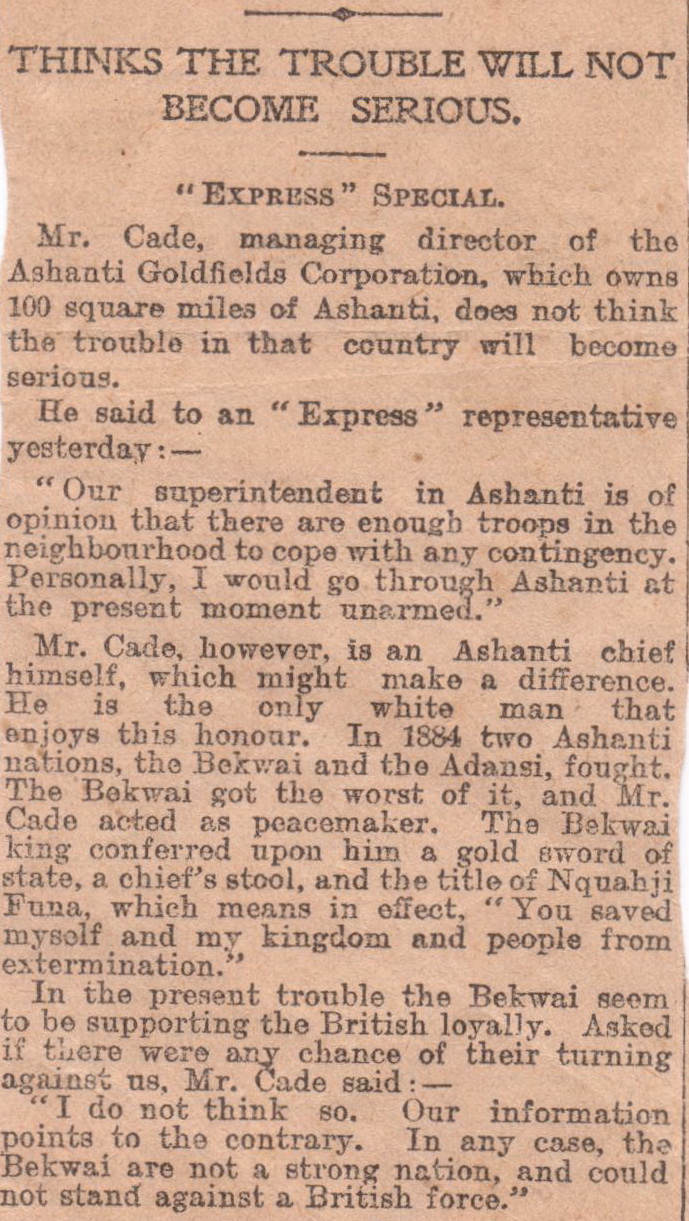
© VCRT