
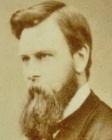
 The Rev John Milum, born on 10th April 1848, was a Wesleyan Missionary to West Africa; he was also a Fellow of the Royal Geographical Society and author of a biography of his predecessor, Thomas Birch Freeman. He married, firstly Charlotte ‘Chatty’ Warner, who died. He married secondly, Ellen (Della) Smith (1855-1879), eldest daughter of John Smith II by his first wife, Anne Collins. They were married on October 22nd 1878 in Clapham.
Della went with John, her new husband – and accompanied by her half-sister, Sarah Elizabeth – to West Africa and, almost immediately, fell ill with dysentery and advised to return to England. Sadly, less than a day after setting sail, Della died on board the SS Gaboon on January 18th 1879 and was buried the same day in the burial ground of the North German Missionary Society at Quittah, Gold Coast Colony. There is a memorial to her in Kensal Green cemetery.
John Milum married, thirdly, Frances Mary Parton, who was born on December 20th 1851, the daughter of John Parton, of Woodchurch, Kent, a miller. They had ten children: John Parton, Paul, Harold, Ruby, Beulah, Gordon, Rita, Stanley, Wesley and Richard.
Frances died, in Acton, London, on 9th November 1935.
John Milum died, in Cullercoats, Northumberland, in 1901.
History Of The Wesleyan School, Lagos
Preliminary Discussions
The establishment of a school for the higher education of Methodist youth in Lagos had been a want felt for many years and had been the subject of conversation among our educated people since the year 1868.
In the year 1870, the subject was brought to the notice of the resident minister by one of our catechists, but little or no attention was paid to it at the time. Two laymen of the Connexion, in 1873, conversed often on the subject and determined to urge the matter further; and, after consultation with the catechist, their desire, as representing the Methodists of Lagos, was brought to the notice of the ministers. To test further the desires and opinions of the people a public meeting was called on January 13th 1974, in the Olowogbowo church under the Presidency of Rev John Milum, the Superintendent of the Circuit, who stated in a few words the object of the meeting. A free conversation then ensued, the speakers being the Rev W Jones – Messrs. JB Thomas, JS Leigh, WP Richards, TF Cole, IA Byass and CJ George. The meeting was unanimous in its expression of the necessity for a high school and, after it had been decided that the old Mission House was too dilapidated to begin the school in, it pledged itself to raise £500 towards the erection of a new building suitable for a high school, and thought that there would be little difficulty in raising that amount. Mr JB Thomas was requested by the meeting to draw up a suitable memorial to present to the Cold Coast District Meeting and the Missionary Committee in England and to have it ready to be read at a adjourned meeting.
On January 22nd, the adjourned meeting was held at Olowogbowo and was attended by a large number of supporters. The meeting was enthusiastic and received the reading of the memorial by (later Rev) JB Thomas with applause. The memorial expressed so precisely the views of the meeting that no alterations were deemed necessary. It received the signatures of twenty-five influential members of the Wesleyan Methodist Society, who made themselves responsible for raising the £500 proposed. The memorial was then handed to the Rev John Milum in duplicate to present to the District Meeting and the Missionary Committee in England, as he was then returning to England, his term of three years on the Coast having expired.
THE MEMORIAL
To the General Secretaries and Committee of the
Wesleyan Missionary Society Lagos, January 27th 1874
Rev and Dear Sirs
We the undersigned members of the Wesleyan Methodist Society of this place are desirous of bringing to your notice certain barriers that stand in the way of the effectual working of the Society in connection with this Mission and to make some humble suggestions as to the best plan to be adopted for their removal, provided it will meet with your approval: –
- That the majority of the community of this town have directly or indirectly been brought under the influence of the teaching of Methodism, but on account of the facilities which are generally afforded by the Church Missionary Society, as regards the higher standard of education, many of our people, who have passed under its teaching, have become Churchmen. Were it not that we feel that we have much to lose by thus allowing things to go on continually, we might not become uneasy about this matter.
- All our schools in connection with this Mission are of an elementary kind, and as soon as our youths have received all they can obtain from them, they require something higher, which our Society does not provide. Hence the necessity of their being sent to the Church Missionary Society Grammar School, and the result is, after their training, it always becomes very difficult for them to shake off the prejudice which they have imperceptibly imbibed against that Church with which their parents have had the honour and privilege to be connected.
- We can point to scores of Methodist youths who have completed their education under the training of the Church Missionary Society, and who hold responsible positions in our community, but because we were not in a position to make a lasting impression on their minds, ere they started out in life, we have become the loser.
- As this state of things has been the subject of our anxious solicitude daily, we have thought it necessary to make known in our minds to you, so that it might be properly represented to the Missionary Committee in London, who, we trust, will sympathise with us in our difficulty.
- As Lagos is an important emporium to the interior of this vast country, and as our Society has already been successful in the establishment of its Mission on the mainland at Abeokuta and Porto Novo, we are desirous to bring before your notice the necessity of establishing a kind of training institution in this place, which may answer a two-fold object, viz., ‘A Native Training Institution and Grammar School.’ That from it we may obtain qualified men to act as native agents, to occupy new stations that may be opened and to supply vacancies that may occur.
- That the Institution be opened to our people who may wish to give their sons a higher standard of education by paying one guinea per head every quarter, which sum we propose to give for the support of the young men who are to become native agents.
- That whatever be the surplus after every expense of the Institution is met, shall be devoted to the improvement of the Institution.
- That a period not exceeding three years be the time allowed for the training of young men who are to become native agents.
- That their number shall not exceed eight unless there be a necessity for its increase.
- And in order to show how anxious we are about this subject, and to further its interest, we do solemnly pledge ourselves on behalf of our Society in this town to hand over to the Missionary Committee in London (as soon as they shall be ready) the sum of Five Hundred Pounds sterling to assist in the erection of a building for that purpose, on a suitable piece of land belonging to us, and situated near our present Mission House, provided the Committee will accede to our wishes which may be summed up in the following words, viz:
- To sanction the establishment of the Institution
- To supply it always with a competent European teacher from Westminster, who may be expected to act as a Missionary at the same time as those sent to Sierra Leone for educational purposes used to do, even as far down as the late lamented Rev John Waite
- And in order that the Institution may be kept in proper working order, permit us to suggest the desirableness of selecting a promising youth from the number of students, and let him have the benefit of a thorough European training in every branch of study, either here on in England, so that he may always be on the spot to assist the European in teaching and in case of ill-health or sudden removal, on the part of the European, the studies of the young men may not be interrupted as has been the case generally with those at Sierra Leone.
- But, perhaps, it may be thought that we are asking for an additional European missionary, and your reply may be, ‘The financial state of the Society cannot allow it now.’ We are not asking for the appointment of more than two Europeans, which has already been granted to Lagos; but we wish to suggest what we consider the best way of distributing their services, so as to secure to us the greatest benefit, especially as the District Meeting last year saw the necessity of granting to Lagos a native minister, but which we trust to be in a better position to meet the pressing demands of that part of our Society which does not understand the English language. What we ask for is this: – that while you retain both of us, let the service of one be devoted to the Training Institution and the service of the other, with the co-operation of a native minister, be directed to the work of the station and by so doing we may hope for great results.
And should our petition meet with your approval, and the approval of the Missionary Committee in London, we shall consider that the long desired want of the Methodist people in Lagos and the Yoruba Mission in general, is well supplied.
Signed: JN Porter, JB Thomas, ET Davies, TF Cole, J Richards, John Metzgar, Thomas Joe, TGHoare, JS Leigh, W Euba, HC Sawyer, RA Alder, JS Bucknor, CJ George, WP Richards, JW Cole, John L Baptist, JB Carrol, JJ Williams, JT Ashley, CW Cole, IA Byass, ET Ludlow, SS Davies, CW Pratt
HOPES REALISED
The above Memorial was duly laid before the ensuing District Meeting and recommended to the Missionary Committee. Whilst in England, Mr Milum fully discussed the scheme with the Secretaries, with the result that the Committee accepted the Memorial and sent a favourable reply to the District Meeting. On the 4th day of April, 1875, a public meeting, presided over by the Rev John Milum, was held to receive subscriptions and to take further steps for the accomplishment of the proposed object. At this meeting the most sanguine hopes of our people were realised, and a sufficient sum of money was promised to warrant the commencement of the work. A building committee was formed and the work began in earnest. A plan of the proposed building was afterwards presented to the building committee by Messrs. JL Baptist and JJ Williams and the ground plan marked out.
LAYING THE FOUNDATION STONE
On December 16th 1875, the foundation stone was laid by His Excellency Captain George Cumine Strahan, CMG, in the presence of the Ministers of the Church, Baptist and Weslelyan Missionary Societies and a good gathering of people. A handsome silver trowel was presented to the Governor with a few words from the Ref John Milum. After making some appropriate remarks on education, His Excellency laid the stone and the interesting ceremony was brought to a conclusion.
The following is an extract from the diary which the boys of the CMS Grammar School used to keep: –
‘Friday, December 17th 1975 – yesterday afternoon at 5 o’clock, the memorial stone of the Wesleyan Boys’ High School was laid by His Excellency the Governor-in-Chief, Captain G C Strahan. Bishops Crowther read a portion of Scripture and Rev JA Maser prayed.’ JO Wilson
THE OPENING CEREMONY
The building was completed in June 18177 and was described as being ‘beautifully furnished with educational appliances of the most modern description.’
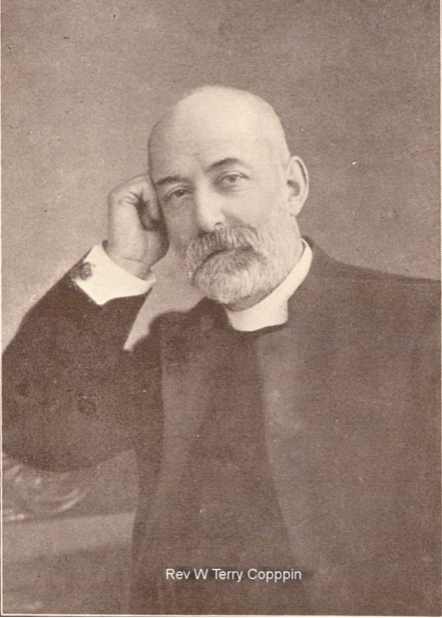
Of the opening ceremony, which took place on March 14th 1878, the Rev W Terry Coppin, the first Principal of the School, writes in a letter dated September 4th, 1926: –
‘I well remember the opening day of our High School. It was a proud hour for my Superintendent, the Rev John Milum. Lagos Methodism owes much to him. Being greatly respected throughout the Colony by all classes a fine assembly filled the school hall. The European community at that time consisted of but two or three score whites of different nationalities. But with many of the chief African residents it was well represented. All that flags, military band and guard of honour could do, with a well-dressed, smiling and appreciative gathering, was done to make the occasion festive and auspicious. Dear old Bishop Crowther gave us his blessing, and the good Governor, ever quiet and dignified and kindly, John DA Dumaresq, CMG, performed the opening ceremony. Alas! In a few short weeks the Venerable prelate committed his remains to their last earthly resting place. Mr John Field (CMS) and the Rev WW Colley (Baptist American Mission) moved votes of thanks.
THE EARLIEST DAYS OF THE SCHOOL
The school was opened to scholars in April 1878, when there were on the roll twelve names only. In addition, however, there were six Mission agents in training. Before the year came to a close, these numbers had been increased to twenty-three boys and seven agents.
Of these early days, Mr Coppin writes in the letter already quoted: –
We made a good start and things went well until that fateful morning when a tornado unroofed the school. Then, later on, we found the termites had got into almost every door post and window frame in the building. But I do not remember any worse troubles. Of course, we had the schoolmaster’s usual difficulties with restive and rebellious boyhood. Yet it was not on a scale to greatly exercise us or call for discipline. For the most part, they were good lads and many in after years rejoiced my heart.
One amusing memory projects itself. A certain chief had a truant son. Consulting the irate father, he earnestly insisted that I should get a chain and fasten the scion of his house to a school desk and keep him there night and day until he showed signs of penitence and reform.’
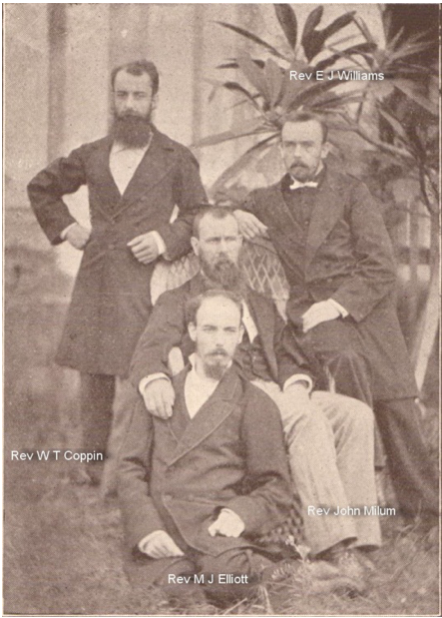
The first staff consisted of the Rev W Terry Coppin (Principal) and Messrs WB Euba and JH Samuel. The latter two afterwards entered the ministry and became Principals of the School. All three are living at the time of writing
GROWTH AND CONSOLIDATION
Even were adequate records available, space would not permit a detailed account of the years which followed those early days.
By the end of 1879, there were thirty-five names on the roll, but this number included five Mission students. Those must have been fortunate days for the scholars for, when His Excellency Governor Moloney distributed prizes on December 23rd 1879, there were sixteen prize winners among the thirty-five lads attending the school. George Smith (Dr Obasa) headed the list.
In 1890, the Twelfth Anniversary of the opening of the school was celebrated on April 29th and 30th. Prizes were distributed on the latter date and on the three following days there were torchlight processions.
Six years later (1896) there were about seventy pupils attending the school and on the staff there were eight masters.
With the opening of Wesley College, Ibadan, in 1905 the training of Mission agents was no longer carried on at the High School.
By 1910, the number on the roll had risen to 150 and the need for more classroom accommodation began to be acutely felt.
Indeed, the extension of the premises had been considered early in 1907. Certain additions to the front of the school hall were made in 1912 and thus several new classrooms became available for the increasing number of scholars.
A few years later, certain portions of the interior structure of the building showed considerable signs of decay; indeed, some parts of the premises became unusable. Plans were made for pulling down the whole of the old school building and for replacing it with premises of considerable magnitude.
A picture of the proposed building, which had been designed by J Bagan Benjamin, CE was printed in the District Report of 1917. The high prices ruling during the Great War made this scheme impracticable, but in 1916 a spacious hall measuring seventy-eight feet by forty-two feet was constructed near the Broad Street entrance. As indicated above the scheme had assumed the demolition of the original school building. After the visit of the Rev E W Thompson MA one of the General Secretaries of the WMMS, and Sir Arthur Black, however, the possibility of re-construction was suggested. The foundations were examined and pronounced to be firm and solid. By the early part of 1923, the work of reconstruction, which cost about £2,000, was completed and the classroom and boarding accommodation was very considerably increased. The average number on the roll is now a little over two hundred and fifty and, on the staff, in addition to the Principal, Vice-Principal and Bursar, there are ten Assistant Masters and two Visiting Masters.
The addition of a school chapel, chiefly for the use of the boarders, has proved of inestimable value.
During the years 1886-8, there existed a Debating Society and a Field Club. The members of the latter went around the countryside on Wednesdays and Saturdays identifying flowers, birds, animals, etc, one purpose being to secure the correct correlation of English and Yoruba names for these objects. From time to time attempts have been made to revive the Debating Society but, after a few meetings interest has flagged. The decease of the Field Club is greatly to be regretted.
On two occasions, a School Magazine was started. In 1891 ‘Grapnel’ was issued bi-monthly. It was written by hand and was run entirely by the boys but, after a very few numbers had been issued, it had to be discontinued owing to the irksome method of production.
The second effort, made in 1896, was printed and went under the name of ‘The High Schoolian’. This lived for about two years only.
It is sincerely hoped that at no distant date a magazine worthy of the School will become a permanent feature in the life of the institution.
In 1891, the Princiipal (Rev WB Euba) introduced the College of Preceptors examinations and at the end of the year fourteen candidates were successful. In three years, no less than forty-seven certificates had been awarded to pupils of the High School – the highest number, so the prospectus announced, of any school on the West Coast. In the examination of 1920, MAAS Agbaje gained the ‘Soames’ prize – a prize awarded to the candidate securing the highest mark for Scripture in the Junior Grade.
While the thoroughness with which instruction has always been given has kept the school in the front rank of Nigerian schools, the other aspects of school life have not been neglected.
In May 1916, the troop of Boy Scounts was commenced by the late Rev LC Mead.
In 1919, the school was divided into four houses (Didsbury, Handsworth, Kingswood and Westminster) and each boy, on being admitted, is placed in one of other of them.
FB Mulford has presented two splendid shields, one for cricket and one for football and His Honour Mr Justice Pennington, a silver cup for athletic sports. These trophies have given a great impetus to the friendly rivalry between the four houses. An annual sports meeting has been held on the Race Course since 1921.
For a number of years, the school uniform, which was worn on special occasions only, consisted of black trousers and a white coat. Just recently, however, the uniform, which is now worn daily, has been changed to white trousers, brown blazer with the school badge, and a straw hat with the school hatband.
The school colours are chocolate, blue and gold and the school motto ‘Non sibi sed aliia.’
The original motto appears to have been ‘Nunquam non paratus,’ and the colours white and gold – the change of motto having been made in the time of Principal Euba.
For several years, the boys have maintained a bed in the Wesley Guild Hospital, Ilesha, and have subscribed £15 annually to the British and Foreign Bible Society.
Four or five years ago an Old Boys’ Association was formed but remained dormant until a few months ago.
Towards the end of the year 1918, the School suffered a severe blow in the deaths of the Rev AW Moulton Wood and the Rev LC Mead, the former in the influenza epidemic and the latter by drowning, one of the many victims of the Great War. The Rev EG Nightingale and the Rev LF Webb came to the assistance of the School until the new Principal arrived.
The old minute book of the School Committee records some facts which are interesting – some because they deal with problems which no longer exist and some because they show how time has changed public opinion.
To the first group belongs the statement on page after page of the record that the work of the school was crippled because of unpaid school fees. The Principal, the Treasurer, and often a specially appointed member of Committee were burdened with the task of collecting the very considerable sums owing. The ‘Collection of Fees’ often received payment – so onerous was his task. More than once the assistance of a lawyer as called in. Happier conditions now exist. All fees are paid in advance and the time and energy once spent in collecting debts are now spent in the classroom for the benefit of the scholars.
The members of the School Committee and even the parents were not as much interested in their duties as they should have been. The former did not attend regularly the committee meetings and on one occasion, when parents were invited to come together to consider the question of school hours, only five persons were present.
This indifference, too, has passed away and all are fully alive to the value of our schools.
There is, moreover, a pleasant contrast in the amounts received from the Government as grant-in-aid. In 1892, the grant was £71/9/-. The sum received for the past year or two has exceeded ten times that amount.
It is also interesting to note in passing that in 1890, the total grant for all the Wesleyan Methodist Schools in the District amounted to only £152/3/-. Last year, the sum exceeded £3,500.
LIST OF PRINCIPALS
Rev W Terry Coppin 1878-1883
Rev George W Baxter 1883-1884
Rev Edmund Tomlin 1884
Rev MJ Elliott 1885
Rev JJ Willington 1886-1889
Rev WB Euba 1889-1896, 1902-1912
Rev JH Samuel 1896-1902
Rev AW Moulton Wood 1912-1918
Rev H W Stacey 1919-1927
Rev JA Angus 1927

FAMILY HISTORY
The Rev John Milum, a missionary of the Wesleyan Missionary Society in West Africa, was born on 10 April 1848. He was a Fellow of the Royal Geographical Society and author of a biography of his predecessor, Thomas Birch Freeman, missionary pioneer to Ashanti, Dahomey and Egba, in West Africa, published by Partridge in London about 1890. He married, firstly, Charlotte ‘Chatty’ Warner, who died. He married secondly, Ellen Morrison (Della), eldest daughter of John Smith II of Coventry and London, by his first wife, Anne Collins. They were married on 22 October 1878 at Studley Road Wesleyan chapel, Clapham, by Rev W Nicholson. Della was born at 7am on 22nd September 1855 at Foleshill, Coventry, Warwickshire.
Della accompanied John, her new husband, to West Africa and almost immediately fell ill. On her early return voyage, she died of dysentery on SS Gaboon, on 18 January 1879 and was buried on the same day in the burial ground of the North German Missionary Society at Quittah, Gold Coast Colony. There is a memorial to her in Kensal Green cemetery.
John Milum married, thirdly, Frances Mary Parton, who was born on 20 December 1851, the daughter of John Parton, of Woodchurch, Kent, a miller (died 18 October 1851) and sister of Richard Jinkins Parton, born 21st May 1850, Tom and John, who died young. She died 9th November 1935, having borne him:
John Parton, of whom below**
Paul, born 20 November 1883, married Carrie Day, a Canadian, and daughter of a farmer. They lived in
Golden, BC. He died in 1956. They had issue:
Harold, who married and had issue
Ruby, who married and had issue
Beulah, who married and had issue
Gordon, who married Phyllis, a former land girl, and had issue
Rita, who married and had issue
Stanley, who married and had issue
Wesley, who married Milly, sometime housekeeper to Mrs E A Maitland at Croydon, England
Dick, who married and had issue
After Carrie’s death, John remarried but had no further issue, and he died in 1956.
(Frances) Hilda, born 19 October 1988, married in 1913 in Edmonton, Alberta, Canada, Bentley Claughton. She died about 14th August 1954, leaving issue:
Frances Dorothy (Dorrit), born in Edmonton, Alberta on 8th March 1914 and killed in an air raid in
Kensington, London on 20 October 1940
Richard Bentley, FRBS, Sculptor of Castelnau, Barnes and, later, Telham Lodge, Battle, Sussex. Director of Sculpture, the Slade, London University; born 28 February 1915, he married Edna **** (88 Old London Road, Hastings, East Sussex). He died 9th March 1997, having had issue:
A daughter, who died in infancy
Russell, a journalist, born 1944, who married 5 April 1975 Sheila Souvane, from India, and
has issue:
Kit
Piers
John David, born 19 March 1929, married Elizabeth Jane Mitchell, born 13 April 1941, and has issue:
Fraser Bentley, born 18 March 1963; married Julia Ruth Pine, born 2 January 1963 and has
issue:
Max Angelo, born 27 August 1986
Marcus Daniel, born 15 February 1989
Bruce Richard, born 1 Mary 1964 and married Jacqueline Mary Turner, born 31 January 1968
And has issue:
Josephine Jade, born 11 October 1993
Emma Louise, born 13 June 1995
Alexander James, born 9 June 1998
Andrew Robert, born 13 February 2000
Dorothy Kathleen, born 18 January 1890, married Rev Charles Leopold Clarke, a minister, son of a printer of Wimborne, Dorset (who died young), who was born on 3 July 1894 and died 20 October 1952. She died at Croydon on 12 April 1957, having had issue:
Joan, born 1917, who married on Mar 25 1955 Major John Charles Wilder, born 18 October 1904, of Old Manor, Twyning, Tewkesbury, Gloucestershire, educated at Eton and King’s College, Cambridge; late Royal Berkshire Regt, served in WWII, Officier de L’Ordre de Leopold, only son of Francis Langham Wilder. He died 21 December 1981. They adopted:
Fanny Helen, baptised Feb 1961
Charles
Helen, born 1918, who married John Howard Peploe Summers and had issue:
Richard, born about 1946, educated at King Alfred’s school
Jill (adopted), born about 1951, educated at Letchworth
Paul, born 1953
Pauline Hilda (Church Farm House, Bottisham, Cambridge), born 1921, a writer of children’s and other books and 1962 winner of the Library Association’s Carnegie medal for the book of the year for children for ‘The Twelve and the Genii’. She married on 27 February 1969, Charles Henry Hunter Blair, university teacher, Emeritus Reader in Anglo Saxon history at Cambridge university and Vice-Master of Emmanuel College, Cambridge. He died 9 September 1982.
**John Parton Milum: he entered the Methodist ministry in 1903 and spent a year at Minehead. He was
instituted in 1904. Born 8 June 1882, he married Nellie Wilkins; they has issue:
Veronica, who married William Tull, with whom she ran the Waverley Hotel, Clacton on Sea, Essex;
they had issue:
Christine
Another child
Robert
Leo, schoolmaster in the Anglo-Americal school of Malaya (Singapore and Penang 1936 – 1939). He
was killed in action at Arnhem, Netherlands, as Lieutenant, Royal Artillery, on 24 September 1944,
aged 33.
Eirene Myrtle, born 1 March 1916 who married and had issue:
A daughter
Stella, who married but whose whereabouts are unknown;
Rev John Parton Milum died 23 April 1952
Newspaper cutting
Jubilee of a West African Mission School
In 1870, when Christian missions had only been at work in Lagos, West Africa, for eighteen years, our Wesleyan community began to talk of founding a school for the higher education of their youths.
Talk led on to action, and under the leadership of the Rev John Milum, over £1,000 was raised locally and a grant of £950 obtained from home.
The Wesleyan Boys’ High School was opened in March, 1878, and recently celebrated its jubilee.
A thanksgiving service was held, the preacher being one wo was on the staff when the school opened. At the public meeting there were on the platform as speakers two who remembered the opening day – a member of the staff and the first senior boy, and during the course of the meeting a cable was sent to the first Principal, the Rev W Terry Coppin.
The school has had an honourable history. Starting with less than 20 boys, it now has over 270 and is forced to turn away as many boys as it takes in.
It ranks as one of the best schools in Nigeria, is classified by the Government as in the highest grade, and is self-supporting. It is now planning to erect new buildings which will give it improved equipment and enable it to render still better service for God and humanity in the days to come
J A ANGUS
OBITUARY
Born April 1848, at St Mary Clist near Exeter; converted when twelve years old, he began at an early age to preach, serving meanwhile, a long and busy apprenticeship, and attending science classes, which all stood him in good stead in after years. While at Richmond College, he offered himself for the Gold Coast, where it was his joy to participate in a remarkable spiritual movement among ministers, leaders and people which drew multitudes of heathen into the church and brought many nominal Christians to cull consecration.
Lagos became his headquarters, where for ten years he laboured earnestly, enduring sore bereavements and much personal suffering. His work as Chairman of the District was characterised by foresight, method, judiciousness, patience, solidity, firm but conciliatory discipline and Christian manliness.
The General Missionary Committee showed their confidence in him as an organiser and administrator by entrusting him with special commissions of re-organisation at the Gambia in 1879, and on the Gold Coast in 1882 and in 1884-5 to adjust certain difficulties which had arisen at Lagos.
His preaching was spiritual, thoughtful, and convincing and indicative of a well-furnished mind; thorough culture, wide observation and conscientious and diligent preparation.
In 1882, painful affliction induced by the climate compelled him reluctantly to leave his much-loved field of labour and enter the home work, in which, for fourteen years he ably and faithfully ‘served his generation according to the will of God/,’
In August 1896, he was seized with sudden paralysis. He waited submissively for the coming of the Lord. On the morning of April 19th 1901, he had another stroke, and the following day he fell asleep, ten days after completing his fifty-third years.
He was a good man, full of faith and of the Holy Ghost.
His career, as follows:
1879 Institution (1 year)
1871 Gold Coast, etc, Dist West Africa (11 years)
1882 North Hill (2 years)
1884 Buckfastleigh (3 years)
1887 Clacton-on-Sea (3 years)
1890 Ossett & Horbury (3 years)
1893 North Shields (3 years)
1896 Sunderland St John’s (1 year)
1897 Sunderland St John’s (Sup) (1 year)
1898 North Shields (Sup) (1 year)
PAULINE HUNTER BLAIR’S LETTERS
Church Farm House, Bottisham, Cambridge
October 1st 1982
Dear John
Thank you and your mother so very much for your letter and your sympathy. My loss is immeasurable and my grief profound. I have had, though, the help and comfort of both Joan (widowed last Christmas) and Helen (who lives so close) and, as it is only three weeks yesterday that darling Peter died, and seems an eternity, I suppose that I must expect to feel tired and ill for some time. we kept him at home, which was wonderful for us both.
I have always been so sorry that I muddled the dates on that stupid way on the occasion we hoped to see you. And have always trusted another occasion would arise, and greatly regret that it has not.
We have only been in this house since May 1980, and had just finished the details of the garden, conservatory and house together. Peter retired from teaching and lecturing in 1977 but was College Archivist and always went in three or four days a week.
If you are near, please come; as I shall to you.
Ages ago, John, you said you had a note of some kind about Grandfather John Milum’s second wife, Charlotte (Chatty) Warner being remembered in Lagos and that I could have a copy. I would greatly like it, if you still have it.
My love to ‘cousin’ Theo as Mummy always called her.
Yours ever
Pauline.
9 The Glebe, Penshurst
January 10th 2002
Dear Pauline
It was a lovely surprise when you telephoned a couple of days ago. I am sorry that I took a moment or two to pull my thoughts together after so many years.
Since that time, I have looked out my Milum file, but I haven’t found anything for 1965 when you say that I send you some information. However, there were a lot of other bits and pieces.
I have, therefore, updated and typed out on this word processor the genealogy of the Milum family in so far as it is known to me. I enclose a copy for your and two others, for Joan and Helen, if you think they wold be interested. You will note that you will be able to send their copies on to them. What I am hoping is that I’ll be fed back with corrections and additions so that I can further update the record. It being on the word processor, I can amend it without great difficulty.
I shall also be sending a copy direct to David Claughton and another to Edna, who is now with Russell.
When it is further improved, I’ll be sending copies to my brother and sisters.
I don’t think I quite finished telling you about the reason for the beheadings. It is certainly not mainly the ghoulishness of the matter, though that does seem to interest many. It is because there were occaions of great drama, almost always relating to persons of note, and what’s more, I don’t think it has ever been done before. It is not the relevant plots but the actual occasions themselves, their locations and any odd details of the process at that time. this is almost entirely from my own library, which includes the DNB and the Complete Peerage.
I should be very interested to have copies of any Smith or Cade papers yhou have.
With kind regards
John (Flower)
Church Farm House, Bottisham, Cambridge
February 19th 2002
Dear John
Forgive me for my late reply. I have been head down in the Parton/Milum papers. First, thank you very much indeed for sending the three copies of you Milum stuff. I am returning one copy, corrected, modified and added to. Joan will have the original version amongst John’s papers and won’t want, or have space, to accumulate more papers now (the Ludlow house is enchanting but not spacious like Twyning!)
Helen did not marry Searle-Jordan and wouldn’t want any reference made to it, so I’ve deleted it. Since, as I explained, it is her son, R J Summers, who has stolen the diaries of John Milum the missionary, which I lent him at her pressing instigation, I think I won’t involve her in archive matters just now. I have put in both my sisters’ current addresses.
John Milum, the missionary: I enquired of the Royal Geographic Society about being a Fellow. There is no accolade about it. All you have to do is be recommended by another (present) Fellow, which John Milum was by a friend he made out there in West Africa, a ‘Consul’, as it was called then. No doubt his keen interest in the people, fauna and flora of West Africa revealed in his description of his journey into the interior, made him very eligible.
Thomas Birch Freeman’s book was by that evangelist himself. John Milum brought it back hoping to get publication in London. We had a copy, which for the moment I have mislaid in my barn room. My feeling is the book may have been a joint effort but till it turns up, I can’t determine this.
Fanny Parton II (Mrs John Milum, third wife of the missionary) was born posthumously, on December 20th, two months after her father, John Parton II had died (October 18th). She became ‘the ewe lamb’ having three brothers older than she. But it didn’t spoil her – she had great sweetness and contentment, despite her own early widowhood, which she passed on to my mother.
My publications: after the Carnegie medal one, you could re-word this: ‘She published twenty-seven books for the young and four novels for the general reader;.
This is because I shall put the complete list onto our archive at the proper place. If you would like a copy, I will put it on the copying list. I have this new copier in my barn room and it will get christened with the family papers. I have already got a list of those you will enjoy: Grace and Adeline when children; John Smith II to John Milum; Della herself; Arthur Cade to John and Fanny Milum; Aunt Adeline to me; etc, etc. John Smith II was a most prolific letter writer and, indeed, a most loving and understanding father-in-law. Johm Milum made ‘Holmwood’ where they lived, his second home in England.
My best hews is that I have had Christine Leighton and her brother, Alan Tull, to lunch here (I had written to her explaining everything, when R J Summers divulged her address in a list of relations he had rounded up). They are on your page 4, daughter and son of Veronica, our first cousin. Alan is the proper male guardian of the archive in their generation (as poor Leo, Veronica’s brother, died at Arnheim, and he had no children).
They showed me the greatest kindness; we felt familiar at once though had never met before. Christine and her husband, Roger, and family chose to live at Woodchurch (our maternal native heath) not knowing that the two mills had been owned by her family! Alan had already invited R J Summers to his club to hand over the Milum diaries. He served him the same trick as he played on me – turned up with the copies not the originals. Alan is still in pursuit and I know will do his utmost. This man (RJS) has separated the diaries from all the other John Milum material, 400 letters, and much else.
I expect I should have done better to ring you up, dear John, but as I had your Milum papers to return, I decided to write. I do hope this screed won’t weary you.
Christine has promised me they will come and bring me to Woodchurch (when the weather is better!) aand that we shall try to visit you.
Yours ever affectionately
Pauline (Hunter Blair)
PS What does ‘wef’ mean after Charlie’s name?
Church Farm House, Bottisham, Cambridge
28 November 2005
Dear John
Thank you for your letter. I was glad to hear from you but very concerned that you call yourself ‘no longer mobile.’ What a good thing you have Nicholas.
As to my (amateur) tree; I had a lot of trouble. The specialist I was put in touch with by the County offices in Cambridge clearly distinguished between the ‘pedigree tree’, when someone simply wants to know who is great, great grandfather was, and the ‘spider tree’, beautifully so called, dealing with the linked web of many families and usually drawn by hand. (I, of course, had done my initial copy by hand, knowing nothing of computers).
I landed up with a woman who, though I had refused her at first, rang again saying she was sure she could do what I wanted. I employed her and very soon wished I hadn’t. it led to much trouble, exasperation and expenses. She made the same mistakes (which I’d already corrected) over and over again, being more concerned with her computer than with the people who should have been coming alive for her.
I knew John Smith had three wives but your yellow book had gone with the archive papers to Alan Tull before I at last had the tree done, so I couldn’t check the details.
Thank you so much for the Cade information, I’ve corrected my master copy at once and I shall look forward to the Cade narrative genealogy.
It was really lovely getting in touch with David again – we hadn’t contacted each other for years though had known each other well when he lived in South Croydon for a bit during the War, with my mother and me.
All good wishes
Pauline
Extracts from the private journal of Rev John Milum FRGS, Pioneer Missionary, Nigeria, Dahomey & Lagos
Ellen (Della), John Milum’s second wife, was born in 1855, only daughter of John Smith and his first wife, Anne Collins (who died in 1857). John Smith then married Philadelphia Wright, who bore him three daughters; Sarah Elizabeth (Trot – though why she had this nickname is unknown, unless she always ‘trotted around’!), Lucy and Alice (the latter two died within days of their birth) and ‘Delphia’ died shortly after Alice.
Sarah Elizabeth went on to marry Edwin Arthur Cade in 1883. She accompanied Della and her new husband out to West Africa, where she thrived but Della became ill with dysentery.
It became clear that the climate did not suit Della, who became ill with dysentery, so the three boarded ship to return to England. Della died on 18 January 1879, and her body was taken ashore at Keta and buried in the German Missionary Cemetery at the mouth of the Volta River.
October 26th 1878
‘Della, Trot and I said ‘goodbye’ to Ma and Pa, who had come to see us off on board the SS Biafra, which was lying off in the river at Liverpool, bound for Madeira and the West Coast of Africa……. By a mysterious providence, here are three of us in company, bound for West Africa. My own return is no marvel, as I have learnt to feel more at home in Lagos than elsewhere, but that Della and Trot should accompany me does seem a marvel ……
7pm: All the passengers appeared at dinner and my old friend, Captain Rattray, congratulates them and hopes they will appear tomorrow….. Glass going down rapidly, indicating bad weather. Telegram from
America, warning of a heavy gale crossing the Atlantic, every prospect, therefore, of our having a bad time.’
There follows the day to day diary of the next twelve weeks, the tragic story of Della’s death, on January 18th 1879; the agonising journey home with Trot; the loving welcome from Ma and Pa Smith; the sharing of the heavy grief; the searching of heart as to whether or not it was the Will of God for him to go back; the decision to do so; the last days in England before sailing again.
Sadly, this journal no longer exists.
April 1879
7th Went to the Mission House, Trot accompanied me.
9th Went to the Mission House by appointment………. Went to the Army & Navy Stores and then to Richmond College. Took Trot over the College and showed her my old study.
10th My 31st birthday; God has blessed me, and I have been an unworthy servant. Packing all day.
11th Good Friday; very cold, snow even falling again; said goodbye to the dear ones at Holmwood; Trot came down to Euston with me, and Papa, to say goodbye. Dear old girl; I wish I could have taken her with me, but it is best as it is; got down to Lawrence’s Hotel at 11pm.
12th Papa and I, with Brothers Elliot, Pullen and Dixon, got on board the SS Coricco bound for West Africa. Once more I am on my way back to the coast. This is my fourth voyage out and just now……… I feel very sorrowful. I have said goodbye to Papa and have left behind all the loved ones who are living. One little gleam of comfort arises. It is all for Christ.
The previous dust of the two dear ones in Africa seems to draw me on. It is useless to speculate as to what may be, what the next two years may bring forth, but, whatever it may be, I am Christ’s. If it might have been, how pleasant, how delightful, it would have been to have had my dear Della with me. God knows why He has done it, and I leave it there, though my heart is very sore. The weather is bitterly cold and snow is falling as we start from Liverpool at 3pm.
Sent post cards back, by pilot, to Trot, Mother and Aunt Baker; went to bed at 9.30, and thought of Papa getting to Euston about that time. I am sure he and all the dear friends are thinking of me.
13th Awakened by a rat running over my face – afterwards, felt a pushing against my side and found that the rat had got there to get warm; I, of course, turned him out without any notice; 7.45pm – the dear friends at home are just now finishing their evening service. I daresay they have had a glorious Easter Sunday.
My thoughts have constantly been with them and I have specially thought of, and spoken of, dear Trot. I do most earnestly pray for the dear girl. She has so many splendid qualifications for usefulness. I believe God has something great yet for her to do. It was dear Della’s great object in life to win her thoroughly over to Christ and to save her from harm; it shall be, with me, a most sacred duty to continue my darling wife’s work in this respect. I have learnt to love her most dearly and am proud of having such a sister. May our great Father protect her from all evil, and may her splendid abilities be sanctified and consecrated to His use. She is one of the most tender-hearted and sensitive of girls and, to cover this, puts on an assumed air of indifference which is too often taken as an indication of her real character. To me, she has been the most tender and loving sister. God bless her and preserve her. I feel thankful that she has promised to pray for me and write to me very often.
My heart is very full tonight. How the memory of that dear home at Holmwood will cling to me. Dear Mr and Mrs Smith have been, indeed, to me father and mother. I love them most sincerely and, when I think of home, my mind will wander there with pleasure. The dear little ones too, Grace and Adeline – what loving little sisters they have been. I wish I could kiss them all and say goodnight to them.
August 1880
29th (ie a year and four months later); preached at Faji; Evening: preached at Olowogbowo
30th Drove to Geeko and married a couple; received letters from home containing news of Trot’s engagement to the Rev Terry Coppin, which has quite upset me. Why? I cannot make it out. I do not know whether I am jealous. I think not, but I think the real source of the feeling is that I have harboured in my heart some feelings of opposition to Coppin arising from the foolish, pompous conduct shown previous to his leaving for England. May God help me to think rightly about this matter. I love dear Trot very much and wish her welfare, but I fear I shall feel henceforth a barrier to my making known to her so fully my heart, as in times past; I can scarcely expect her to keep from Coppin my confidences and many things that I now write to her, I could not confide to him.
This is how I seem to go on blundering through life, stumbling upon some dear soul that I dearly love, when the prop is suddenly kicked away. I think that is what I feel so keenly now; the old blank has come over my heart and, there comes up that dreadful sense of loneliness that I have felt so often before.
Trot says nothing about it in her letter, showing that her confidence is withdrawn; Coppin writes about it in his usual, pompous style and Mr Smith writes telling me of it, and asking my opinion.
I suppose the dear girl might have done worse, for when I analyse it what, after all, have I against Coppin? According to my thinking, he has a good deal of conceit but then I probably may not have sufficient self-respect or may have a superabundance of conceit myself. I suspect him, too, of listening to tales about me during my absence and of being influenced by them and of acting upon them to my prejudice; but then I have no right to expect that he should approve of me, any more than I approve of him all round.
These very thoughts prove to me that I am far from being perfect. I fear I have not ‘charity that thinketh no evil, etc’. I can make out a long list of complaints against myself and, if I can do so, I must expect other people to do so… But, whatever is the matter with me, this much I am certain of; that I love Trot and want to see her happily married.
I have had to give up self many times in my life, and must do it again. I see, however, that I cannot trust myself to write much on the subject to Mr Smith or to Trot, so must be wise and cautious.
31st Have scarcely done anything today for thinking of Trot but am beginning to be reconciled to the shock. It is time I was getting past all such feelings as these. I have kept the matter so far a profound secret (ie from his colleagues) and trust I shall be able to do so till Coppin himself makes it known to the people of the coast.
Among family papers still in existence, there is no reference to the ‘breaking off’ of the engagement to Rev Terry Coppin, or what happened to him
© VCRT